THE PERFORMANCE OF ACCOUNTABILITY SERIES
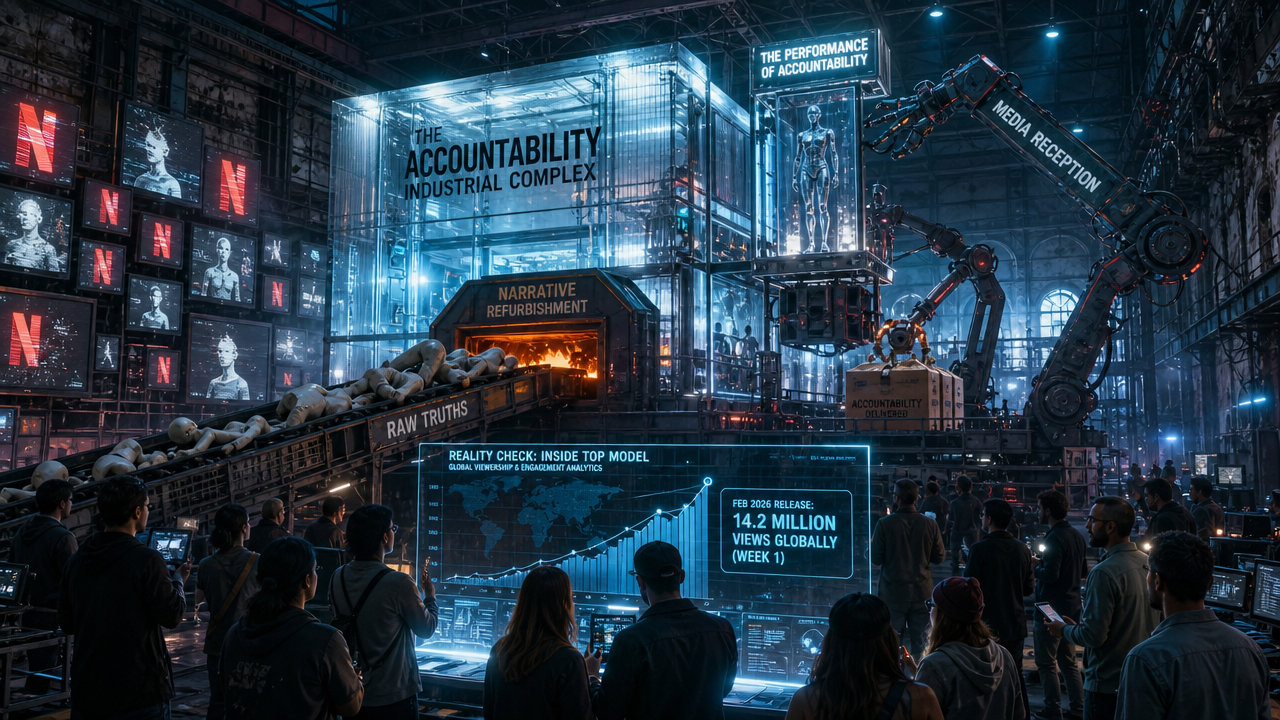
Cultural Litmus on ANTM, Tyra Banks, and the Systems That Produced Both the Show and the Outrage
PART 1: THE ACCOUNTABILITY INDUSTRIAL COMPLEX
Before we talk about Tyra Banks, we need to talk about the documentary that made everyone want to talk about Tyra Banks. Not what it reveals. What it is. Reality Check: Inside America's Next Top Model dropped on Netflix in February 2026 and within seven days had accumulated 14.2 million views globally, making it the platform's most-watched series worldwide during that period.
It outperformed Bridgerton Season 4. It outperformed The Night Agent Season 3. It became, briefly, the most consumed piece of content on the largest streaming platform in the world. Ask yourself what that actually means. Not what it says about ANTM. What it says about the document that is now shaping the public conversation about ANTM. A streaming platform with 300 million global subscribers, generating 45 billion dollars in annual revenue, a platform whose business model is built on subscription fees and advertising revenue generated by audience engagement, produced a documentary about the exploitation of unprotected creative labour in a reality television environment.
That documentary became the most watched piece of content on the platform for its launch week. The financial logic of that outcome is not complicated. The accountability documentary is a product. The outrage it generates is its commercial mechanism.
THE ACCOUNTABILITY DOCUMENTARY AS GENRE
What we are now calling accountability is, in a significant portion of contemporary media, a content format. It has conventions, a formula, and an economic logic that has been refined across a series of similar productions over the preceding years.
Quiet on Set: The Dark Side of Kids TV in 2024 examined the controversies surrounding Nickelodeon series produced under Dan Schneider. Before that, documentaries dissecting MTV's programming, early 2000s music industry practices, and various celebrity feuds from the reality TV era have all followed variations of the same structure: identify a culturally embedded piece of nostalgia, reframe it through a contemporary moral lens, find the most visible individual associated with it, and present the resulting tension as a reckoning.
Fast Company noted that Reality Check is the latest entry in a trend of expose documentaries about TV shows that many young adults watched in their childhoods, cashing in on nostalgia by peddling the sordid stuff. This is not a peripheral observation. It is a description of the economic model.
The accountability documentary exploits the same audience relationship with the past that nostalgia content exploits, but adds the moral dimension of outrage, which generates more engagement than simple nostalgia alone. Engagement is the currency of the streaming economy. The accountability documentary is an extraordinarily efficient engagement machine. None of this means the specific criticisms within these documentaries are false. Some of them are important and necessary. What it means is that the format itself, the accountability documentary as a genre, is a commercial product whose relationship to genuine accountability is more complicated than its presentation suggests.
Let's get into it.
NETFLIX AND THE QUESTION IT CANNOT ASK ABOUT ITSELF
Netflix generated 45 billion dollars in revenue in 2025. Its operating margin was 31 percent. It plans to spend approximately 18 billion dollars on content in the same year. It reaches 300 million subscribers across 190 countries. Its content acquisition model, as the streaming economy series on this platform examined in detail, is built on flat fee acquisitions that do not include residuals for the creative practitioners whose work populates its library.
A documentary filmmaker who licences their film to Netflix for a flat fee receives that fee regardless of how many millions of times the film is watched. A showrunner whose series drives subscriber growth in a key territory receives no additional compensation when that growth converts into advertising revenue on the platform's ad-supported tier. The business model of Netflix, in other words, involves the acquisition of creative content at below-market rates relative to the value that content generates for the platform, the retention of the overwhelming majority of that value difference by the platform, and the building of a 300 billion dollar market capitalisation on the accumulated result of those acquisitions. This is, in structural terms, the same dynamic that the documentary critiques within the ANTM ecosystem: creative labour producing value that is captured by the infrastructure owner rather than shared equitably with the practitioners who generated it. The documentary cannot ask this question about itself because the documentary is a product of the infrastructure. It can critique the infrastructure's past but it cannot critique its present, because its present is the economic condition of the documentary's own existence. This is not a dismissal of the documentary's specific claims. It is an examination of the epistemic position from which those claims are made.
THE ENGAGEMENT ECONOMY AND HOW IT SHAPES THE CONVERSATION
The 14.2 million views that Reality Check accumulated in its first week are not simply a measure of public interest in ANTM. They are a measure of the engagement economy functioning as designed. The engagement economy rewards content that generates strong emotional reactions because strong emotional reactions drive sharing, commenting, and return viewing, all of which generate the data and the advertising inventory that the platform monetises. Outrage is one of the most reliable generators of strong emotional reaction. The documentary's specific framing choices, the centreing of the most emotionally charged testimonies, the visual presentation of Tyra Banks's most problematic on-screen moments, the narrative structure that builds toward a sense of unresolved accountability, are not simply editorial decisions. They are engagement optimisation.
This does not make the testimonies false. It does not make the problematic moments less real. It means that the selection, emphasis, and framing of those testimonies and moments is shaped by the commercial logic of the platform as much as by the ethical commitments of the documentary's makers. The documentary that would most accurately represent the full picture of ANTM's institutional history, examined with structural depth and genuine complexity, would generate less engagement than the documentary that focuses its emotional intensity on the most visible individual. And the platform's commercial interests are not served by the less engaging version.
THE MISSING QUESTION
The conversation that the documentary has generated, the social media outrage, the celebrity comment sections, the think pieces and counter-think pieces, shares one consistent feature: it is a conversation about whether Tyra Banks is a good or bad person. This is not an accountability conversation. It is a personality conversation dressed in accountability language. Real accountability asks structural questions: who designed the system, what interests did the system serve, who benefited from it economically, and what would be required to prevent equivalent harm in current and future contexts. The personality conversation generates engagement. The structural question generates understanding. This series is about the structural question. What follows, across seven further parts, is the investigation that the accountability documentary could not conduct, because conducting it honestly would have required the platform that produced it to examine its own reflection.
This is Part 1 of The Performance of Accountability series, published in Cultural Litmus inside The Multiverse. Part 2 examines the economics that made reality television possible, the specific business decisions that produced the format, and the workforce that built ANTM without receiving the protections the show now stands accused of denying.