Episode 2: The Local Club of North London and Lagos
THE SOVEREIGN PITCH | SERIES ONE: THE CAPTIVE AUDIENCE
Editorial and Legal Declaration
Companion essay for Public-tier publication, governed by The Sovereign Pitch Series Bible and the Series One Production Framework. The safety register applies throughout: no individual is named in connection with any failure; the diaspora and football history is drawn from the public record and carried, with its sources, in the Series One Bibliography; general historical movements are stated at common-knowledge altitude.
© L’El-Roi Global Ltd 2026. All rights reserved.
Episode Two Companion Essay
The Local Club of North London and Lagos
Every argument that African devotion to English football is a colonised reflex depends on a chapter being left out, and the missing chapter is London. Tell the story without London and the devotion looks like something done to Africans from a distance, beamed in by satellite and stamped on a passive continent by the marketing departments of foreign clubs. Put London back into the story and the whole thing turns over, because what looks from one angle like capture turns out, from the angle of the people who actually lived it, to be the most ordinary and most human thing in the entire history of the game. So this episode restores the missing chapter, and it begins not in Lagos or Nairobi but in the cold streets of north and east London, in the nineteen seventies, with the people who carried this loyalty home.
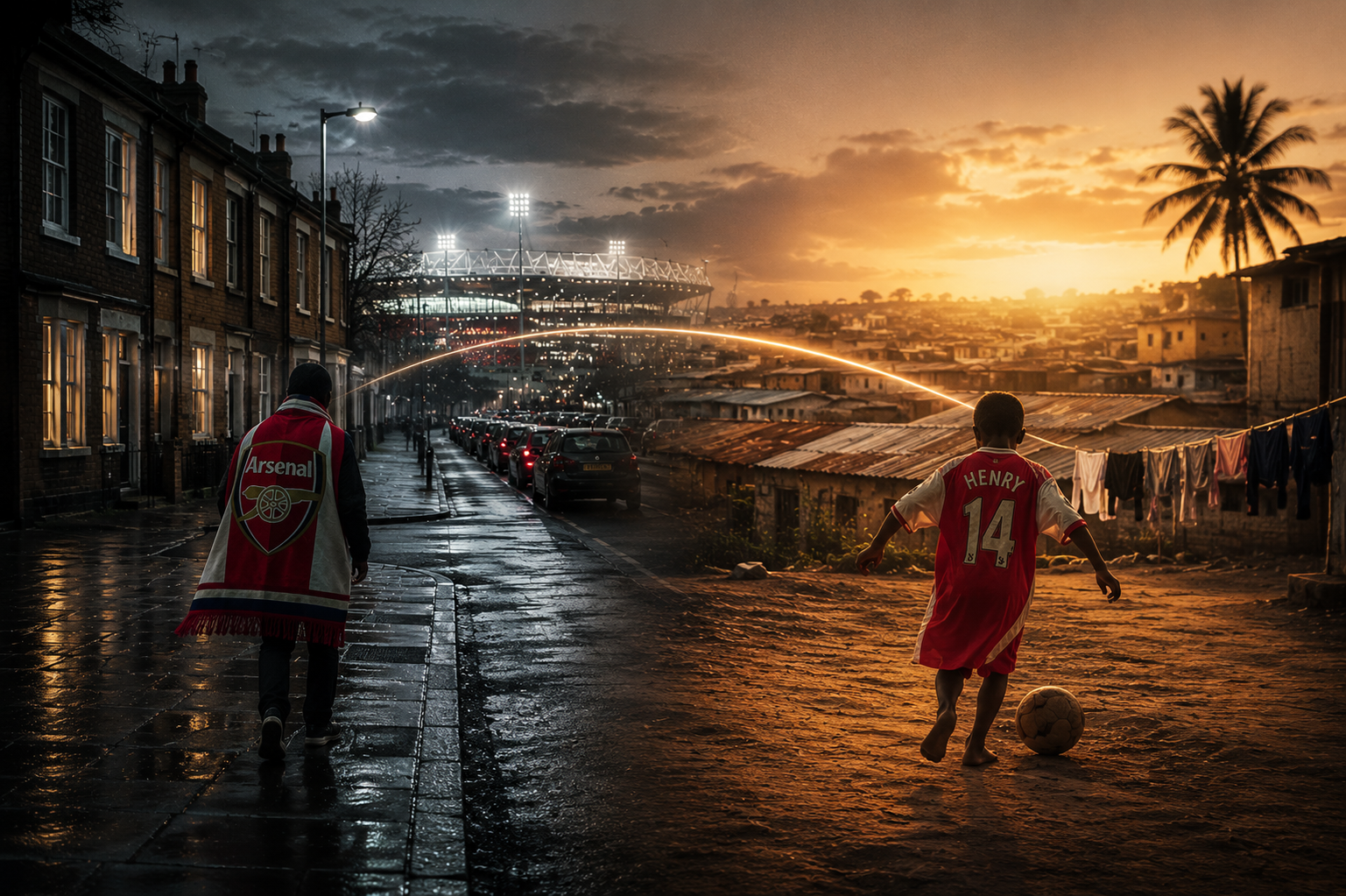
From the late nineteen seventies onward, migrants from Nigeria, Ghana, Kenya, Uganda, Sierra Leone, the Gambia, Somalia and Zimbabwe settled in London in great numbers, and they did not scatter evenly across the city. They concentrated, in particular, in its north and its east: in Edmonton, in Wood Green, in Stoke Newington, in Finsbury Park. Take a map of the city and mark those neighbourhoods, and then mark the ground at Highbury where Arsenal played for ninety-three years, and the stadium a few hundred metres away that succeeded it, and you will see the thing that the colonisation argument cannot survive.
The African diaspora of London settled, in great numbers, inside the catchment of one particular football club. So when an Igbo accountant in Wood Green, or a Kikuyu nurse in Finsbury Park, or a Krio teacher in Stoke Newington became an Arsenal supporter in nineteen seventy-nine, what exactly was happening to him? Was it emotional colonisation, a capture of the African soul by a foreign power? Or was it the single most ordinary act in the whole history of football: a man supporting the club at the end of his own street, the same act, performed for the same reason, that made a docker in Liverpool a Liverpool supporter and a machinist in Manchester a Manchester supporter? Proximity made them Gooners. Community, the men from the church walking to the ground together on a Saturday, made it stick. There is nothing colonised about the most local form of fandom that exists.
It is worth pausing on the ordinariness, because the ordinariness is the argument. Football fandom, everywhere it exists, is overwhelmingly a matter of accident and proximity rather than considered choice. Almost nobody surveys the clubs of the world, weighs their merits, and selects the most deserving; people support the club their father supported, or the club whose ground they could reach on foot, or the club the older boys in the street already followed.
The romance of the game is precisely that it is not chosen on the merits, that it is inherited and local and a little irrational, and an Englishman would no more expect a supporter in Sunderland to defect to a better-run club than he would expect a man to swap his surname for a more fashionable one. When an African Londoner became a Gooner because the ground was at the end of his road, he was being a football supporter in the only way anyone has ever truly been one. To single out his version of this universal accident, and to call it colonisation while calling the identical English version simply loyalty, is not analysis. It is a double standard wearing the costume of a critique.
And then comes the part of this history that deserves to be called beautiful, because it is. The loyalty travelled home the way everything in a diaspora travels home: in letters, in expensive phone calls made on Sunday evenings and rationed by the minute, in visits at Christmas with a suitcase heavier going out than coming back, and above all in replica shirts, posted in brown paper parcels, bought two sizes too big so that a nephew in Enugu or a niece in Kisumu could grow into them.
A football club became a living thread strung between a man in Edmonton and his brother’s son in Lagos, between an aunt in Finsbury Park and her sister’s daughter in western Kenya, a thing the two ends of a separated family could hold at the same time on the same Saturday and talk about on the phone afterwards as though they had been in the same room. For a diaspora, that shared weekly ritual is not a small thing. It is one of the load-bearing structures of a family stretched across an ocean, a dependable point of contact in lives that migration had pulled into different time zones and different weather and different worries, and the club at the centre of it carried a freight of meaning that had very little to do with the football and almost everything to do with belonging.
The fandom did not cross the ocean as a marketing campaign. It crossed as love made portable, and by the time the Premier League’s cameras reached the continent in force, the loyalty was already two generations deep and had been planted not by any broadcaster but by family.
This is why this series will not permit anyone to call it captured emotion. A grandmother’s club becoming a grandson’s club is not capture. It is inheritance, the most human form of fandom there is, and to sneer at it as a colonised reflex is to insult three generations of a family’s Saturday afternoons and to call the insult analysis. The colonisation reading does not merely get the history wrong; it performs a small cruelty, because it takes something that a family built with care across an ocean and across decades, a genuine achievement of love and persistence under the hard conditions of migration, and it reframes that achievement as a weakness, a symptom, a thing to be ashamed of.
It tells the grandson that the inheritance his grandfather posted to him in brown paper was a kind of infection. No people should be asked to accept that account of their own tenderness, and this series rejects it on their behalf.
The seizure, and the open window
The deeper history of the game on the continent runs along the same grain, and it matters because the colonisation argument depends on a second false premise, that football itself was simply imposed on Africa and never truly became African. The historical record says otherwise. Football did arrive with the apparatus of empire, carried by schools, missions, railways and ports, that much is true. But Africans did not passively receive it. They seized it.
Within a generation the continent had built its own clubs, its own fierce rivalries, its own federations, and had poured its own meanings into the game, so that clubs became vehicles for identity and, in many places, quiet vehicles for resistance against the very power that had brought the ball. By the middle of the twentieth century the continent had produced golden domestic eras that filled grounds from Accra to Kinshasa to Cairo.
The game was not an implant that failed to take. It took magnificently, and it became African the way the trumpet became jazz: by being seized, transformed, and played with more meaning than its origin had ever intended.
Alongside that domestic game, a window stayed open to England, and the window was the radio. Across Anglophone Africa, Saturday evening had a liturgy: the BBC World Service, the football results read out in that famous unhurried cadence, and fathers and sons keeping a ritual silence to catch the scores of clubs they had never seen and would never see. English football was not sold to those households. It arrived as sound, and it was adopted as ritual, and this is the layer of the fandom that the cynics most consistently miss, because rituals are not chosen the way a consumer chooses a brand. Rituals are inherited. They are handed down, father to son, across the kitchen table, with the radio between them, and a thing handed down across a kitchen table is not a thing imposed by a marketing department. It is a thing a family decided to keep.
There is a deeper point buried in that radio liturgy, and it is worth drawing out because it dismantles the colonisation argument at the root rather than at the surface. The argument assumes that the African relationship with English football was always one of consumption, of a passive audience receiving a foreign product. But the radio households were not consuming anything in the modern sense; there was nothing to buy, no subscription, no merchandise, no machine to capture them. There was only a result read aloud and a family choosing, freely and at no profit to anyone, to care about it.
A loyalty that begins where there is no money to be made from it cannot have been manufactured by the people who would later make money from it, because they were not yet in the room. The commerce came decades after the affection, arriving to monetise a devotion that families had already built for their own reasons, and a critique that mistakes the later commerce for the original cause has the chronology exactly backwards. The marketing did not create the African Gooner. It found him, already there, already three generations deep, and sold him a shirt he was always going to want.
When the screen met the abandoned pitch
Then the nineteen nineties arrived and turned the window into a screen. Satellite television spread across Sub-Saharan Africa in the very same decade that the Premier League was born, and English football has been on the continent’s screens since the league’s first season, carried by its longest-serving international broadcaster since nineteen ninety-two. The viewing centre was invented: a hall, a screen, a door fee, a hundred plastic chairs, and on Saturdays a congregation. For millions of young Africans growing up in the satellite decades, the viewing centre did exactly what the radio had done for their fathers, except that now the ritual had faces, names, highlights and replays, and the inheritance compounded into a mass devotion of extraordinary depth.
But notice what was happening at home in those exact same decades, because the timing is the entire hinge of the story and this series will spend a whole second series proving the point with sources. In the very years that the screen was bringing English football into every African town in glorious reliable colour, the domestic golden eras were ending. The grounds were beginning to empty. The leagues were beginning their long decline.
This series will count precisely how and ask precisely why, institution by institution, in the work that follows. But the shape of it can be stated now, and it overturns the colonisation argument completely. The satellite era did not defeat African domestic football in a fair contest, dazzling fans away from a healthy and well-run home game. It walked into a stadium whose own custodians had already begun switching off the lights, and it simply turned the lights back on. The inheritance met the screen, the screen met an abandoned pitch, and the result was arithmetic rather than psychology. The grandfather had the radio. The father had the posted shirt and the World Service. The son had the viewing centre. The daughter has the streaming application on her phone.
Four generations, one club, one unbroken chain of Saturday ritual handed down a family line, and on the twenty-fourth of May this year all four of those generations stood together in the same street, in the same red, at the same moment of release. What the world saw in those videos was not a captured continent. It was a family tradition, a hundred million strong, keeping faith with itself across half a century and an ocean. The question this series asks next is not why that faith found a foreign home. It is who was supposed to build the home it should have had, and where they were while the lights at home went out.
Sources are carried in the Series One Bibliography published with this strand.
© L’El-Roi Global Ltd 2026.