Episode 1: The Week the Continent Wore Red
THE SOVEREIGN PITCH | SERIES ONE: THE CAPTIVE AUDIENCE
Editorial and Legal Declaration
Companion essay for Public-tier publication, governed by The Sovereign Pitch Series Bible and the Series One Production Framework. The safety register applies: no individual is named in connection with any failure or allegation; the commentary answered here is treated as a school of thought, with no commentator, platform, or account identified; players and public figures appear only in their documented, celebratory, public context; attributions are carried in the text; and all factual claims are carried, with their sources and legal statuses, in the Series One Bibliography. The Nigerian grants matter is reported strictly as an allegation under investigation; the continental final is treated as sub judice and verdict-neutral.
© L’El-Roi Global Ltd 2026. All rights reserved.
Episode One Companion Essay
The Week the Continent Wore Red
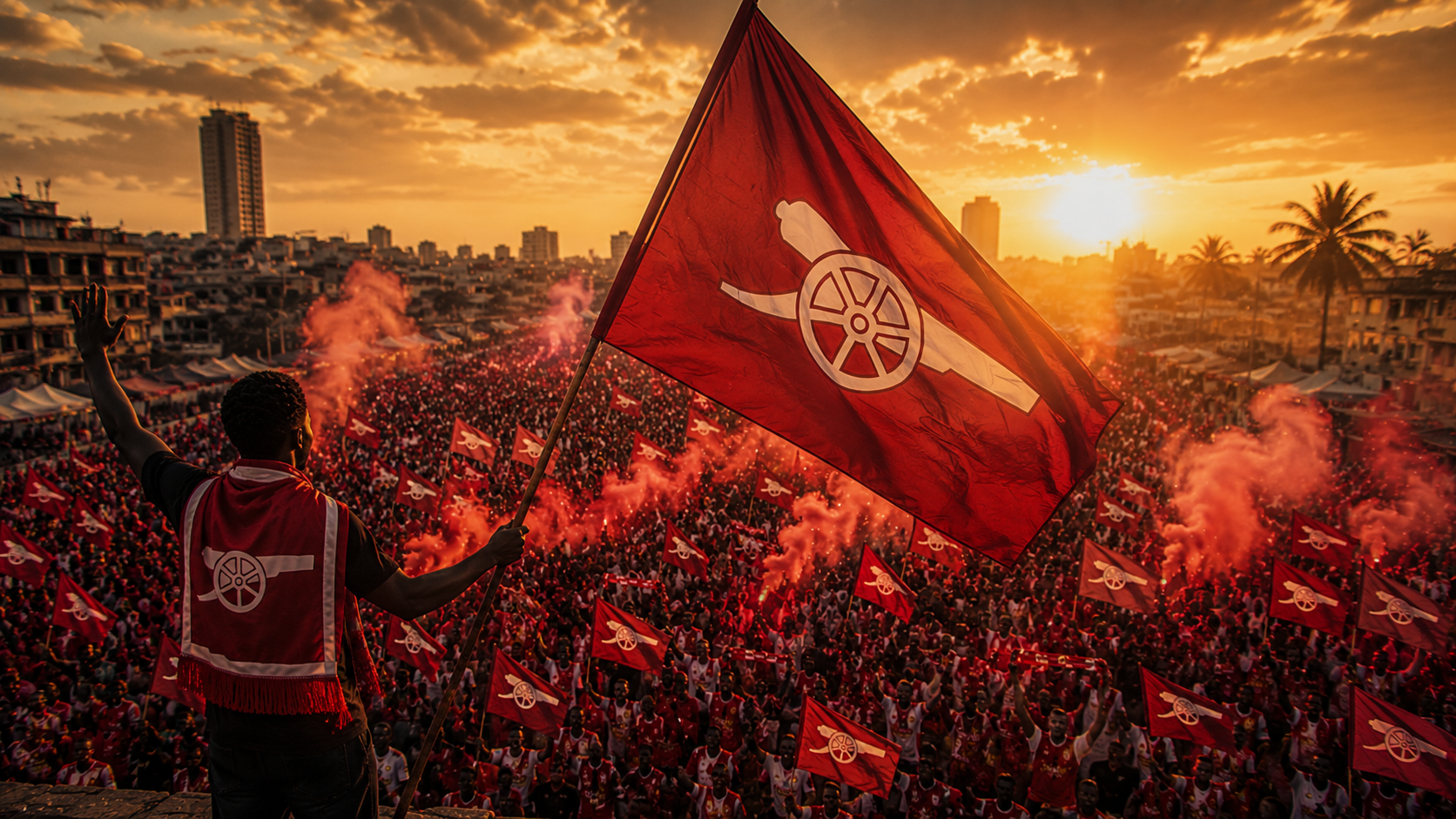
On the evening of the twenty-fourth of May, twenty twenty-six, a football title was settled in the south of England, and the loudest celebrations on earth broke out four thousand miles from the trophy. Arsenal had beaten Crystal Palace, and then, in the way that championships are so often decided at one remove, the title fell when Manchester City failed to beat Bournemouth elsewhere in the country. After twenty-two years of waiting, the wait was over, and a continent that had been promised this moment so many times that it had half stopped believing in it finally got to keep the promise.
Nairobi’s city centre became, in the words of The Star, a sea of red and white running from Moi Avenue to Kenyatta Avenue. The Daily Nation reported thousands pouring into the streets, convoys building along Thika Road, celebrations breaking out in Nakuru and across Western Kenya. And in the middle of it all, the newspaper recorded one supporter whose first words, amid the delirium, were not about the football at all. We have been ridiculed for a long time, he said. I never thought a time like this would come.
Hold that sentence, because this whole series will keep returning to it. A grown man, standing in the largest street party his city had seen in years, and the first thing that rose to the surface of his joy was the memory of being laughed at. Not the goals, not the table, not the trophy: the ridicule, and its ending. There is a whole argument folded inside that, about what this fandom has cost the people who carry it and what it means to them, and we will spend eight episodes unfolding it. But begin simply, with the scale and the texture of the joy itself, because the joy is the thing the cynics never pause long enough to actually look at, and it is impossible to understand what this series is defending until you have seen it properly.
The week did not belong to one city or one country. It belonged to the whole continent at once. The continental press documented choreographed celebrations in Lagos, Abuja, Ibadan, Calabar and Enugu, supporters’ clubs that had planned their routes and their colours the way families plan a wedding. There were car horns and flash mobs in Addis Ababa. There were bars and hotels overflowing in Kigali, where the small East African nation of Rwanda had spent eight years with its tourism slogan on the Arsenal sleeve, a deliberate piece of national strategy that put the country in front of hundreds of millions of viewers every week.
There was Kampala, which will tell you to your face and with evidence that it hosts the most passionate Arsenal supporters anywhere on earth. And the celebration reached the very summit of public life: Kenya’s President, a famously public Arsenal supporter who had received the Premier League trophy at State House during its tour and declared on camera that Arsenal was back, celebrated openly, while the country’s media paused to remember the late Raila Odinga, one of the most beloved figures in Kenyan public life and one of its most recognisable Gooners, a man who had carried his loyalty to the club through the whole of a long and turbulent political career.
Within days the trophy itself stood at the Kenya National Archives, ringed by a carnival, while a Kenyan artist’s rendition of North London Forever, the song written for a borough of a city an ocean away, travelled the internet, sung back to that borough in harmony from East Africa.
Sit with the strangeness and the beauty of that last image for a moment, because it contains the puzzle this series exists to solve. A love song to north London, composed for the supporters of one English club, raised in Nairobi by Kenyans who have in most cases never set foot in Islington and some probably never will. To a certain kind of observer that is evidence of something gone wrong, a sign of misplaced love and captured emotion. To this series it is evidence of something extraordinary, and the difference between those two readings is the whole argument.
But notice, first, the plain fact that sits underneath the puzzle, the fact that ought to stop any honest observer in their tracks. Nothing else on the entire African continent gathered crowds like this that week. Not a policy. Not a programme. Not a politician. Not one institution of any of these states could call its people into the streets in those numbers, in that joy, at no charge and under no compulsion, for the pure shared gladness of a thing held in common. A football club from Islington could. That fact is either an embarrassment to be sneered at or a question to be answered, and the commentary that arrived in the days that followed chose, overwhelmingly, to treat it as an embarrassment.
Before we turn to that commentary, stay with the joy a little longer, because there is something in it that the cynics never weigh and that the celebrations were quietly demonstrating to anyone willing to look. A people who can produce joy on that scale, spontaneously, without payment or coercion, organised entirely from below by supporters’ clubs and viewing halls and group chats rather than by any state, are showing the world a capacity, not a weakness. They are proving that the social trust required to fill a city centre with strangers in shared colours, peacefully, in celebration, is intact and abundant on this continent.
That capacity is one of the rarest and most valuable things a society can possess; there are wealthy nations that cannot summon it. To watch a hundred million people demonstrate it and to conclude that the demonstration is shameful is to look at a reservoir in a drought-stricken land and complain about the shape of the lake. The joy is not the problem. The joy is the proof that the raw material of a flourishing collective life is present in enormous quantity, waiting, as this series will argue all the way to its end, only for institutions worthy of it. The tragedy the cynic mistakes for the crime is simply that this magnificent capacity has, for now, no home of its own to be spent in, and so it is lent, every Saturday, to a city across the sea.
The other voice
Because as the videos travelled, a familiar commentary travelled alongside them, and it deserves to be stated at its full strength rather than caricatured, because this series intends to defeat it at its strongest and a strawman would prove nothing. The commentary said, in effect: look at this devotion, all of it poured out for someone else’s city. Where was this energy when fuel prices doubled? Where is this passion for the country itself, for its crises, for its future? An African who feels more for Arsenal than Arsenal’s own neighbours in north London feel has had his emotions captured; this is what colonisation looks like once the flags have come down and the soldiers have gone home, not conquest by force but a hundred million hearts beating for a place that will never know their names. The fan, on this reading, should be ashamed of himself. One viral post from that week, carried in the regional press, compressed the whole charge into a single line: where was this energy when fuel was at a hundred and thirty? Embarrassing fan base.
This series treats that commentary as a school of thought rather than as the property of any one person, because it is a school of thought; it speaks from many mouths and it recurs every time the continent dares to be visibly happy. So no commentator is named here, no post is linked, no account is identified. The argument is engaged, not the individual. And the engagement begins with a concession, because the school of thought is not stupid and is not made entirely of bad faith. It has seen something real.
There genuinely is something painful, something that ought to trouble anyone who loves this continent, in the picture of its people pouring their devotion into a game played four thousand miles away while their own stadiums stand empty and their own leagues struggle to survive. The commentary sees that wound clearly. Its error, the error this entire series is built to correct, is in where it then points the blame.
The crowd is the diagnosis, not the disease
Because the wound is real, but the crowd is not the cause of it. The crowd is the diagnosis. The supporter on Moi Avenue is not the sickness in the picture; he is the symptom that reveals it, and to read him correctly you have only to ask what he actually knows. He knows that the English Premier League has kept its promise to him every single weekend for thirty years.
The fixtures happen when they are scheduled. The broadcast works. A bad decision by the referee is reviewed by a process he can see. The table at the end of the season tells the truth about what happened on the pitch. And he knows, with equal precision, what the alternative has looked like at home, because the public record has counted it, and this series will spend its second instalment counting it in full.
He has watched a Ghanaian league whose own federation once recorded five-figure crowds at the turn of the century fall, by analysis the Atlantic Council published in February of this year, to fewer than eight hundred people a game. He has watched a Nigerian television deal reported at six billion naira terminated by the broadcaster itself after two seasons as commercially unsustainable, leaving the largest football nation on the continent with a season watchable only on a telephone application. He has followed a Nigerian parliamentary investigation, opened in October of twenty twenty-five, into the alleged misuse of more than twenty-five million dollars in development grants, a matter that is an allegation under investigation and is reported here as exactly that and nothing more.
He has read of a continental confederation whose own commissioned audit, as reported at the time, was able to sufficiently document only five of the forty payments it examined. He has read of a hundred-million-dollar World Cup legacy fund whose clean audits were, by a published investigation, later contradicted by forensic examination. And he has seen, most recently, even the result of his own continental championship final become the subject of a dispute now before the Court of Arbitration for Sport, a live proceeding on which this series expresses no view and which it will not discuss while it remains undecided.
Set the supporter’s knowledge against his choice and the verdict becomes obvious. His devotion to a foreign league that keeps its word is not the mark of a captured mind. It is a market verdict, the most honest consumer review ever written, delivered every weekend by a hundred million people, and addressed not to themselves but to every office on their own continent that failed them. He did not choose the foreign product because he was dazzled. He chose it because, after decades of careful and painful attention, it was the one that worked. And this is precisely why this series declines, deliberately and from the outset, to use the language of colonisation to describe what he did.
Not because the continent’s historic wounds are unreal; they are profoundly real, and other strands of this house’s work document them at length. But because in this particular debate, about this particular devotion, the word colonisation functions as an amnesty. It picks up the blame and carries it across an ocean, and sets it down somewhere safely abstract and safely foreign, and in doing so it lets every administrator and every office-holder who actually hollowed out the domestic game step quietly out of the frame. This series will not grant that amnesty. The accounting it intends to do happens at home, because home is where the mandate was, and home is where the answers are owed.
So this is the road ahead, set down plainly at the start so that no reader can mistake where it leads. Over the episodes that follow, The Sovereign Pitch will tell the true story of how this fandom was inherited rather than implanted, carried home across an ocean by families rather than pressed upon a passive continent by marketing.
It will draw the full money map of what flows out of the continent every season, through the screens and the betting slips and the sale of its own gifted children, and it will set that against what a single other country has built by treating its football league as a national asset worth protecting. And then it will end, in its eighth episode, by reading a charge sheet into the record, every entry sourced and every status named, and handing the whole file forward to a second series in which the accounts are rendered line by line.
After the accounting comes the build, because this house does not stop at anger. But the build is a long way ahead. For now there is only the joy, and the question the joy forces, and the first answer this series will give to it, which is also its last word on the supporter and its first word on everyone else. The fan is innocent. The ledger is not.
Sources for every figure and event in this essay are carried in the Series One Bibliography published with this strand.
© L’El-Roi Global Ltd 2026.