3: The Manufacturing Trap
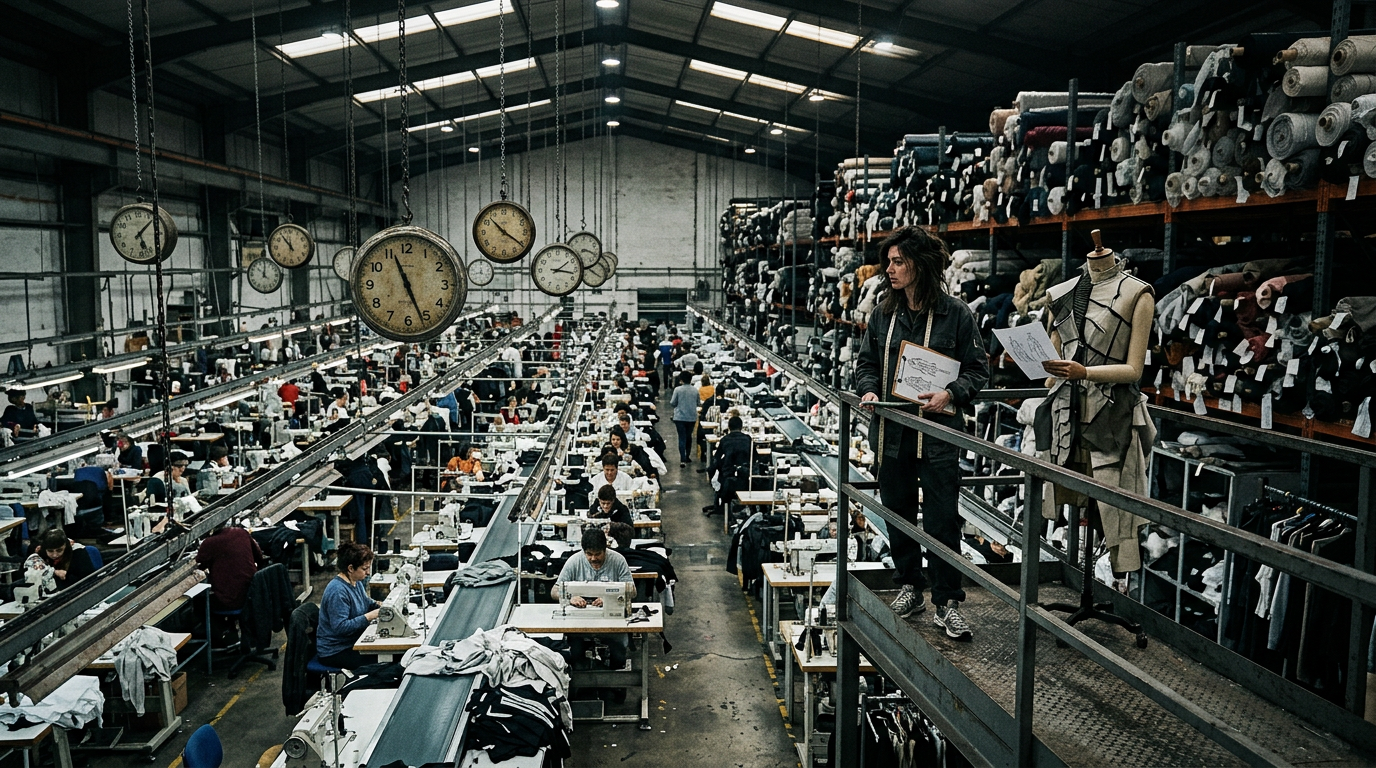
The Creative Collapse Series - Episode Three
For most consumers, fashion appears to move effortlessly from concept to product. Collections are announced, garments appear on runways, and shortly afterwards those same pieces are available for purchase. The process seems seamless, as though once a designer creates something, the systems required to make and deliver it naturally organise themselves around the creative vision. This impression is not accidental. It is the result of enormous institutional infrastructure working to make complexity invisible. For the large fashion houses that can afford that infrastructure, it does become relatively invisible. For the independent designers who cannot, the manufacturing process is the terrain on which brands live or die, and it is terrain that the industry's celebration of creative vision systematically refuses to examine.
Transforming a design into a finished garment requires coordination across a network of manufacturers, fabric suppliers, pattern makers, quality controllers, graders, cutters, and logistics providers, each operating across different geographies, different time zones, and different commercial priorities. Each of these components must work in precise alignment for a brand to deliver products on schedule and to the standard the customer expects. When any single link fails, the consequences do not stay contained to that link. They cascade through the entire commercial cycle of the business, arriving at the customer-facing end of the chain in the form of delays, quality problems, and the kind of public frustration that social media platforms are designed to amplify.
For large fashion conglomerates with vertically integrated production networks, long-standing supplier relationships, and dedicated logistics operations, this complexity is managed through systems built over decades with significant capital investment. For independent designers, it is managed by the founder, personally, often while simultaneously running every other function of the business.
The Minimum Order Problem
The structural disadvantage begins at the first stage of production engagement: minimum order quantities. Factories set minimum thresholds because production line efficiency depends on volume. Running a production line for fifty units of a single design costs the factory almost as much as running it for five hundred, so the economics of factory operation require commitments that independent designers frequently cannot make without taking on financial risk that the business cannot absorb if the order does not sell through completely.
For emerging brands, this creates a dilemma with no clean resolution. Committing to the minimum quantity required by a manufacturer the brand can afford ties up capital that the business needs for the next production cycle. If the units do not sell at the pace required, the unsold inventory sits as a liability that constrains every subsequent decision the founder makes. If the brand negotiates a smaller order with a different manufacturer, it typically pays a higher per-unit cost, which compresses the margin it needs to sustain the business. And if it cannot meet the minimum at all, it cannot access the manufacturer, which means finding an alternative, often at shorter notice and with less information about the alternative's reliability.
Shanel Campbell, founder of SLF Label, has spoken publicly about navigating exactly this dynamic in the early stages of building her brand, managing minimum order requirements with limited capital while simultaneously trying to maintain the quality standards the brand's identity depended on. Her experience is representative rather than exceptional. It describes the standard operating condition of independent fashion entrepreneurship at the production stage.
The problem compounds when a brand experiences sudden demand growth. A viral moment or a high-profile placement can produce a surge in orders that the brand's existing manufacturing relationships cannot fulfil at the scale or speed the demand requires. The founder must either turn away orders, find new manufacturing partners under time pressure without adequate due diligence, or commit to production volumes that exceed what the business can financially support. Each of these options carries significant risk, and none of them is the option the customer expects or the platform algorithm rewards.
The Geography of Production
The structural challenge deepens when manufacturing is overseas, which for most independent brands it is, because domestic manufacturing at the scale and price point that independent brands require largely does not exist in the markets where those brands are selling.
Fabric sourcing may depend on suppliers in one country. Garment construction may happen in a factory in another. Finishing and quality control may occur somewhere else entirely. Each stage introduces a handoff, and each handoff introduces the possibility of delay, miscommunication, quality divergence, or the kind of logistical complication that becomes visible to the customer as a late delivery without the customer having any visibility into the chain of circumstances that produced it.
In 2021 and 2022, global supply chain disruption following the pandemic produced conditions that were genuinely unprecedented in their severity. Shipping container shortages created delays that were measured not in days but in months. Port congestion in Los Angeles, Felixstowe, and Shanghai produced backlogs that moved slowly through the system for years. Raw material costs increased sharply and unpredictably. Freight costs for some routes increased by factors of five to ten relative to pre-pandemic levels. Major fashion corporations with long-term freight contracts, dedicated logistics teams, and the capital reserves to absorb cost increases were significantly insulated from these conditions. Independent brands, negotiating spot rates with freight forwarders and absorbing full cost increases that they could not always pass on to customers, experienced them at full force.
Several Black-owned fashion and beauty brands that had scaled rapidly in 2020 in response to the surge of consumer support found themselves navigating these supply chain conditions with none of the infrastructure that would have allowed them to manage the disruption. The timing was not coincidental. The rapid growth that the cultural moment of 2020 produced had required scaling commitments, and the scaling commitments had locked brands into production and logistics arrangements that the 2021 and 2022 supply chain environment made extremely difficult to honour. The delays that resulted were real. The customer frustration that followed was real. The online discourse that treated operational complexity as personal failure was real. And the structural conditions that produced all of it, the combination of rapid demand growth, inadequate capital buffers, overseas manufacturing dependency, and global supply chain disruption, were not the result of individual management failures. They were the predictable consequence of a structural environment that had been building pressure for years before the pandemic made it explosive.
Quality Control at a Distance
Manufacturing quality control is the dimension of independent fashion production that receives the least public attention and carries some of the most significant business consequences. For brands working with overseas manufacturers, quality control requires either the physical presence of someone the brand trusts at the factory during production, which is expensive and logistically complex, or reliance on remote inspection processes that cannot always catch the specific quality issues that matter for a particular brand's standards.
When quality problems emerge after production is complete and goods have shipped, the options available to an independent brand are all bad. Return the goods and delay delivery further while the manufacturer rectifies the problem, absorbing additional freight costs and extending the customer-facing delay. Accept the goods and sell them at reduced quality, risking the brand reputation the founder has spent years building. Or absorb the cost of the defective goods, write them off, and produce a replacement run, which requires capital the business may not have.
Larger brands manage this through dedicated quality teams, long-standing relationships with factories whose standards have been tested across multiple production runs, and the commercial leverage that comes from being a significant customer whose business the factory is motivated to retain. Independent brands manage it through whatever personal relationships they have been able to build, which may be excellent but which provide much less institutional protection when something goes wrong.
What the System Rewards and What It Does Not
The fashion industry's infrastructure rewards scale in ways that are so embedded in how the system operates that they often appear as natural features of production rather than as structural choices that could be made differently. Factories prioritise larger clients with more predictable order volumes. Freight rates favour volume shippers. Quality management becomes more accessible as relationships mature and as order history provides the leverage that new relationships cannot generate. Each of these features of the production system is rational from the perspective of the institution providing the service. Collectively, they produce a manufacturing environment in which independent brands are structurally disadvantaged relative to established ones, not because they are less capable but because the system's logic does not accommodate their scale.
The consequence is that independent designers must navigate the same complex, multi-stage, geographically distributed production landscape as global fashion houses, but without comparable resources, leverage, or institutional support. When delays occur, the consequences fall on the founder and on the customers the founder has made commitments to, rather than being distributed across the institutional infrastructure that a larger organisation would bring to bear.
This is not a story about individual brands failing to manage their supply chains well enough. It is a story about a production system that was built for a scale of operation that most of the culturally significant independent brands in the industry have not yet reached and may never reach under current conditions. The system does not fail independent brands through malice. It fails them through indifference to the specific conditions under which they operate, and that indifference is itself a structural choice that the industry has consistently made without examining its consequences.
What Would Have to Change
Manufacturing cooperatives, where independent brands share production capacity and split minimum order requirements, have been proposed and in some cases attempted as a partial solution to the minimum order problem. The model has worked in limited contexts and has not scaled, in part because the coordination costs of managing shared production are significant and in part because brands at different stages of development have different production requirements that make genuine sharing difficult to organise.
Domestic manufacturing revival in the United States and United Kingdom has attracted policy attention and investment in recent years, and some progress has been made in developing capacity for smaller production runs at prices that independent brands can access. The progress is real and insufficient. The price points of domestic manufacturing for most categories of fashion product remain significantly higher than offshore alternatives, and the overhead that higher price points impose on already thin margins constrains the extent to which domestic manufacturing can serve as a viable solution for the full range of independent brands that need it.
What the manufacturing trap ultimately requires is a fundamental redesign of the relationship between the production system and the independent brands that depend on it, one that acknowledges the specific constraints of small-scale production and builds infrastructure around those constraints rather than requiring small-scale producers to navigate a system built entirely around the logic of large-scale production.
That redesign has not happened. The independent brands navigating the current system are doing so in conditions that the system was not designed to make manageable for them. The cultural celebration of their creative output continues. The structural examination of the conditions under which they produce it is, with some exceptions, largely absent from the public conversation about the industry whose energy they supply.
The next episode turns to the dimension of that public conversation that has transformed the relationship between brands and their audiences in ways that compound every structural pressure this series has examined so far.
The Creative Collapse Series is an ongoing investigation into the structural pressures shaping the modern creative economy.