THE CLOTH NOBODY OWNS
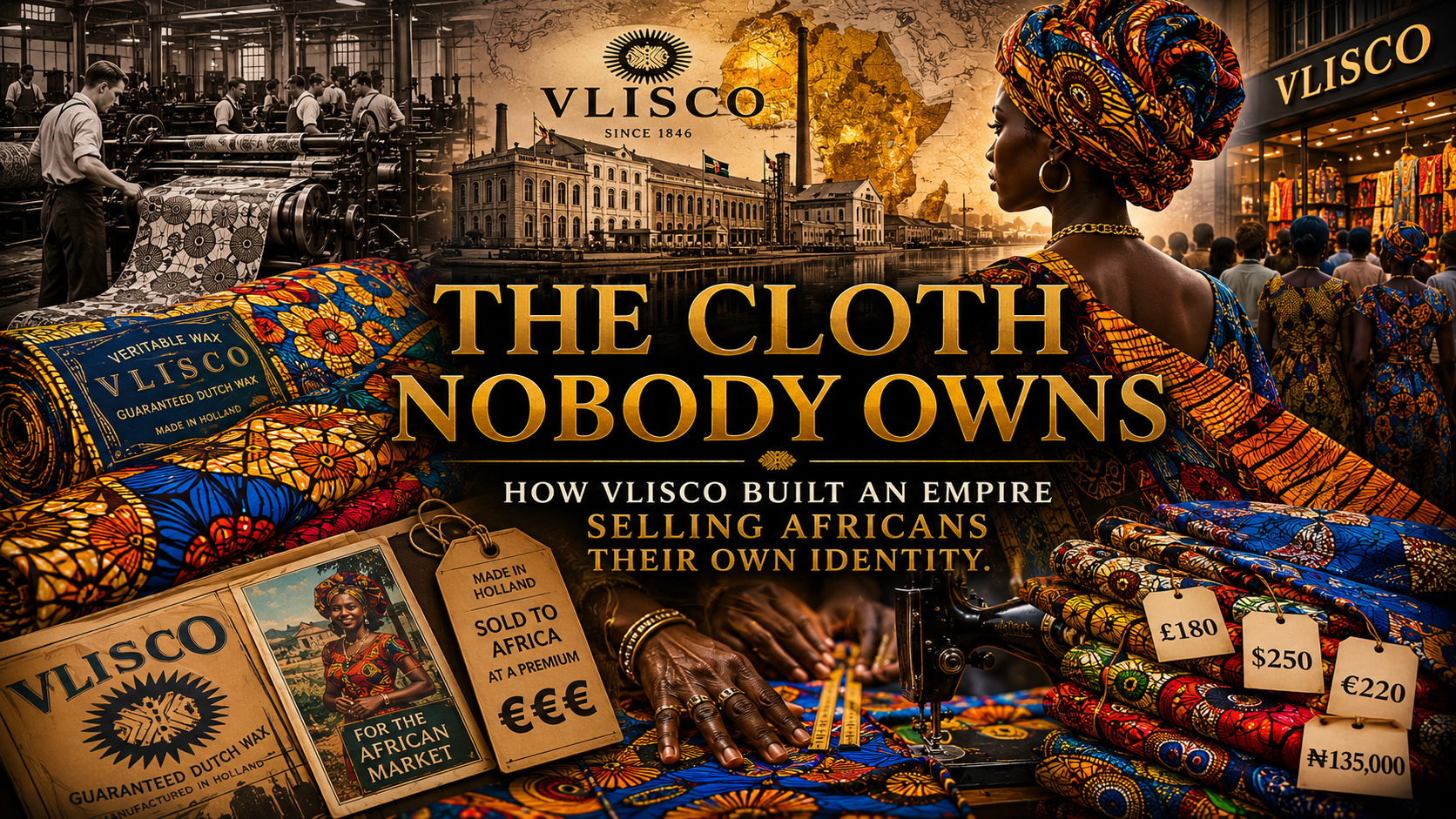
How Vlisco Built an Empire Selling Africans Their Own Identity
Document 01 | Free Tier | Series One: Worn Without Permission
EDITORIAL AND LEGAL DECLARATION The Multiverse | The Cloth and the Crown | Worn Without Permission Publication context. This document is published by The Multiverse, a brand of L’El-Roi Global Ltd, registered in England and Wales. It constitutes Document 01, Free Tier, of Worn Without Permission, Series One of The Cloth and the Crown strand. It is the opening document of the series. Nature of this publication. This document constitutes investigative journalism and analytical commentary on matters of significant public interest concerning the commercial history and current market architecture of the African wax print textile industry. References to Vlisco and the Chinese wax print market are based on publicly available published reporting, documented academic analysis and published company communications. All market figures are drawn from published industry analysis. The analysis of the commercial relationship between Vlisco’s business model and African community economic welfare constitutes honest editorial opinion on documented commercial facts within the meaning of the Defamation Act 2013. Intellectual property and editorial independence. The analytical framework and original editorial content of this document are the intellectual property of L’El-Roi Global Ltd. The Multiverse is funded entirely by reader subscriptions and exercises complete editorial independence. |
“When I wear Ankara I am wearing Africa. That the cloth is designed in the Netherlands and manufactured in China before being sold to me in Lagos is a fact I was not taught. It is a fact the industry prefers I do not examine.” — The Multiverse |
The Fabric That Crossed the Wrong Ocean
In the 1840s, a Dutch textile entrepreneur named Pieter Fentener van Vlissingen looked at the batik cloth of Java and identified a commercial arbitrage. The Indonesian batik tradition, built over centuries through a wax-resist dyeing process applied by hand to cotton or silk, produced patterns of intricate complexity that commanded premium prices wherever they were sold. If those patterns could be mechanically reproduced at industrial scale using a roller-printing process to replicate the wax-resist effect, the production cost would collapse while the visual appeal, the management hoped, would hold. The resulting fabric was not batik. It was a printed cotton that resembled batik from a distance, produced in a factory in the Netherlands at a fraction of the cost of the hand-made original.
The Javanese market saw through it immediately. Hand-made batik’s value rested partly in its visible humanity: the slight irregularities of the wax application, the colour variations across a single cloth, the evidence of a skilled maker’s hand moving through hours of concentrated work. Machine printing could not replicate these imperfections because imperfection was not the point of machine printing. The Dutch product was rejected on the Indonesian market it had been designed for. The factories kept running. The inventory accumulated. A commercial solution was required.
Dutch and British merchants trading along the West African coast in the 1890s discovered that the printed cotton had found an unexpected and enthusiastic market. West African consumers, particularly women in the coastal trading communities of what are now Ghana, Ivory Coast, Nigeria and Senegal, responded with immediacy to the fabric’s bold colour combinations and its surface pattern density. They were not buying batik and they were not buying a European imitation of batik. They were buying a blank commercial canvas onto which, over the following decades, they would build something the Dutch manufacturers neither created nor controlled: an entire cultural language.
The Dutch brought a failed product to a new market and called it commerce. West African communities transformed that product into a cultural infrastructure spanning 130 years of social meaning, ceremonial life and aesthetic identity. One party created the value. The other party owns the company.
By the early twentieth century, African women traders, most famously the ‘Nana Benzes’ of Togo who became extraordinarily wealthy intermediaries between the European mills and West African consumers, had begun actively commissioning and co-designing patterns. A Nana Benz did not simply distribute Vlisco’s output. She identified which patterns were generating demand, paid for exclusive distribution rights to specific designs, and used that monopoly to build commercial empires of sufficient scale that by the 1960s, some were among the wealthiest women in West Africa. The designs they commissioned carried names chosen by the communities that adopted them: Angry Husband, David Beckham, Six Thirty, Mother-in-Law. The patterns accrued stories. The stories accrued social meaning. The social meaning made the patterns commercially irreplaceable in ways that no amount of industrial ingenuity had produced in the Dutch factory. The cultural intelligence was African. The intellectual property was Dutch. The commercial infrastructure was held by a company in Helmond.
One hundred and thirty years after the first West African sale, Vlisco’s CEO Perry Oosting described his company’s relationship with its market in terms that captured the architecture with unintentional precision: ‘African women just embraced it. They loved the brighter colours and they saw that the quality was better than what was available in the market compared to other imported goods, so that’s how it started. They embraced it and they also gave stories to it.’ They gave stories to it. In four words, the CEO of a company with approximately €300 million in annual revenue acknowledged that the value of his product was created by the communities he sells to, not by the company he runs. What he did not address is the structural question that follows: if African women gave the stories that made the cloth commercially significant globally, why is the commercial infrastructure built on those stories owned by a Dutch company and, since its acquisition by British private equity, not even by a Dutch one?
Part One: How the Cultural Architecture Was Built and Who Owns It
The Design Intelligence That Stayed in Africa
The commercial history of Ankara is frequently told as a story of European supply and African demand. The more accurate account is a story of African co-production in which the design intelligence was almost entirely African while the legal and commercial infrastructure remained entirely European. From the earliest decades of the Vlisco trade, West African women were not passive consumers. They were the market research department, the trend forecasters, the brand managers and the distribution network of a commercial system whose profits they did not share.
The Nana Benzes of Lomé, Togo, represent the most documented version of this dynamic. Operating from the late colonial period through to the 1990s, these women built commercial networks of extraordinary sophistication, holding exclusive distribution rights to specific Vlisco patterns across defined territories and using those rights to control pricing, timing and availability in ways that generated both personal wealth and collective market influence. They were not employees of Vlisco. They were traders who had negotiated commercial relationships with European mills on terms that gave them significant market power within their territories. What they did not have was any ownership stake in the intellectual property of the patterns their commercial decisions had made valuable, nor any equity in the companies that manufactured the cloth whose cultural resonance their commercial intelligence had cultivated.
This distinction, between commercial influence and structural ownership, defines the entire Ankara economy’s relationship with African communities. Vlisco’s own product development process acknowledged African design intelligence by using it systematically: the company’s design teams worked from African market signals, employed African agents, commissioned patterns based on African aesthetic preferences. The patterns that became commercially dominant were the ones that African communities signalled they wanted. The company that owned the resulting designs was in Helmond.
The $4 Billion Market and the Community’s Share of It
The West African wax print market is currently valued at approximately $4 billion annually. Of the 130 million yards of textiles purchased in Ghana alone in a recent documented year, approximately 100 million yards came from Asian imports, primarily Chinese manufacturers who identified the market in the 1990s and have steadily increased their share. Ghanaian domestic manufacturers, primarily ATL, GTP and Printex, produce approximately 30 million yards combined. Vlisco itself, while generating approximately €300 million in annual revenue, has seen its market share eroded by both Chinese competition and locally-made alternatives.
The Chinese entry into the Ankara market created a specific commercial dynamic that illuminates the underlying problem with unusual clarity. When Chinese manufacturers began producing lower-cost imitations of Vlisco’s designs, Vlisco launched legal actions, seized counterfeit cloth, and ultimately invested in authentication technology including QR codes and encrypted barcodes to help consumers distinguish genuine Vlisco from imitations. The interesting observation here is not that intellectual property enforcement is happening, but who is doing the enforcing and over whose designs. The patterns that Chinese manufacturers were imitating were not traditional African patterns over which African communities could assert IP claims. They were Vlisco’s registered commercial designs, protected under Dutch and international trademark law. The same legal framework that allows Vlisco to sue Chinese manufacturers for copying its patterns prevents African communities from claiming any rights over those same patterns, because the patterns, however much their commercial appeal derives from African cultural investment, are Vlisco’s IP, not Africa’s.
The shift from Dutch to Chinese dominance of the mass market has therefore been, for African communities, a change of extraction nationality rather than a change of extraction logic. Both Vlisco and the Chinese manufacturers are foreign industrial systems extracting commercial value from a cultural market that African communities created, grew and sustain through their continued aesthetic investment and purchasing power. The $4 billion market exists because African women made it exist. The ownership of that market’s commercial infrastructure sits entirely outside the continent.
Part Two: Two Forms of the Same Extraction
Ankara Was Never African Property. Kente Always Was.
There is a distinction that this document must draw explicitly, because without it the analysis of African textile extraction collapses into a single undifferentiated argument that misses something important about the specific forms of harm involved. The Ankara story and the Kente story are both stories of extraction, but they are fundamentally different in the nature of the thing being extracted and therefore in the specific injustice being committed.
Ankara’s substrate, the wax-resist printed cotton cloth, is a foreign industrial product. West African communities did not create the cloth. They created the culture surrounding the cloth: the patterns’ meanings, the social functions of specific designs, the occasions on which particular fabrics are appropriate, the entire grammar of a textile language that transformed a failed Javanese imitation into the fabric that people across twenty countries recognise as a core element of West African cultural life. The extraction in the Ankara story is the extraction of cultural value that African communities created around a foreign product, without those communities holding any IP in the product itself. Vlisco’s injustice is the injustice of a company that profits enormously from cultural work it did not perform, by communities whose creative and commercial contribution to its success is acknowledged informally and uncompensated structurally.
Kente is categorically different. Kente is an entirely African creation: the specific weaving techniques, the strip-loom construction, the pattern vocabulary, the symbolic grammar in which the pattern called Oyokoman Adweneasa communicates the fullness of royal authority and the pattern called Emaa Da expresses moral prohibition, all of this was developed by Ashanti and Ewe communities over at least four centuries without any foreign substrate, foreign capital or foreign commercial infrastructure. What has happened to Kente is not that a foreign company captured the commercial infrastructure around a product it introduced. It is that a foreign fashion industry captured the commercial value of a design tradition it had no part in creating, and did so because the international IP framework provided no mechanism for the tradition’s owners to prevent or charge for that use.
The result of these two different forms of extraction is identical: African communities that created the commercial value receive nothing from the commercial market that value sustains. But the mechanisms are different, and the solutions are different. The Ankara problem requires structural reform of the commercial architecture: community ownership models, cooperative production infrastructure, benefit-sharing agreements with manufacturers. The Kente problem requires IP protection: geographical indication registration, certification marks, licensing frameworks. The Vault tier of this series addresses both. Understanding that they are different is the prerequisite for understanding why the solutions are designed the way they are.
Whether the textile’s origin is foreign, like Ankara, or entirely indigenous, like Kente, the global commercial architecture achieves the same result: the communities who created the value receive none of the revenue it generates. Different mechanisms. The same extraction.
What Kente Weavers Actually Earn From a Global Market
In Bonwire, the principal weaving village of the Ashanti Region of Ghana, a master Kente weaver working a traditional horizontal strip loom produces approximately four yards of finished cloth per working day. At premium retail pricing of between £80 and £200 per yard in international markets, the arithmetic should suggest income of considerable significance. The reality is that the majority of Kente weavers do not sell at international retail prices. They sell wholesale to intermediaries, at considerably lower prices, with the premium captured by traders, export companies and the retailers at the commercial end of the chain. The weavers who have direct access to premium international buyers, typically through craft fair networks, museum shop relationships or direct diaspora community connections, are a small minority.
More significantly for the scale of the injustice: the weavers’ income from authentic Kente production is entirely disconnected from the global commercial market for Kente-inspired products, which is orders of magnitude larger. When Louis Vuitton’s Fall/Winter 2021 menswear collection, designed by Virgil Abloh, featured garments in patterns whose geometric structures and vibrant colour combinations echoed the Kente visual language, those garments sold out globally. The revenue flowed to LVMH. The cultural authority that made the aesthetic commercially desirable, the four centuries of accumulated meaning that makes the Kente visual language carry weight for consumers in Tokyo, New York and Paris, flowed from Bonwire. Nothing flowed back.
This is the specific commercial mechanism that the Kente GI of September 2025, the first geographical indication registration for a Ghanaian textile, begins to address. By establishing that only cloth produced by licensed weavers in the registered communities, meeting the specific requirements of the Book of Specifications for thread count, loom type and weaving technique, may be legally marketed as authentic Kente, the GI creates the authenticated provenance story that premium consumers pay for. It does not immediately resolve the licensing question for Kente-inspired commercial products that do not use the GI name. That resolution requires the certification mark infrastructure and the ATRCO’s enforcement capacity, both of which are described in the Vault tier of this series. But September 30, 2025 is the date from which the architecture of the problem changed.
Part Three: The Scale of What Has Been Taken
Calculating the precise value extracted from African textile heritage without compensation is not straightforward, because the industry has no institutional incentive to calculate it and the communities that would benefit from the calculation lack the resources to conduct it systematically. But the order of magnitude is visible from the available data, and the order of magnitude is what matters for understanding the scale of the injustice and the scale of the remedy required.
The $4 billion wax print market generates annual revenue primarily for Dutch and Chinese manufacturers from a cultural market that African communities created. Vlisco’s €300 million annual revenue comes from selling to African consumers a product whose commercial value was created by those consumers’ sustained cultural investment over more than a century. The Chinese manufacturers who have captured 77% of Ghana’s domestic textile market generate revenue from designs whose appeal derives from the same cultural investment, at prices that make authentic African production uncompetitive. These are the numbers from a single product category in a single region.
The luxury appropriation market multiplies this across every major fashion house’s seasonal relationship with African aesthetics. Valentino’s Spring/Summer 2016 collection drew so extensively from sub-Saharan African aesthetic traditions that critics across the fashion press commented on its African sources. The collection generated revenue at luxury price points and critical acclaim that furthered the house’s brand equity. The Maasai communities whose beadwork tradition featured in the collection, the West African textile traditions whose printed patterns appeared in the garments, the East African communities whose garment silhouettes informed the collection’s shapes: none of them received a licensing payment, a royalty, a credit line or any other commercial acknowledgement that the collection’s commercial value rested on their cultural heritage.
Season after season, house after house, this transaction repeats. The cumulative value transferred from African aesthetic heritage to Western luxury commercial profit across sixty years of documented engagement represents one of the largest uncompensated commercial transactions in the history of the creative industries. The rest of this series builds the institutional architecture that would end it: the IP protection instruments, the licensing framework, the manufacturing development infrastructure and the continental distribution system that would ensure the next sixty years produce a different result. The cloth has been worn without permission for long enough.
Narrative Engineering: The Transaction That Masqueraded as a Gift
Vlisco’s official history describes its relationship with West Africa as a 177-year partnership, a story of mutual discovery in which the company and the market grew together, each responding to the other, each benefiting from the relationship. Perry Oosting’s description of African women ‘giving stories’ to the cloth is the most candid version of this narrative: the company provided the product, the communities provided the meaning, and both parties got what they needed from the exchange. The narrative is structurally similar to the one that sustained the colonial cotton economy: the metropole provided the infrastructure, the colony provided the labour, and the relationship was presented as mutually beneficial even as the distribution of commercial benefit was systematically one-directional.
What the partnership narrative suppresses is the question of what constitutes fair value for 130 years of sustained cultural work. West African communities did not give stories to Vlisco’s cloth as an act of charity or cultural enthusiasm with no commercial dimension. They performed an act of cultural investment: they imbued a commercial product with meanings, social functions and aesthetic significance that made it irreplaceable in their markets and globally recognisable as a signifier of African identity. Cultural investment at that scale, sustained over that duration, producing commercial value of that magnitude, is not a gift. It is a contribution to a commercial enterprise, and contributions to commercial enterprises have a standard commercial treatment: equity, royalties, profit-sharing, or some combination of the three. West African communities received none of these. They received the fabric they had made valuable and Vlisco received the company built on their making it so.
The specific reason this narrative succeeded is that the alternative required naming a form of commercial relationship that the existing commercial and legal architecture had no instruments to recognise. In the absence of an IP framework that could protect community-created cultural value, in the absence of a corporate governance model that included community stakeholders, in the absence of a trade law framework that treated cultural investment as a commercial contribution deserving commercial return, the partnership narrative filled the conceptual space where the commercial accountability analysis should have been. The narrative did not just describe a relationship. It justified an architecture. And the architecture, as this document has shown, transferred value from the communities that created it to the institutions that owned the infrastructure around it, for 130 years, without interruption.
What Narrative Engineering proposes is not the dismantling of the commercial relationship between African communities and the global textile market. That relationship is real, economically significant and capable of being restructured rather than dissolved. What it proposes is the replacement of the partnership narrative, which treats cultural investment as a gift that needs no commercial return, with the investment narrative, which treats it as what it is: a contribution to a commercial enterprise that has generated enormous returns, none of which have been proportionately shared with the contributors. The Kente GI is the first legal instrument in which this investment narrative has been formally recognised. The ATRCO’s architecture is the system through which it is commercially operationalised. The terms of trade are being rewritten. This series is the specification document for the rewriting.
CLOSING DECLARATION AND NOTES ON SOURCES Document 01: The Cloth Nobody Owns | Worn Without Permission | The Multiverse On claims about Vlisco. The history of Vlisco’s West African market development including the mechanical batik development, the Javanese rejection and the West African commercial discovery is drawn from documented journalism including MyJoyOnline, Asaase Radio and TEXtalks, all drawing on Al Jazeera’s extended company profile. Perry Oosting’s quotation about African women ‘giving stories’ to the cloth is documented across multiple publications drawing on the same Al Jazeera source. Vlisco’s approximately €300 million annual revenue and 70 million yards production from Helmond are from Africans on China’s documented market analysis. The description of Vlisco as owned by British private equity is from the CSMonitor’s 2015 investigation into the Ghanaian textile market. On the Nana Benzes. The Nana Benzes of Lomé are documented in academic and journalistic literature on West African textile trade. Their role as exclusive distributors who commissioned and co-designed patterns, held exclusive distribution rights and accumulated significant personal wealth is documented in The Conversation’s analysis of West African textile markets and in academic textile scholarship. The claim that some were among the wealthiest women in West Africa is from documented academic and journalistic sources. On market figures. The $4 billion wax print market valuation and the 130 million yards / 100 million from Asian imports / 30 million from Ghanaian domestic manufacturers breakdown are from Africans on China’s documented analysis. The Kente GI registration September 30 2025, the UNESCO inscription December 2024, and the LV Virgil Abloh collection’s commercial performance are documented in sources cited in Documents 03, 04 and 09 of this series. Copyright. This document is copyright L’El-Roi Global Ltd. The Multiverse is a brand of L’El-Roi Global Ltd. All rights reserved. |
Document 01: The Cloth Nobody Owns | Worn Without Permission | The Cloth and the Crown | The Multiverse | Series One