SIG-003: Spotify Bundles
How a Reclassification Worth Hundreds of Millions in Unpaid Royalties Is Still Being Fought
In March 2024, Spotify reclassified its Premium subscription tiers as bundles by adding audiobook access to music subscriptions. The reclassification reduced mechanical royalty payments to songwriters by an estimated 48 percent of the relevant revenue base. The MLC sued. A federal court sided with Spotify. The MLC is now in appeal. Here is what this means structurally and why every songwriter with streaming income should be watching the Second Circuit.
The Signal
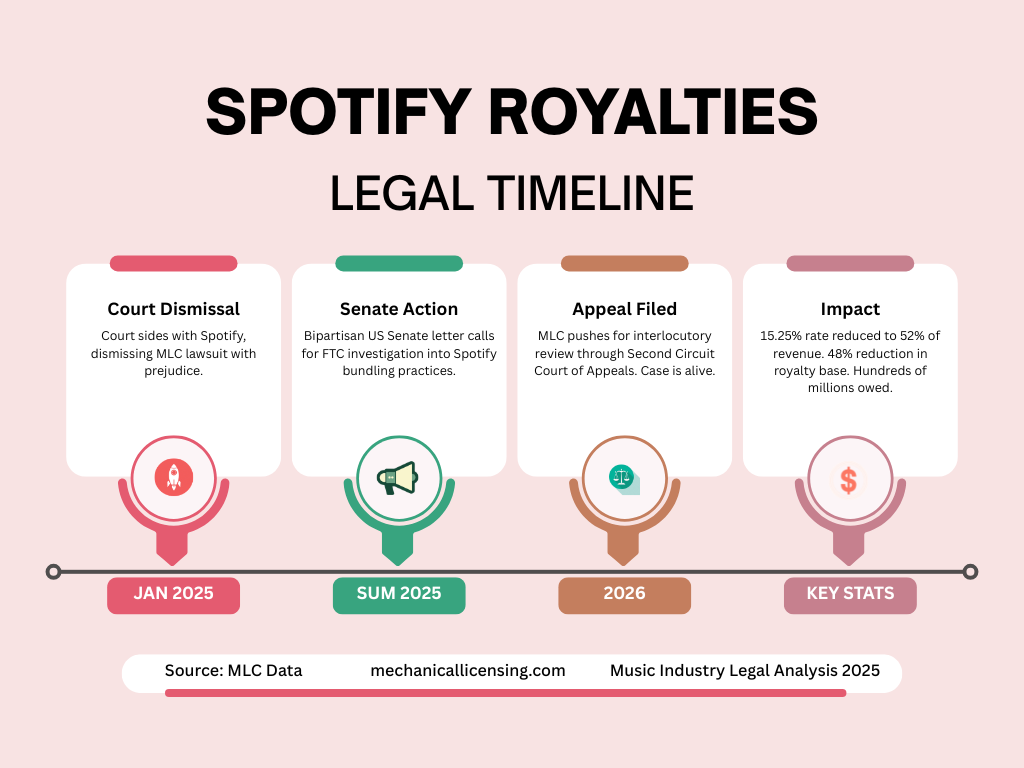
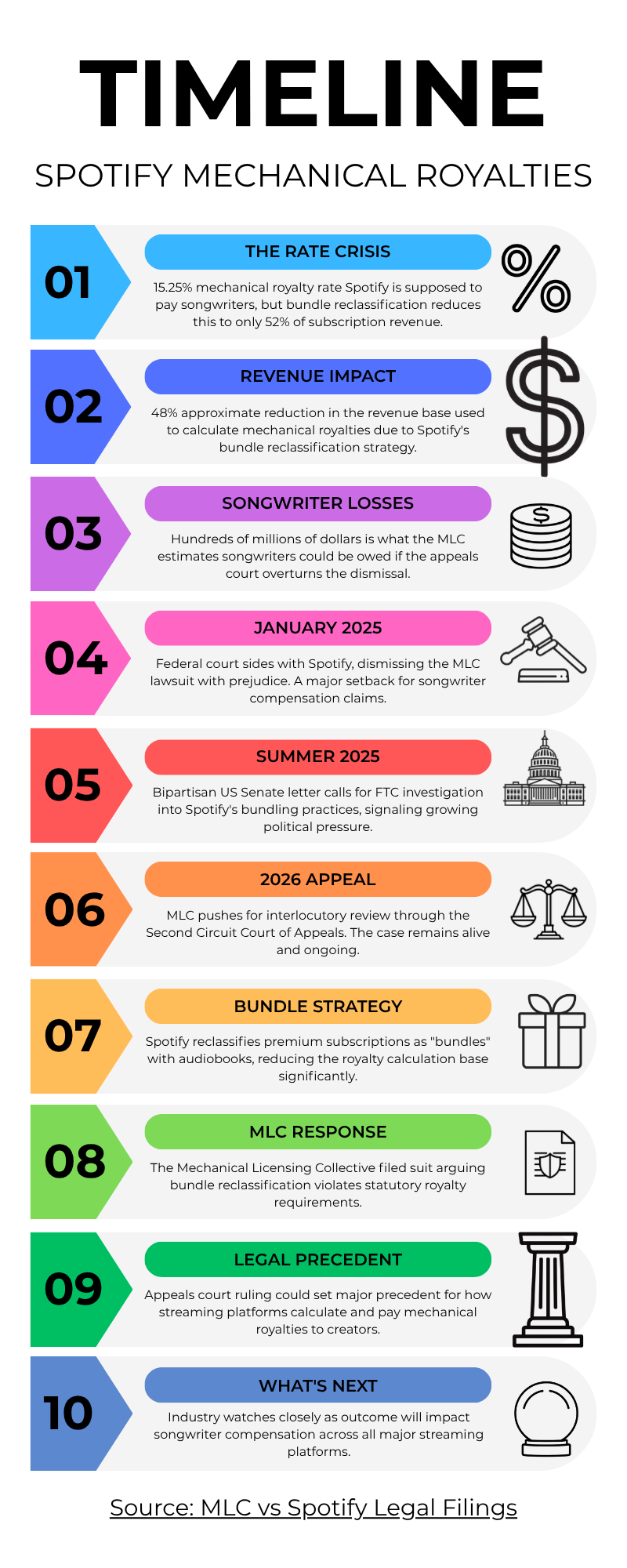
Spotify's decision in March 2024 to reclassify its Premium subscription tiers as bundles by adding audiobook access to music subscriptions triggered one of the most consequential royalty disputes of the streaming era. The reclassification was not a product development decision. It was a commercial and legal manoeuvre, executed with precise understanding of a specific provision in the Phonorecords IV mechanical royalty rate determination, which allows bundled services to calculate mechanical royalties on a reduced revenue base. By treating its music subscription as a bundle rather than a standalone music service, Spotify reduced the effective revenue base against which mechanical royalties are calculated from the full subscription price to approximately fifty-two percent of it. That is a reduction of nearly half, applied to every mechanical royalty payment made since March 2024, on a platform generating tens of billions in annual subscription revenue.
The specific mechanism matters because it illustrates how commercial reclassification achieves what direct rate negotiation cannot. Spotify did not ask the Copyright Royalty Board to reduce the mechanical royalty rate. The CRB process is public, adversarial, and subject to creator advocacy. Instead, Spotify changed the commercial structure of its product in a way that reduced the revenue base to which the existing rate applies, achieving a materially equivalent reduction in royalty payments through a definitional move rather than through a rate negotiation. The result for songwriters and publishers is the same: significantly less money for the same consumption of their work by the same subscribers paying the same subscription price.
The Mechanical Licensing Collective sued in 2024, arguing that the reclassification was unlawful under the existing rate determination framework. A federal court dismissed the case with prejudice in January 2025, ruling that Spotify's restructuring was lawful under the existing framework's terms. The MLC is now pursuing an appeal through the Second Circuit, arguing that if the bundling issue is not resolved at the appellate level, the entire question may need to be retried from scratch if it is later found to have been decided incorrectly at first instance. A bipartisan Senate letter in summer 2025 called for an FTC investigation into Spotify's bundling practices, reflecting Congressional concern that the existing regulatory framework is not equipped to respond quickly enough to commercial manoeuvres of this type.
The Structural Pattern
The Spotify bundling dispute is the most recent example of a pattern that recurs throughout the history of the music industry's relationship with commercial platforms, and understanding it as a pattern rather than as an isolated dispute is the difference between tracking a single legal case and understanding the commercial architecture that produces these disputes systematically.
The pattern is this: a platform uses technical or legal reclassification to reduce the royalty base it pays to creators without reducing the commercial value it extracts from creators' work. The streaming deals of the early 2010s reduced the effective per-play rate through minimum guarantees, equity arrangements, and most-favoured-nation clauses whose interaction with artist royalty calculations was not disclosed to artists at the time and was not fully understood until years of litigation and advocacy forced greater transparency. The bundle reclassification reduces the effective mechanical rate through a definitional manoeuvre that the existing regulatory framework did not specifically anticipate, in the same way that the streaming deals exploited a framework designed for physical media that did not specifically anticipate the commercial mechanics of subscription streaming.
In both cases the commercial logic is structurally identical. The platform has more legal resources, more time, more regulatory expertise, and more bargaining power than the individual creators whose work generates its revenue. The regulatory process that is supposed to protect creators, the CRB rate determination, the MLC oversight mechanism, the FTC investigation that may or may not proceed, operates on a timeline measured in years. The commercial manoeuvre that triggers the regulatory response operates on a timeline measured in months. The gap between when a platform changes its commercial structure and when the regulatory or legal processes designed to evaluate that change produce a binding outcome is the gap within which hundreds of millions of dollars in royalty value is transferred from creators to the platform. By the time the appeal is decided, Spotify will have been paying at the reduced rate for years. Whether back royalties will be owed, and to whom, and at what rate, is precisely what the Second Circuit appeal will determine.
The bundling manoeuvre is also significant because of what it reveals about the relationship between platform commercial strategy and the regulatory framework that is supposed to govern it. Spotify did not invent the bundle provision. It is a feature of the rate determination framework that was designed to address genuinely bundled services, not to allow a music platform to add a nominal additional service to a music subscription for the purpose of accessing a lower royalty rate on the music subscription. Whether the court ultimately finds that Spotify's use of the provision was within its intended scope or beyond it is a legal question. The commercial intent of the manoeuvre is visible in the public record. T-INK documents both.
The Implication
Any songwriter, publisher, or independent artist whose income depends on streaming mechanical royalties should be tracking the MLC versus Spotify appeal through 2026 with the same attention they give to their own royalty statements, because the outcome of that appeal will determine whether Spotify owes hundreds of millions in back royalties and will reshape how the MLC evaluates compliance across the entire streaming sector for years following the decision.
The broader structural implication extends beyond the specific case. The bundling dispute is a live demonstration of the operational intelligence that T-INK exists to provide: understanding how platforms use commercial reclassification to reduce creator income is not historical analysis of something that happened and was resolved. It is real-time intelligence about a process that is happening now and whose outcome is not yet determined. The window in which the outcome can be influenced, through the appeal, through Congressional pressure, through the FTC investigation that the Senate letter requested, is open. It will not remain open indefinitely. The creators who understand what is at stake are the ones positioned to engage with the process while engaging is still possible.
CLOSING NOTE: Every claim, figure, statistic, and institutional reference in this document is sourced from the public record and freely accessible information. T-INK Core Think Tank does not fabricate, exaggerate, or speculate beyond what the evidence supports. Full source attribution is available in the Reference Document for this series. This work is published in the public interest. Its purpose is intelligence. Its method is evidence.
EDITORIAL STATEMENT AND DISCLAIMER: This document is produced by T-INK Core Think Tank, the Creative and Cultural Intelligence engine of The Multiverse, for the purposes of education, analysis, and public understanding of the creative economy. Nothing contained in this document is intended to cause harm, create legal disputes, or target any individual or institution for personal attack. All figures, statistics, case references, industry data, legislative details, and institutional histories documented here are drawn entirely from public records, published reporting, official documents, regulatory filings, industry disclosures, academic research, and sources freely available and accessible in the public domain at the time of writing. No claim, figure, or statistic in this document has been fabricated or invented. Where disputes exist between accounts or where data is contested, those disputes and contestations are noted and the available evidence is presented without prejudice. Full source attribution is available in the Reference Document for this series. The purpose of this work is not to condemn but to document; not to inflame but to illuminate. The intelligence gathered here is public record. The analysis is ours. The conclusions are evidence-based.