SIG-002: Live Nation Settles

What the DOJ Deal Actually Changed and What It Left Intact
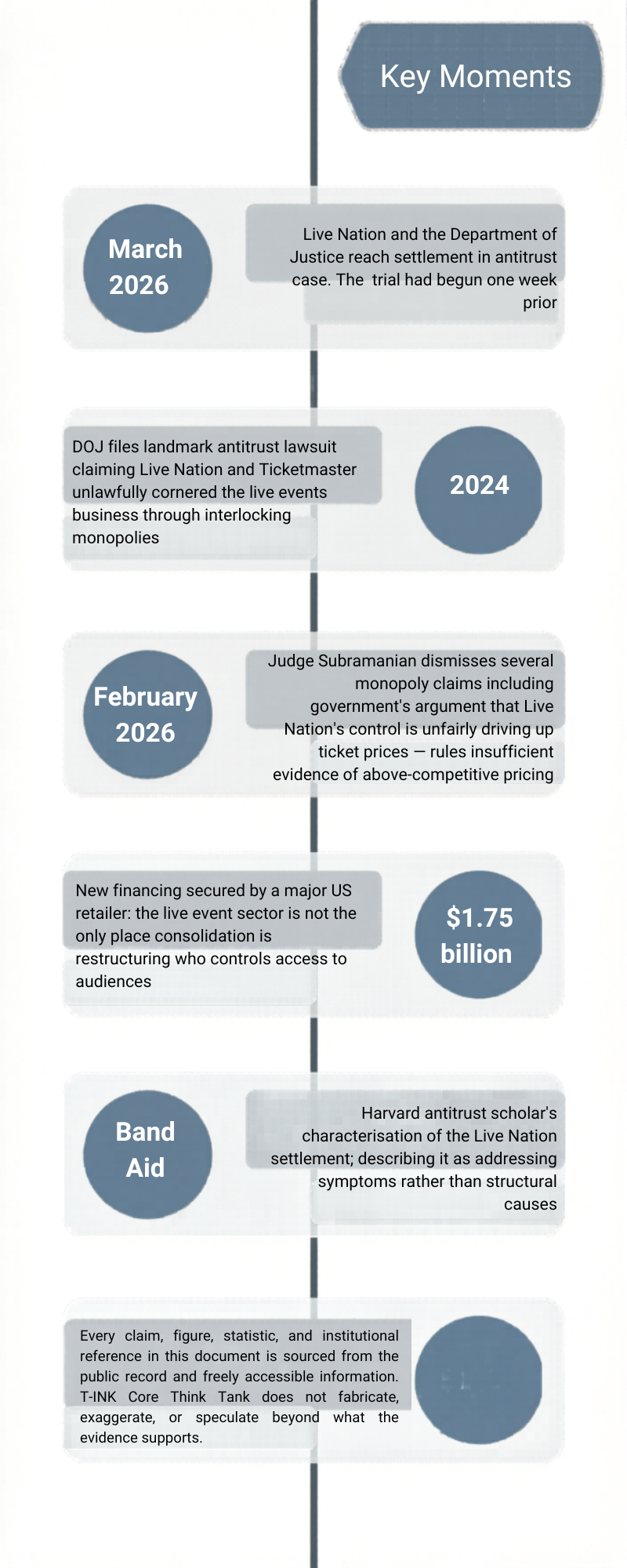
The Department of Justice filed the most significant antitrust lawsuit against the live entertainment industry in May 2024. In March 2026, one week into the trial, Live Nation and the DOJ reached a settlement. Here is what changed, what a Harvard antitrust scholar called just a Band Aid, and what the settlement reveals about who actually has power over the live music economy.
The Signal
The Department of Justice's antitrust lawsuit against Live Nation and Ticketmaster, filed in May 2024 alongside thirty state and district attorneys general, claimed that the two companies, merged since 2010, had unlawfully cornered the live events business through a series of interlocking monopolies covering venues, promotion, artist management, and ticketing simultaneously. The case was the most significant antitrust action against a live entertainment company in the history of the American music industry, and its scope reflected something important: the problem was not Ticketmaster's service fees. The problem was the vertical integration that put one company in control of the infrastructure that every touring artist in America depends on to reach their audience.
The trial began in a New York federal court in early March 2026. One week in, Live Nation and the DOJ reached a settlement. Live Nation confirmed the agreement while maintaining that it had consistently held the antitrust allegations to be without merit, which is the standard corporate formulation for settling a case you believe you could have won while avoiding the specific risk that a full trial might have produced. A Harvard visiting professor of antitrust law, speaking to the Harvard Gazette, described the outcome plainly: just a Band Aid. Addressing specific practices without touching the structural vertical integration that generated those practices in the first place.
The Structural Analysis
The Live Nation case matters to the creative economy not primarily because of what it does to ticket prices, though that matters to artists and audiences in direct and measurable ways. It matters because of what it reveals about the specific mechanism through which institutional consolidation extracts value from creative labour at scale, and because the settlement's limitations reveal exactly how much structural power the live entertainment monopoly retains despite the most significant regulatory challenge it has ever faced.
Live Nation controls approximately seventy percent of major venue capacity in the United States. Ticketmaster processes the majority of primary ticket sales for those venues. Live Nation's promotion arm manages many of the artists who perform at those venues. The three functions, venue control, ticketing, and artist promotion, operating under single ownership create a specific commercial dynamic that the settlement's antitrust scholars have identified: an artist who wants to tour at scale in the United States has no viable alternative to the Live Nation infrastructure at any stage of the process. The venue is Live Nation. The ticket system is Ticketmaster. The promotion may be Live Nation. The leverage that this vertical integration creates is not incidental to the business model. It is the business model.
The dynamic pricing that generated the Oasis reunion tour controversy in the United Kingdom in 2024, which a UK government watchdog found may have misled fans by advertising tickets at prices that the dynamic pricing system then increased substantially at the point of purchase, is not a technical glitch or a consumer relations failure. It is the commercial logic of a monopoly applied to a market where the buyer has no alternative and where the seller controls both the price and the information environment in which the buyer makes their decision. The practice attracted regulatory attention in the UK because the UK has a different regulatory architecture. The underlying commercial logic is the same on both sides of the Atlantic, and the DOJ settlement does not change that logic in any structural sense.
What the settlement changes is specific practices around bundling and consumer information disclosure. These are real changes and they are not meaningless. Consumers will receive clearer information about fees before they commit to a purchase. Certain bundling arrangements that made it difficult for venues to work with alternative ticket systems will be modified. These are improvements to the behaviour of the monopoly. They are not changes to the architecture that makes the monopoly possible.
The structural conditions that allowed Live Nation to build dominant control over the live entertainment infrastructure, specifically the 2010 merger of Live Nation and Ticketmaster, which the DOJ under a previous administration approved over the objections of artists, independent promoters, and consumer advocates who argued at the time that the merger would produce exactly the market dynamics the 2024 lawsuit subsequently alleged, remain entirely intact. The merger was the problem. The settlement does not undo the merger. It modifies some of the specific commercial practices that the merged entity developed. The Harvard antitrust scholar's Band Aid characterisation is not rhetorical. It is an accurate description of the relationship between the intervention and the structural condition being intervened upon.
The Implication
The Live Nation settlement is a case study in the difference between regulatory intervention and structural reform, and the distinction matters practically for every artist and manager building a touring strategy in the current environment.
Regulatory intervention changes behaviour within an existing structure. Structural reform changes the structure itself. The DOJ has achieved the former without the latter, and the consequences are specific. Artists who depend on Live Nation infrastructure for touring revenue, which is to say virtually every artist attempting to tour at scale in the United States, are operating in conditions that the settlement has marginally improved at the point of consumer-facing ticket purchase but that remain structurally unchanged in the ways that matter most to the artists themselves. The venue relationships, the promotion dynamics, the ticketing dependencies, and the specific leverage that comes from controlling the infrastructure at multiple points in the touring value chain simultaneously remain in place.
Understanding this architecture explicitly, rather than treating the settlement as a resolution of the structural problem it actually left intact, is the minimum required for any artist or manager making decisions about touring infrastructure, venue relationships, and the specific commercial leverage points that the settlement has and has not addressed. The behaviour has been modified. The architecture has not changed. Those are different conditions and they require different strategic responses.
CLOSING NOTE: Every claim, figure, statistic, and institutional reference in this document is sourced from the public record and freely accessible information. T-INK Core Think Tank does not fabricate, exaggerate, or speculate beyond what the evidence supports. Full source attribution is available in the Reference Document for this series. This work is published in the public interest. Its purpose is intelligence. Its method is evidence.
EDITORIAL STATEMENT AND DISCLAIMER: This document is produced by T-INK Core Think Tank, the Creative and Cultural Intelligence engine of The Multiverse, for the purposes of education, analysis, and public understanding of the creative economy. Nothing contained in this document is intended to cause harm, create legal disputes, or target any individual or institution for personal attack. All figures, statistics, case references, industry data, legislative details, and institutional histories documented here are drawn entirely from public records, published reporting, official documents, regulatory filings, industry disclosures, academic research, and sources freely available and accessible in the public domain at the time of writing. No claim, figure, or statistic in this document has been fabricated or invented. Where disputes exist between accounts or where data is contested, those disputes and contestations are noted and the available evidence is presented without prejudice. Full source attribution is available in the Reference Document for this series. The purpose of this work is not to condemn but to document; not to inflame but to illuminate. The intelligence gathered here is public record. The analysis is ours. The conclusions are evidence-based.