SIG-001: The AI Deal Nobody Read
How the Major Labels Structured AI Licensing to Repeat the Streaming Mistake
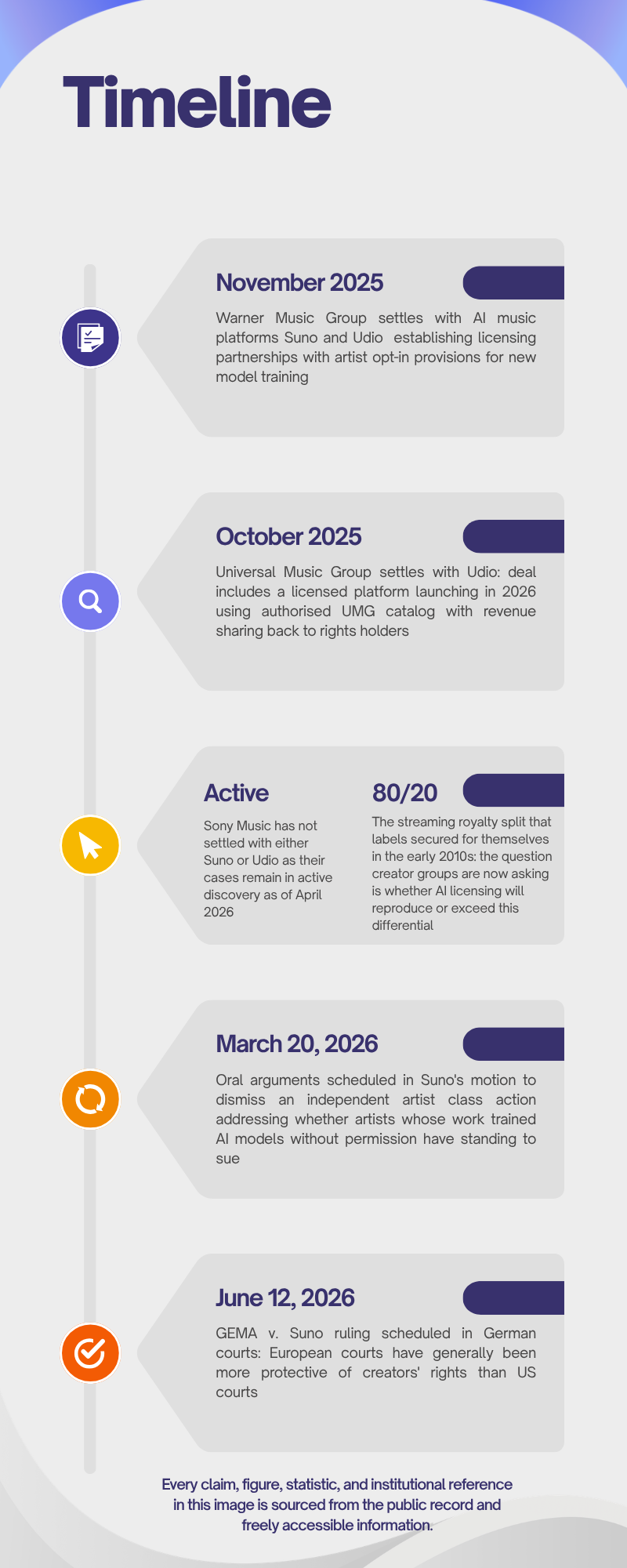
Warner settled with Suno and Udio in November 2025. Universal settled with Udio in October 2025. The deals were announced as historic milestones. The terms were not disclosed. Here is what the public record suggests about what those terms likely contain and why artists should be asking the same questions now that they failed to ask in 2009.
The Signal
The major label settlements with AI music platforms in the final quarter of 2025 represent the most consequential commercial negotiation in the music industry since the streaming deals of the early 2010s. Warner Music Group's settlements with both Suno and Udio in November 2025, and Universal's settlement with Udio in October, established the first commercial framework for how AI platforms will license music catalogues and how the resulting revenue will flow back to rights holders. Sony Music has not settled and continues in active litigation. The terms of the Warner and Universal settlements have not been publicly disclosed beyond broad characterisations, which is itself significant. The decision to announce the deals while withholding the terms follows a pattern that anyone who lived through the streaming era should recognise immediately.
The broad characterisations that have been disclosed are nonetheless telling. The Warner settlements established licensing partnerships under which new AI models would be trained on authorised catalogue with artist opt-in provisions. The Universal-Udio deal includes a licensed platform launching in 2026 that will allow users to create AI music using authorised UMG catalogue, with revenue sharing back to rights holders. Both settlements shift the commercial dynamic from pure litigation to commercial partnership, a move that mirrors exactly the sequence through which the streaming deals were negotiated between 2008 and 2012. At the time, that shift was described as the industry finding a sustainable model. What it actually produced was a sustainable model for labels. The sustainability of that model for artists took another decade of litigation, advocacy, and collective action to partially address, and it has not been fully addressed yet.
The Parallel That Matters
When streaming emerged as a commercial model in the late 2000s, the major labels negotiated equity stakes and per-stream rates with platforms including Spotify, Apple Music, and Tidal. The specific terms of those deals were not disclosed to artists. The rates that labels subsequently applied to pass streaming revenue through to artists were governed by existing recording contracts, which were written before streaming existed and which did not anticipate the commercial mechanics of a platform that pays fractions of a cent per play in perpetuity. The result was that labels captured the majority of streaming revenue generated by artists' recordings through a combination of the label's own streaming royalty rate and the pre-existing recoupment mechanics of recording contracts that had been designed for a physical product era and that applied to streaming revenue in ways most artists did not understand when they signed.
This was not illegal. It was contractual. And that is precisely the point. The streaming deal was structured at the label level, on terms artists had no visibility into, applied through contracts artists had signed years earlier without anticipating how those contracts would govern a revenue stream that did not yet exist. The artists whose recordings built the streaming economy are still, in many cases, receiving a fraction of what a more transparent and more equitable framework would have produced.
Creator groups including the Songwriters Guild of America and the Recording Academy have publicly flagged that the AI licensing deals are being structured through the same architecture. The specific questions they are raising, documented in reporting by Complete Music Update and Billboard in January 2026, are the right questions and they are being asked at the right moment, which is before the deals are fully settled and before the terms become the new industry standard that everyone will spend the next decade trying to renegotiate.
The questions are these. Whether AI licensing revenue will be split on the historical 80/20 streaming basis, which consistently favours the label, or on the 50/50 sync licensing basis, which is more equitable and which reflects the specific way that AI training use resembles synchronisation licensing rather than streaming consumption. Whether the payments will be allocated to individual recordings and songs, which allows artists to identify what their specific work generated, or pooled at the catalogue level, which makes individual accountability impossible and ensures the money flows to whoever controls the pool. What royalty rate labels will apply when distributing AI licensing revenue to artists under existing recording contracts, given that those contracts were not written to govern this type of use. And whether artists whose recordings were used to train AI models before the licensing deals were signed will receive any compensation for that pre-licensing use, which is the question that the ongoing class action proceedings are pressing most directly.
The Implication
The AI licensing deals being structured now will govern how AI-generated music revenue flows through the industry for the next decade, in the same way that the streaming deals structured between 2008 and 2012 governed streaming revenue for the following decade. The window in which artists and songwriters can meaningfully influence the terms of those deals is not approaching. It is now, and it is narrowing with each settlement announced.
The Recording Academy and Songwriters Guild are applying public pressure for transparency on the settlement terms. Independent artists whose recordings trained AI models without consent have a class action proceeding that reached oral arguments in March 2026. The GEMA ruling in Germany, expected in June 2026, may establish European legal precedent that alters global platform policies in ways that no commercial settlement between a US label and a US platform can prevent.
The streaming mistake was not made because nobody understood what was happening. It was made because the people who understood what was happening were the labels and the platforms, the artists were not at the table, and by the time the terms were visible it was too late to change them without litigation. The AI deals are being made right now, and the public record is available. Every creator working in recorded music should be tracking these proceedings with the same attention they give to their own contracts, because what is being decided in these conference rooms and courtrooms is the commercial architecture of the next era of the music industry. It will be very difficult to renegotiate once it is set.
CLOSING NOTE: Every claim, figure, statistic, and institutional reference in this document is sourced from the public record and freely accessible information. T-INK Core Think Tank does not fabricate, exaggerate, or speculate beyond what the evidence supports. Full source attribution is available in the Reference Document for this series. This work is published in the public interest. Its purpose is intelligence. Its method is evidence.
EDITORIAL STATEMENT AND DISCLAIMER: This document is produced by T-INK Core Think Tank, the Creative and Cultural Intelligence engine of The Multiverse, for the purposes of education, analysis, and public understanding of the creative economy. Nothing contained in this document is intended to cause harm, create legal disputes, or target any individual or institution for personal attack. All figures, statistics, case references, industry data, legislative details, and institutional histories documented here are drawn entirely from public records, published reporting, official documents, regulatory filings, industry disclosures, academic research, and sources freely available and accessible in the public domain at the time of writing. No claim, figure, or statistic in this document has been fabricated or invented. Where disputes exist between accounts or where data is contested, those disputes and contestations are noted and the available evidence is presented without prejudice. Full source attribution is available in the Reference Document for this series. The purpose of this work is not to condemn but to document; not to inflame but to illuminate. The intelligence gathered here is public record. The analysis is ours. The conclusions are evidence-based.