PART 01 - TLC
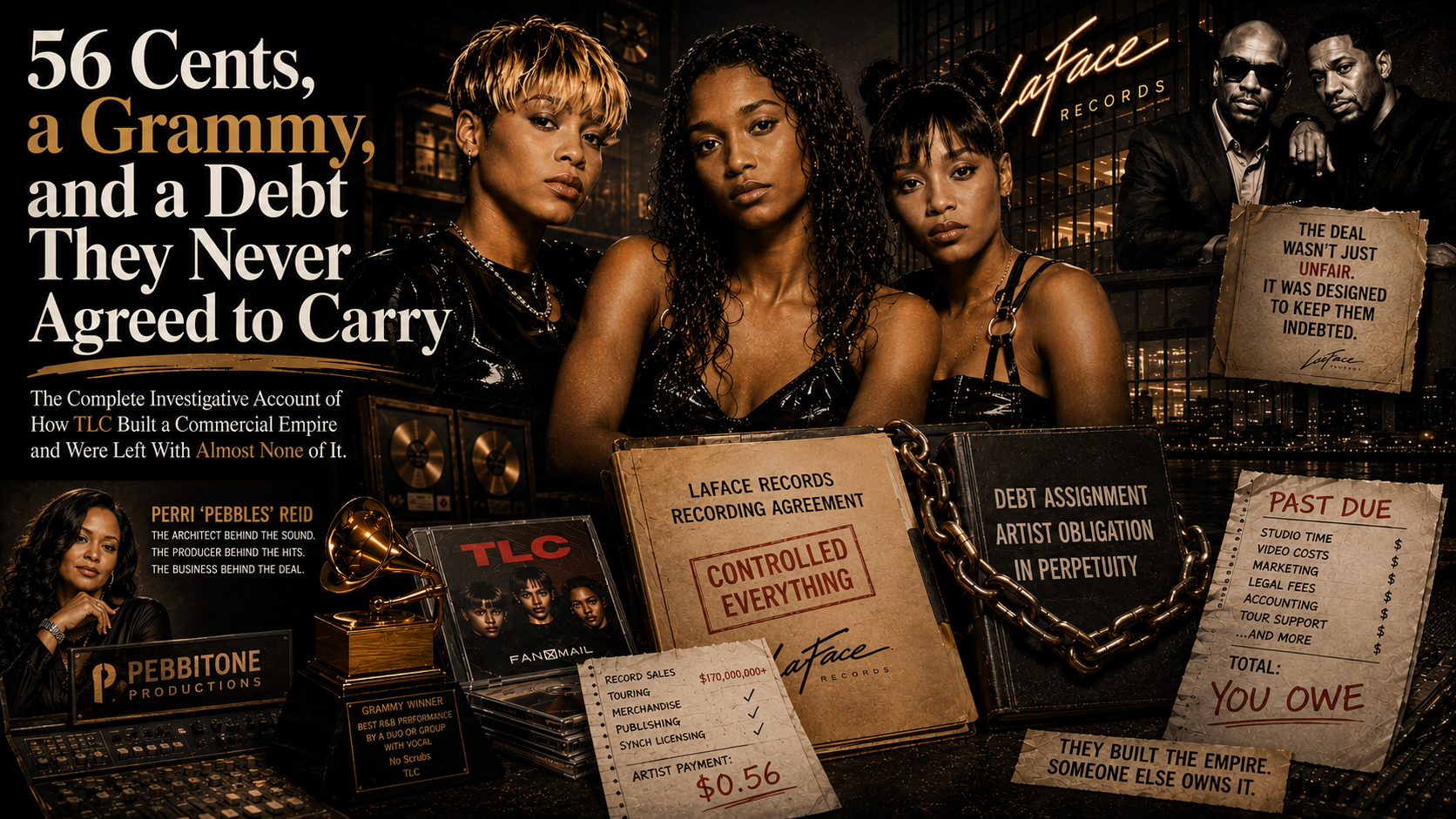
56 Cents, a Grammy, and a Debt They Never Agreed to Carry
The Complete Investigative Account of How TLC Built a Commercial Empire and Were Left With Almost None of It.
[THE LEDGER | AUDIT]
Investigative Standard & Intent This document is a product of The Multiverse and is grounded in Structural Imagination. The following analysis is a forensic examination of systems and architectures; it is not intended to target or attack any specific individual, institution, or company.
Every claim, figure, and contract term presented is drawn exclusively from verified public records and is fully attributed in the Reference Documents archive. This work is for the purposes of education, analysis, and civilisational record.
The Grammy Moment and What It Actually Meant
When Tionne 'T-Boz' Watkins, Lisa 'Left Eye' Lopes, and Rozonda 'Chilli' Thomas walked to the Grammy microphone in February 1996 holding awards for Best R&B Album, they were standing at the absolute commercial pinnacle of the American music industry. CrazySexyCool had become the only album by a female group to ever receive diamond certification, selling fourteen million copies worldwide, and that evening TLC had just collected two Grammys. The cameras captured the glow of recognition and the shine of achievement that the industry's most prestigious stage was designed to project. What they did not capture, and what no one in that room who ran the machinery of the music business was prepared for, was what Chilli said next into the microphone: that they were broke.
She didn't say they were "struggling" or navigating a "difficult period." She didn't make it sound like they were simply in transition between albums. Broke. Those were her words, and I still remember them as clear as day, even as young as I was then. I didn't fully understand the weight of it until I came across the video again earlier this year. She bluntly told the world they were broke. As broke as broke can be, in her exact words, spoken without apology or performance of shame, spoken as a factual description of the relationship between three of the most commercially successful musicians on the planet and the money their work had generated.
The public confusion that followed was immediate, enormous, and entirely predictable, because the industry had spent decades perfecting the infrastructure that made what Chilli said simultaneously true and unspeakable. The Grammy stage was one of the few public spaces large enough and prestigious enough to ensure the statement could not be suppressed or ignored. TLC used it. In doing so, they forced the architecture of extraction into direct contact with the light of public scrutiny.
This document is the complete account of how TLC's financial situation came to be, how the structures that produced it were built, who built them, what they extracted, what TLC fought to recover, and how the same essential mechanisms, refined and made more sophisticated by three additional decades of practice, continue operating against music artists in 2026. It is investigative in its sourcing, analytical in its framing, and unapologetic in its moral position: what happened to TLC was not an accident, not an anomaly, and not primarily the result of personal decisions made by young women who did not understand business. It was the designed outcome of a system built to ensure that the people generating value received as little of it as the law permitted.
II. The Foundation Was Already Rotten Before They Signed
Race Records, Fifty-Dollar Buyouts, and the Template That Never Changed
To understand what happened to TLC, you must first understand that the recording industry's relationship to its artists was never intended to be equitable. The earliest commercial recordings of Black music in America were made under conditions that would constitute fraud in almost any other commercial context.
Labels creating what were then known as race records in the 1920s and 1930s understood that Black musicians could generate significant commercial income and deliberately structured their transactions to prevent those musicians from benefiting materially from the value they created. While Black songwriters were being paid twenty-five dollars for complete and permanent ownership of their songs and sound recordings, their white counterparts were negotiating contracts worth up to one hundred thousand dollars annually with royalty provisions attached.
Chuck Berry spent decades in litigation to reclaim authorship credit for his own song 'Maybelline' after a radio disc jockey and the landlord of his record label were added as co-writers and given a share of his royalties without his knowledge or consent. Little Richard sold the publishing rights to 'Tutti Frutti' permanently for fifty dollars. Bessie Smith, the Empress of the Blues, negotiated flat-fee deals with her record label rather than royalty arrangements, which meant that as her recordings continued generating income across decades, she received nothing beyond the initial payment. Robert Johnson, whose influence on blues and rock music is foundational to the entire modern popular music industry, died penniless. These are not anomalies at the edges of the industry's history. They are the template from which every subsequent generation of recording contracts was constructed.
What changed across the following decades was not the fundamental orientation of the contract but its legal sophistication. As civil rights legislation evolved and the cultural visibility of Black artists grew through the 1960s and 1970s, the crude mechanisms of the early industry required updating. The fictitious co-writer credit, the flat-fee buyout, and the outright theft of publishing rights were replaced with contractual structures of considerable legal complexity that achieved the same outcome through mechanisms that appeared, on their surface, to be standard commercial arrangements. The advance against royalties. The recoupment provision. The production deal layered beneath the recording contract layered beneath the distribution agreement. These were the modernised successors to the fifty-dollar publishing buyout. They worked on the same principle. They were simply much harder to see.
"None of the major labels would even be standing if the business were fair." — Industry A&R executive, speaking anonymously to Rolling Stone, 2020
The Chain of Command: Designed to Drain
TLC's story begins not in a recording studio but in a hair salon in Atlanta. Through a connection made while T-Boz worked there, the group arranged an audition with singer Perri 'Pebbles' Reid, who had recently formed her own management and production company called Pebbitone. Pebbles was not simply an independent manager who liked their sound. She was the wife of Antonio 'L.A.' Reid, one of the co-founders and chief executives of LaFace Records, the Atlanta-based label that was becoming one of the most significant imprints in R&B. She was, in the language of the industry, connected. That connection was precisely what made her simultaneously useful to TLC and catastrophic to their financial future.
On February 28, 1991, T-Boz and Left Eye, who were nineteen and twenty years old respectively, signed production, management, and publishing deals with Pebbitone. They were given no independent legal representation. The attorneys who explained the contracts to them were Pebbles's attorneys. They were not provided copies of the contracts to take home and review. They signed on the same day they were presented with the documents, under time pressure, with the eager urgency of young people who had been waiting their entire lives for exactly this kind of moment. What they signed gave Pebbitone ownership of the name TLC, which Pebbles had created, and placed TLC in a deal structure in which they were signed to LaFace not directly but through Pebbitone as the intermediary production company.
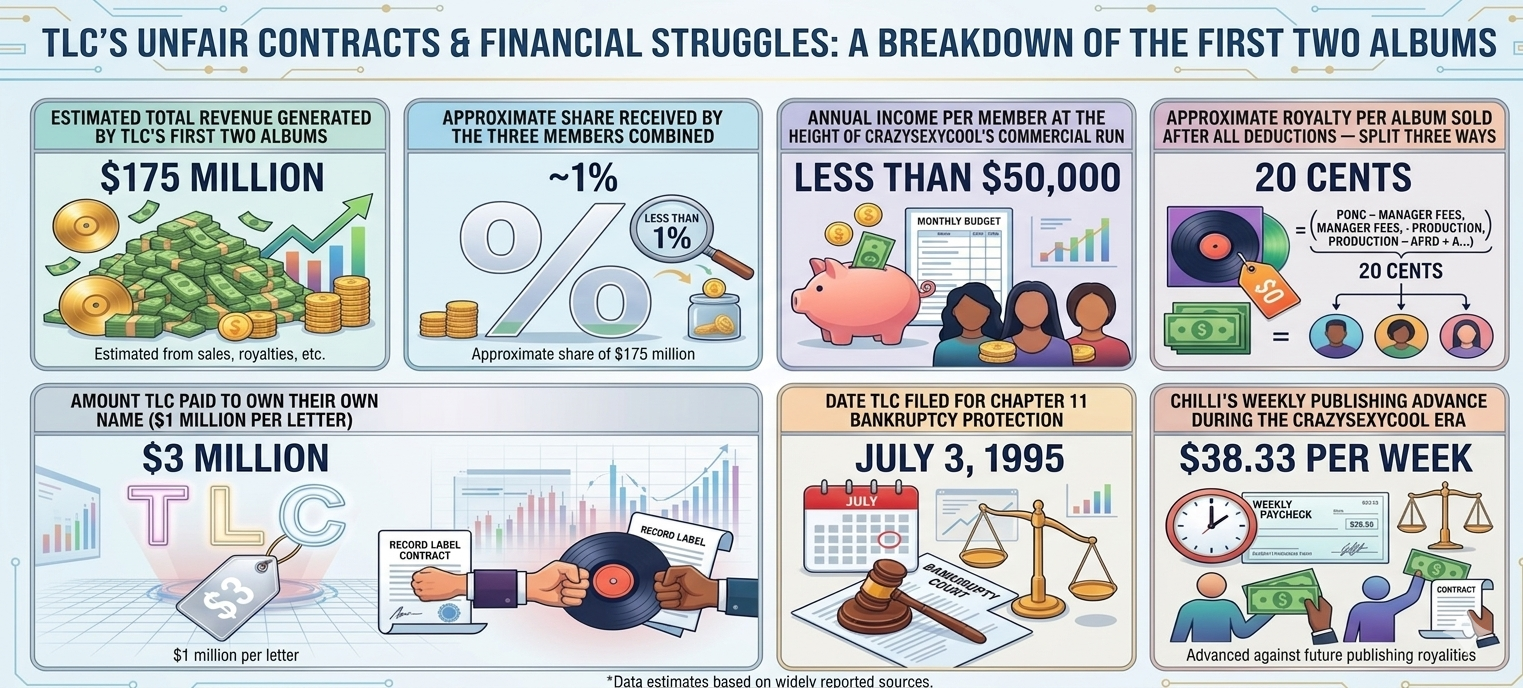
This layering is the architectural key to everything that followed. A typical major label deal positions the artist at one remove from the parent company, receiving a royalty percentage after the label recouped its costs. TLC's deal positioned them at a minimum of two removes, with Pebbitone sitting between them and LaFace and extracting its own substantial share from whatever passed through that channel. Court documents that emerged during the Viacom defamation litigation confirmed the precise figures: Pebbitone was entitled to fifty percent of TLC's royalties and advances from their share of earnings. From the publishing advance, Chilli received thirty-eight dollars and thirty-three cents per week. T-Boz and Left Eye each received eighty-five dollars per week. Even those amounts were reduced further, because Pebbles docked portions from members for infractions such as cursing.
The full chain of command governing TLC's financial relationship to their own work looked like this: Arista Records, the parent company and distributor, took its percentage from the top. LaFace Records, the imprint label, took its percentage as the recording label. Pebbitone, the production company, took fifty percent of what remained from TLC's contractual share. Managers, lawyers, accountants, and taxes then took their further portions from whatever was left after that. Every link in that chain was extracting value before any of it reached the three women whose voices, creative energy, artistic identity, and cultural significance were generating all of it in the first place.
III. The Recoupment Engine: How Success Became Debt
The single most important mechanism in the architecture of music industry exploitation is a concept called recoupment, and it operates with a logic so perfectly inverted from ordinary commercial fairness that it requires deliberate unpacking to be understood. Under the standard recording contract structure that governed TLC's deal, the label pays an advance to the artist before recording begins. This advance is categorised not as compensation or salary but as a loan against future royalties. The label also pays for recording costs, music video production, promotional campaigns, tour support, styling, travel, accommodation, and a wide range of other expenses that are similarly categorised as recoupable amounts, meaning they must all be repaid from the artist's future royalty income before the artist sees any payment at all.
The critical detail that transforms this from a legitimate commercial arrangement into a structural trap is that the label controls three things simultaneously: what counts as a recoupable expense, how much each expense is valued, and how quickly the promotional machinery moves to generate revenue that might repay those expenses.
TLC's 1991 contract specified a royalty rate of seven percent of album sales. Seven percent sounds like something real and meaningful until you understand that it was applied not to gross revenue but to a net figure calculated after the label had deducted every expense it chose to attribute to the CrazySexyCool campaign. The practical result was a royalty rate of approximately twenty cents per album, which was then split three ways, delivering each member roughly six to seven cents for every copy of the album that sold.
CrazySexyCool sold fourteen million copies. The mathematics of what that should have generated at any reasonable rate of compensation versus what it actually generated for each member of TLC represents one of the starkest illustrations of structured extraction in the history of the popular music industry.
At twenty cents per album split three ways, each member received approximately seventy-three cents in combined royalties for every three copies sold. For fourteen million total copies, the group collectively received roughly 2.8 million dollars in royalties before Pebbitone took its fifty percent, leaving approximately 1.4 million dollars to be split three ways before taxes, lawyers, accountants, and managers took their further shares. Three women who had built the most commercially dominant girl group in American history collectively received roughly the economic equivalent of what a moderately successful mid-level regional executive might earn over the same period.
"The more successful the album became, the more they were in debt." — Wikipedia documentation of TLC's testimony about their contract structure
What made the recoupment mechanism especially insidious in TLC's specific situation was the relationship between their success and their debt. Under the contract structure they were bound by, the more successful CrazySexyCool became, the more promotional activity the label generated around it, the more international touring was scheduled, the more magazine shoots were arranged, and every single one of those activities was billed back to TLC's recoupment account as an expense that had to be repaid before royalties could flow. Their extraordinary success generated an extraordinary promotional campaign, and that campaign generated an extraordinary debt that kept them perpetually in the red. As their testimony later confirmed: they had signed a contract under which the more successful they became, the more they owed.
IV. Pebbles, the Conflict of Interest, and Owning the Name
Lisa Lopes said something important about the Pebbitone contract in the VH1 Behind the Music documentary that deserves to be taken at face value rather than filtered through a narrative of villainy or victimhood. She said the deal they signed was not a good or a bad deal but the type of deal new artists get, and that the problem was that Pebbles had them signed to so many deals simultaneously. This is a precise and analytically useful description of the structural problem. The deal TLC signed was the type of deal new artists get because the industry had constructed an ecosystem in which the type of deal new artists get was specifically designed to benefit everyone in the chain above them.
Pebbles was simultaneously TLC's manager, the owner of the production company through which they were signed to LaFace, the creator and legal owner of their name, the person who had made the introduction to LaFace, and the person whose then-husband ran LaFace. She controlled access to the label, she owned the production deal through which they reached the label, she owned the name under which they would build their entire career, she held a fifty percent ownership of their earnings as the production company, and she directed them to attorneys who also represented her. Every institutional relationship TLC had to an industry that was supposed to serve their interests ran through someone whose financial interests ran in a fundamentally different direction from theirs.
In the Viacom memo submitted during the subsequent defamation litigation, the document noted that at the time TLC signed the Pebbitone contracts, they were nineteen and twenty years old with virtually no professional experience and no sophisticated personal or family advisors. The memo further observed that traditionally a manager is a key consultant to guide and advise young artists in contract decisions, and that as Pebbles herself had acknowledged, record contracts are put forth to confuse everybody. The person who was supposed to protect them from confusion was the primary architect of the confusion. The legal system allowed it to happen because the contracts were signed by adults who were technically of legal age, even though they had no legal counsel, no independent advice, no copies of the documents they signed, and no meaningful understanding of the multi-layered extraction mechanism they were entering.
The three million dollars TLC eventually paid to reclaim ownership of their own name, one million dollars per letter is the detail that consistently generates the most visceral public reaction, and the reaction is entirely proportionate to the reality. Pebbles owned the name TLC because the management contract she had them sign at the beginning of their careers contained a clause making that possible. They could not simply fire her and walk away. They could not keep performing under the name that had made them famous without paying her for the right to do so. The name that they had built into a cultural monument through years of their own creative labour, the name that was associated with their voices, their faces, their artistic decisions, and their cultural impact, belonged to someone else as a consequence of a contract they signed as teenagers with no independent legal advice.
V. The Bankruptcy, the Grammy Statement, and the Fight to Survive
TLC filed for Chapter 11 bankruptcy protection on July 3, 1995. The filing listed debts totaling $3.5 million, including insurance payments arising from the arson incident involving Left Eye and Andre Rison, medical bills relating to T-Boz's sickle cell anaemia diagnosis, and most significantly, the accumulated weight of contract structures that had left them each earning less than fifty thousand dollars annually despite generating commercial success that had made hundreds of millions of dollars flow through the industry surrounding them. LaFace Records and Pebbitone both contested the filing, arguing publicly that TLC simply wanted more money and were in no real financial danger. The bankruptcy court, having examined the actual financial evidence, concluded in a published decision that the members of TLC had filed in good faith as they were each experiencing genuine financial problems.
When Chilli stood at the Grammy podium in February 1996 and said they were as broke as broke can be, she was not making a strategic media intervention. She was telling the truth about what it felt like to hold a Grammy in your hand and know that the award represented the commercial success of an enterprise from which you personally had been almost entirely excluded. The statement landed in the room and in the culture with the force of something thrown deliberately through a window, not because it was designed to, but because it was true and because the industry had invested enormous institutional energy in ensuring that truth was never spoken in public by someone with the profile to make it matter.
After two years of legal proceedings, TLC settled with LaFace and Pebbitone. The settlement allowed them to exit the Pebbitone contract and renegotiate directly with LaFace. The renegotiated deal was better. But better than exploitative is, as one observer noted, still a relatively low bar. The three million dollars to buy back their name came out of these settlement proceedings. They paid it. They paid one million dollars per letter for a name that had been made famous entirely through their own artistry and labour, under a contract clause that no one had explained to them and that an independent attorney would very likely have advised them to refuse.
Left Eye Lopes died on April 25, 2002, in a car accident in La Ceiba, Honduras, at the age of thirty. She was on a spiritual retreat she had been documenting with a handheld camera. She was driving a rented Mitsubishi Montero SUV when she swerved to avoid an oncoming truck and lost control. She was the only person in the vehicle not wearing a seatbelt. She was the member of TLC who had been most vocal about the financial injustice they had endured, who had gone furthest in laying out the mathematics of what they were receiving versus what the industry was taking, and who had been most explicit in naming the system rather than simply describing its effects. She was thirty years old, working on a solo album, working on a fourth TLC album, and working on a documentary about the Garifuna people of Honduras when she died. The industry she had fought released a statement. The fans held candlelit vigils. The contracts that had shaped her financial life did not change.
VI. The LaFace Pattern: Toni Braxton and the Repetition of the Identical Structure
What makes the Toni Braxton case essential to any complete understanding of TLC's situation is not that it is a similar story. It is that it is the same story, at the same label, under the same contract architecture, in the same period, involving an artist who had access to TLC's public statements about their financial situation and was still unable to escape the mechanism. Braxton's debut album for LaFace Records and Arista Records climbed to number one on the Billboard 200 and sold 1.7 million copies in its first four months. By the time her financial situation was publicly examined, the album had generated an estimated $170 million in sales. Braxton's royalty check from that first recording contract was $1,972.
One thousand nine hundred and seventy-two dollars in royalties from a $170 million commercial enterprise. Braxton later confirmed in multiple interviews that she was earning thirty-three cents per album sold, and that the label had repeatedly refused to renegotiate her rate upward in two successive contract negotiations despite her being one of the most commercially successful artists on their roster. She filed for Chapter 7 bankruptcy in 1998. LaFace filed a countersuit citing breach of contract. The judge at one point asked Babyface, one of the label's co-founders, directly whether Braxton's deal was fair. Babyface acknowledged under oath that if he had sold the records she had sold under those contract terms, no question, it was not fair.
Braxton observed in a later interview with Black Enterprise that after TLC had spoken publicly about their bankruptcy, the label had prohibited other LaFace artists from discussing their own financial situations. TLC had broken a silence. The industry response was to rebuild that silence explicitly, contractually, and in writing. Braxton said the issue eventually went all the way to Congress around the question of bankruptcy law and recording contracts, specifically the provision that kept recording artists bound to their contracts even when they filed for financial protection, a carveout that existed in no other commercial contract category. Every other profession could discharge or restructure its obligations through bankruptcy. The recording artist, uniquely, could not.
VII. The 2026 Continuation: How the Structure Evolved and Got Worse
The 360 deal is the music industry's formal admission that the traditional contract structure it had perfected over decades was no longer sufficient to guarantee the extraction rates it had built its financial model around. When streaming devastated physical album sales beginning in the mid-2000s, labels faced a genuine revenue crisis. Their response was not to find new efficiencies or to share more equitably with the artists whose work was generating whatever revenue remained. Their response was to expand the surface area of their contractual claims over every dimension of the artist's professional existence.
Under a 360 deal, a label receives a percentage of everything an artist earns in connection with their career as an entertainer: record sales and streaming revenue, concert income, merchandise sales, endorsement deals, licensing placements in film and television and advertising, money from writing songs for other artists, and in many cases income from acting work or other entertainment-adjacent activities. The label's argument for this expansion is that it invests more heavily in developing the artist's career across multiple dimensions and therefore deserves to participate in all the revenue streams that investment helps create. The artist's experience is that they have signed a contract giving a corporation a permanent tax on their entire professional existence in exchange for an advance that functions as a loan they may spend years or decades repaying.
Under standard 360 deal mathematics, labels retain between fifty and eighty-five percent of streaming revenue and deduct expenses including marketing and production before calculating the artist's share. Only 1.7 percent of Spotify artists earn more than fifty thousand dollars per year. Artists earn between three-tenths and half a cent per stream, meaning that repaying a one million dollar advance requires approximately 1.2 billion streams. The Big Three labels, Universal Music Group, Sony Music, and Warner Music, control approximately seventy percent of global recorded music revenue and negotiated equity stakes in Spotify itself before the platform launched publicly, ensuring that even as streaming replaced physical sales, the major labels were positioned to benefit from the transition in ways that bypassed the artists whose music was driving the streaming numbers.
Megan Thee Stallion signed with 1501 Certified Entertainment in 2018, reportedly for a ten-thousand-dollar advance, a figure described by industry observers as well below standard. The deal was structured as a 360 agreement. She later sued the label for fraud, breach of contract, and negligent misrepresentation, accusing them of preventing her from releasing new music and refusing to renegotiate. Lil Wayne sued Cash Money Records for fifty-one million dollars in 2015, citing unpaid royalties and the label's refusal to release his album for seven years after its completion. Megan Thee Stallion in 2020. Lil Wayne in 2015. TLC in 1995. The mechanisms were updated with each decade. The fundamental experience of the artist, generating value while being systematically excluded from sharing it equitably, did not change.
VIII. What TLC's Story Actually Means
TLC's financial story is sometimes framed as a cautionary tale about the importance of reading contracts before signing them. This framing is not wrong, but it is dangerously incomplete, because it locates the problem and therefore the solution primarily with the artist rather than with the structures designed to exploit the artist. Nineteen-year-olds without legal representation who are presented with complex multi-party contracts by the person who is simultaneously their manager, the owner of the production company through which they will be signed, and the person who controls access to the label they want to sign with, are not in a position where better personal decision-making would have produced a materially different outcome. They are in a position where the system has been designed to prevent a materially different outcome.
The more accurate framing is this: TLC entered an industry that had been constructed over more than a century on the principle that the people generating value should not be the primary holders of it. They were young, Black, female, without legal counsel, and eager for the opportunity they were being offered, which made them precisely the kind of artists the system was optimised to exploit. Their talent was extraordinary. Their commercial achievement was historic. The system extracted almost all of the financial value of both and distributed it upward through a chain of institutions and individuals who contributed far less to the creation of that value than the three women it left with less than fifty thousand dollars each per year.
That Chilli stood at the Grammy podium and said what she said is not just an act of personal courage, though it was that. It is one of the most important moments of public truth-telling in the history of the music industry, because it forced a system built on opacity into a moment of visibility that could not be controlled. The industry responded by silencing other artists on its roster. TLC responded by fighting for three years and paying three million dollars to own their own name and renegotiate their contract. Left Eye responded by doing the mathematics publicly, by name, in interviews, until she died in 2002. T-Boz and Chilli have been fighting ever since, including the 2017 Kickstarter campaign to fund their final album because the mechanisms of the industry they had spent their careers inside had left them without the resources to fund it themselves.
The architecture of extraction that TLC's case exposed is still standing in 2026. It has been renovated, extended, given new legal language, and applied across new technological platforms. But the foundation is the same foundation. The principle is the same principle. The artists at the end of the chain are still the people who receive the least of what they create and the Grammy stage remains one of the few places large enough to make that visible to the world.
Continued in Part 02: Toni Braxton - One Thousand Nine Hundred and Seventy-Two Dollars.
EDITORIAL STATEMENT & LEGAL DISCLAIMER
Standard of Evidence
This document is produced by The Multiverse as an analytical and educational component of The Ledger: Sound and Fury. All arguments, models, and case studies are grounded in documented evidence, including public records, legal scholarship, sworn testimonies, and global financial disclosures. All data is cross-referenced with the Series Research Reference Document held in our archives.
Legal Notice & Intent
- Structural Imagination: The purpose of this work is education, analysis, and Structural Imagination. It is not designed to attack any specific name, institution, or company.
- No False Claim of Implementation: No claim is made that any specific individual or organisation will implement the solutions or frameworks proposed.
- Non-Advisory: This work does not constitute legal or financial advice.
- Methodology: Illustrative examples are clearly labeled, and every solution proposed is grounded in historical or legal precedent.
- Liability: The Multiverse assumes no liability for actions taken based on this analysis; the work of building a different creative economy begins with the knowledge that one is possible.