KENTE AND THE QUESTION OF INTELLECTUAL PROPERTY
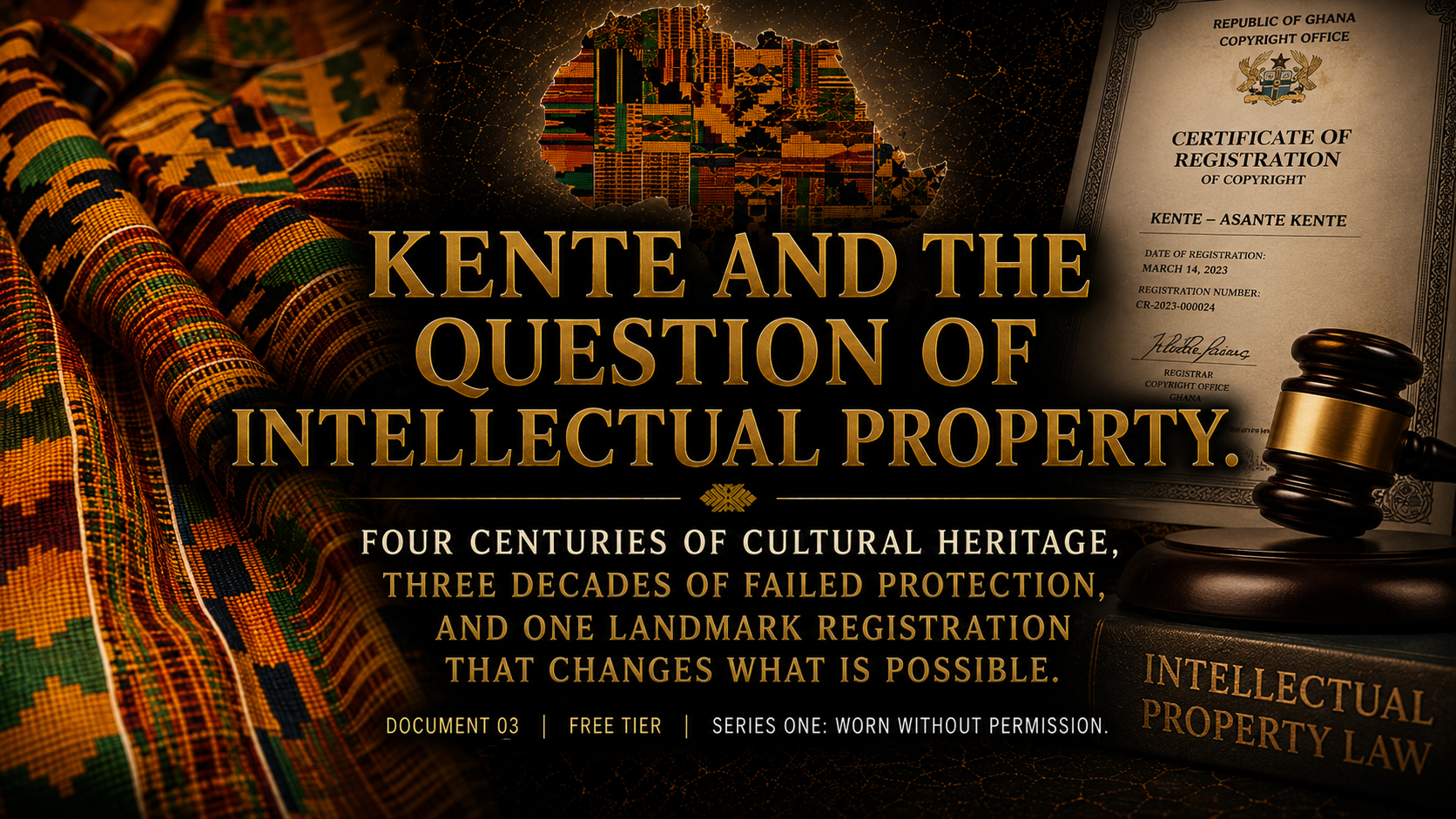
Four Centuries of Cultural Heritage, Three Decades of Failed Protection, and One Landmark Registration That Changes What Is Possible
Document 03 | Free Tier | Series One: Worn Without Permission
EDITORIAL AND LEGAL DECLARATION The Multiverse | The Cloth and the Crown | Worn Without Permission Publication context. This document is published by The Multiverse, a brand of L’El-Roi Global Ltd, registered in England and Wales. It constitutes Document 03, Free Tier, of Worn Without Permission, Series One of The Cloth and the Crown strand. Nature of this publication. This document constitutes investigative journalism and analytical commentary on matters of significant public interest concerning the intellectual property history and current legal status of Kente cloth. All claims about the Kente GI registration, the Swiss-Ghana IP Cooperation Project, Ghana’s Geographical Indications Act and the legal framework are based on publicly available official documentation, academic scholarship and published journalism. All claims about the wax print market, Chinese textile competition and Vlisco are based on published journalism and market analysis. Intellectual property and editorial independence. The analytical framework and original editorial content of this document are the intellectual property of L’El-Roi Global Ltd. The Multiverse is funded entirely by reader subscriptions. |
Kente Was Always Property. The Question Was Whose.
In the Ashanti Kingdom, Kente was not merely culturally significant. It was legally regulated. The Asantehene’s court issued specific decrees determining which patterns could be worn by whom, at which ceremonies and for what purposes. The pattern called Oyokoman Adweneasa, which translates roughly as All Motifs Are Used, was reserved for royalty at the highest occasions and communicated the fullness of the monarch’s authority through its visual complexity alone. The pattern called Emaa Da communicated moral prohibition in cloth. Wearing a pattern above one’s rank was not a fashion offence. It was a violation of the social and political order and carried consequences accordingly. The weaving communities of Bonwire, Adanwomase and the surrounding villages of the Ashanti and Ewe peoples were not simply craftspeople producing beautiful objects. They were the custodians of a semiotic system through which Ghanaian social life was conducted, relationships were formalised and power was communicated across a kingdom.
The question that the nineteenth century colonial encounter created, and that the twentieth and twenty-first centuries have spent negotiating in international bodies from Geneva to Doha, is whether the legal system that replaced the Ashanti Kingdom’s governance of its own heritage would recognise what that kingdom had always understood: that a weaving tradition developed and regulated by a specific community over four centuries is property, that property has owners, and that owners have rights over how their property is commercially used. The answer the international IP framework provided for most of the twentieth century was no, not because the framework examined Kente and found it wanting, but because the framework was built for different subjects in a different world. The Berne Convention protects individual authors. The Paris Convention protects individual inventors. TRIPS protects the commercial interests most effectively represented in the Uruguay Round negotiating rooms of 1993 and 1994. None of these instruments were designed to protect a weaving tradition held collectively over four centuries by communities whose relationship to their own creative inheritance was rooted in communal cultural sovereignty rather than individual commercial ownership.
The Ashanti Kingdom regulated Kente’s use through law for centuries. The international IP system spent most of the twentieth century unable to extend that protection because the system was built for individual authors and inventors, not for communities whose creative heritage is held collectively. The September 2025 GI registration is the moment that gap begins, formally, to close.
This document tells the specific story of how Ghana, the Kente weaving communities of the Ashanti and Volta Regions, WIPO’s Africa Division and the Swiss-Ghana IP Cooperation Project spent eight years building the legal instrument that the international framework’s gaps had made unavailable. It names the three specific threats that made the work urgent, examines precisely what the GI registration achieves and where its current limits lie, and uses the Champagne comparison not as a statement of aspiration but as an analytical tool for identifying exactly what structural work remains.
The Three Threats That Made Protection Urgent
Threat One: The Luxury Displacement Mechanism
When a luxury house releases a collection drawing on Kente visual language, the commercial harm to the Kente weaving communities operates through a specific mechanism that is worth naming precisely: it is not simply appropriation of revenue. It is active displacement of the market that authentic Kente production depends on. Louis Vuitton’s Fall/Winter 2021 menswear collection, designed by Virgil Abloh, featured garments in bold multi-coloured geometric patterns whose visual language referenced the Kente tradition. The collection sold out globally. The brand framed its aesthetic choices as a universal vocabulary of heritage and identity. The cultural authority those garments carried in the market, the weight that made Kente-referencing products command attention from Tokyo to Paris, derived entirely from the four centuries of tradition that the Ashanti and Ewe weaving communities built. The commercial value of that authority went entirely to LVMH.
The specific displacement mechanism operates as follows. A consumer who buys the LV Kente-inspired product has already made the cultural and commercial decision this market category requires: they want Kente’s cultural authority at a price point they can access. The luxury house’s product satisfies that demand. The consumer who has bought the LV version does not then seek out authentic cloth from Bonwire because the market demand has already been met, at a price point that the authentic product cannot compete with and through a distribution channel the authentic product has no access to. The luxury house’s commercial success from a cultural tradition therefore does not create a secondary market for that tradition’s authentic production. It substitutes for it. The Kente-inspired suit that sold out in Paris represents not just revenue extracted from a community that received nothing, but demand captured from a market the community could, in a better-structured world, have served.
This displacement analysis is what makes the GI’s commercial significance larger than the licensing income it will generate directly. By establishing that authentic Kente is a legally distinct and specifically defined product, the GI creates the conditions in which a luxury consumer can make an informed choice between a Kente-inspired product and authentic certified Kente. That consumer choice did not exist before September 30, 2025. It exists now. The ATRCO’s certification mark infrastructure, described in the Vault tier, is the mechanism that extends this distinction into the EU, UK and US markets where the displacement mechanism currently operates freely.
Threat Two: The Generic Fabric Danger and the Numbers Behind It
The most quantifiable of the three threats is the one that comes not from the luxury end of the market but from its mass-market floor. The West African wax print market is valued at approximately $4 billion annually. In Ghana alone, documented analysis shows that approximately 130 million yards of textiles are purchased in a typical year, of which 100 million yards, or 77 percent, come from Asian imports, primarily Chinese manufacturers. Ghanaian domestic manufacturers, principally ATL, GTP and Printex, supply approximately 30 million yards combined. The Chinese market leader, Hitarget, has become a household name among younger West African consumers. It is valued, specifically and explicitly, for its price point rather than its authenticity.
Embedded in this market structure is a specific threat to Kente that goes beyond revenue displacement: the risk of genericide. Genericide occurs when a term that originally described a specific product from a specific source becomes so widely used as a descriptive or generic term that it loses its capacity to signal origin. Aspirin was a trademark until it became the generic word for analgesic tablets. Hoover was a brand name until it became the verb for vacuum cleaning. If Kente patterns circulate globally for long enough as a generic category of African geometric textile, the capacity of the Kente GI to assert that the name refers specifically to cloth from Bonwire, Adanwomase, Agotime Kpetoe, Agbozume and Tafi Atome is progressively undermined. Peer-reviewed scholarship published in the Journal of Intellectual Property Law and Practice in 2021 named this danger explicitly, warning that Kente cloth was in critical danger of being viewed as a generic African fabric rather than the revered embodiment of the cultural history of the Ghanaian Ashanti and Ewe communities. The researchers were not describing a theoretical risk. They were describing the documented commercial direction of travel in a market where 77 percent of consumption was already served by imports with no connection to the communities that created the tradition.
The Vlisco dynamic sharpens the analysis. Vlisco, a Dutch company now in British private equity ownership, has produced wax print cloth in Helmond for 177 years, generating approximately €300 million annually from fabric it describes as quintessentially African. When Chinese manufacturers began producing lower-cost imitations of Vlisco’s patterns in the 1990s, Vlisco pursued legal actions for IP infringement: it seized counterfeit cloth, litigated, invested in authentication technology. What Vlisco was protecting was its registered commercial designs under Dutch and international trademark law. The authentic Kente weaving communities of Ghana had no equivalent legal instrument with which to protect their tradition against either Vlisco’s adjacent positioning or the Chinese mass-market Kente-inspired products. The company with the weakest cultural claim to African textile heritage had the strongest commercial IP protection. The communities with the oldest and deepest cultural claim had none. The GI is the instrument that begins to reverse this asymmetry.
Threat Three: Why Copyright Could Not Do the Work
Ghana’s Copyright Act 2005 (Act 690) protects specific Kente designs and styles from direct reproduction. If a specific contemporary weaver creates a new pattern and registers it, she has copyright in that specific expression and can pursue an infringer who copies it directly. What the Copyright Act cannot do, as the academic scholarship establishing the GI case documented precisely, is address the broader appropriation of the Kente tradition as a whole. An imitation of Kente does not directly copy any specific copyrighted design. It replicates the tradition’s general aesthetic language, its colour vocabulary, its geometric structure, its visual density, without reproducing any individual work closely enough to meet the infringement standard. The gap between what copyright can protect and what the Kente tradition requires protection for is the gap the GI was designed to fill. Copyright protects expressions. The GI protects a tradition. These are different things requiring different instruments, and it took twenty-two years from the enactment of Ghana’s GI Act in 2003 for the instrument designed for the job to be operationalised.
The Eight-Year Journey to Registration
The Kente GI did not arrive in September 2025 as a sudden policy decision. It is the conclusion of eight years of sustained institutional work that began in 2017 with the Swiss-Ghana Intellectual Property Cooperation Project, a bilateral programme through which Switzerland provided technical assistance for Ghana’s development of a comprehensive geographical indication system. Kente was identified from the project’s earliest stages as the priority non-food product: globally the most recognised Ghanaian textile tradition, facing the most acute commercial appropriation pressure, and already named in the GI Act 659 of 2003 as a product eligible for protection. The legislative foundation existed. The implementation infrastructure, the Book of Specifications, the community consultation process, the WIPO Geneva Act accession, the authentication technology, did not yet exist and had to be built from the ground up.
The Book of Specifications is the document at the centre of the GI’s legal meaning. It is the instrument that transforms the concept of authentic Kente from a cultural understanding held within weaving communities into a legally enforceable standard. It specifies: the exact thread counts acceptable in certified production; the specific loom types, horizontal strip looms of the traditional Ashanti and Ewe design, that constitute authentic construction; the weaving techniques that qualify as traditional rather than mechanically assisted; the geographic boundaries of the five registered communities; and the quality standards a finished cloth must meet to carry the certification. The sustained engagement with master weavers in Bonwire, Adanwomase, Agotime Kpetoe, Agbozume and Tafi Atome that the Book’s development required was not a bureaucratic exercise. It was a process of translating living cultural knowledge, knowledge held in hands and transmitted through apprenticeship over generations, into language precise enough to be legally enforced in a court. That translation is one of the hardest problems in traditional knowledge protection, and Ghana and WIPO’s Africa Division solved it.
THE KENTE GI: TIMELINE 2003 Ghana enacts the Geographical Indications Act (Act 659). The Act specifically names kente cloth from Bonwire and Kpetoe as a product that can be protected by GIs. The legislative foundation exists; the implementation infrastructure does not yet. 2017 Swiss-Ghana Intellectual Property Cooperation Project initiated. Ghana’s IP Office of the Registrar General’s Department begins sustained work on GI implementation. Kente identified as priority non-food product. The Book of Specifications development begins. 2021 Ghana accedes to WIPO’s Geneva Act on Geographical Indications. The international framework for extending domestic GI registrations toward global recognition is now available. Peer-reviewed scholarship in the JIPLP formally names the genericide risk and makes the case for urgent registration. December 6, 2024 UNESCO inscribes the craftsmanship of traditional woven Kente on the Representative List of Intangible Cultural Heritage of Humanity. International cultural recognition creates institutional momentum for the final registration phase. September 30, 2025 Ghana launches the Kente GI at La-Palm Royal Beach Hotel, Accra. Ghana’s Registrar General’s Department with WIPO technical support. QR-coded authentication labels introduced. Only licensed producers meeting the Book of Specifications may market cloth as authentic Kente. From Act 659’s enactment in 2003 to registration in 2025 was twenty-two years. From the Swiss-Ghana project’s initiation in 2017 to registration was eight years. Both figures are arguments about the structural difficulty of protecting traditional knowledge under a framework not designed for it. |
What the GI Does: A Precise Account
The Kente GI creates three legally significant effects that did not exist before September 30, 2025. The first is the authenticated production standard. Only cloth produced by licensed producers in the five registered communities, meeting the Book of Specifications’ requirements for thread count, loom type, weaving technique and finishing quality, may be legally marketed as authentic Kente in Ghana and in any country that recognises the GI registration. The QR-coded labels introduced at launch allow buyers anywhere to verify a cloth’s provenance at the point of purchase, creating a direct digital connection between a transaction in a London retailer or a Lagos market and the specific community where the cloth was woven. This connection did not exist before registration. It is the commercial infrastructure that turns the cultural heritage argument into a purchasing decision.
The second effect is the enforcement framework. Any trader who uses the name Kente to market cloth that does not meet the Book of Specifications’ standard, or who implies through labelling or marketing that their cloth is authentic Ghanaian Kente when it is not, is now subject to legal action under Ghana’s GI Act. The Act provides for seizure, injunctions and civil damages. The enforcement mechanism does not operate automatically: it requires institutional capacity to monitor the market, identify infringements and pursue legal action. That capacity is the ATRCO’s primary enforcement infrastructure as described in Document 11 of this series. The registration created the legal right. The ATRCO builds the enforcement reality.
The third effect is the premium market signal. The GI certification creates, for the first time, a legally anchored provenance narrative that premium consumers in international markets can rely on. The specific commercial analogy to Champagne is commercially exact in this respect: Champagne’s premium over other sparkling wines is not solely a quality argument. It is a provenance argument that the law has made commercially reliable. A buyer who pays Champagne prices is paying for the specific place, the specific tradition, the specific legal protection that makes the name mean something precise. The Kente GI creates the same infrastructure for Kente cloth: an authenticated Bonwire-woven Kente cloth now carries a legally enforced provenance guarantee that a Shein-produced Kente-inspired print or a Vlisco wax print cannot legally carry.
What the GI Does Not Yet Do
The GI’s enforcement operates primarily within Ghana and in countries that have specifically recognised the registration through bilateral arrangements or through the WIPO Geneva Act’s notification process. It does not automatically prevent a fashion house in Paris from releasing a collection labelled ‘Kente-inspired’ and declining to use the GI name. The TRIPS Article 22 standard, which requires proof of consumer deception about geographic origin, is not triggered by a product that makes no geographic claim. A garment labelled ‘Kente-inspired geometric print’ is legally distinguishable from a garment labelled ‘Kente’ under the current framework, which means the most commercially significant form of Kente appropriation, the use of the visual language without the name, is not yet directly addressed by the GI.
This limitation is why the Vault tier of this series builds a four-instrument protection stack: the GI as the primary instrument, EU and UK and US certification mark registrations as the trademark law supplement, the African Traditional Textile Knowledge Library as the prior art documentation instrument, and the TRIPS Article 23 extension campaign as the long-term legal reform that would close the consumer-confusion evidentiary gap permanently. Each instrument addresses a gap the others leave open. The GI alone does not resolve the appropriation problem. It begins the legal architecture whose completion resolves it. Naming this honestly is not a concession to the conglomerates and fast fashion enterprises that benefit from the enforcement gap. It is the analytical precision that the blueprint requires.
Champagne and Kente: The Comparison That Proves the Point
Every piece of coverage produced about the Kente GI registration has reached for the Champagne comparison. The comparison is deployed almost universally as an expression of aspiration: Kente is now in the same legal category as Champagne, which is significant and good. This document uses the comparison differently, as a precise diagnostic instrument that identifies exactly which structural differences between the two situations are responsible for the commercial gap between them, and therefore exactly what the reform agenda must address.
Champagne and Kente share more historical depth than the comparison typically acknowledges. Champagne’s sparkling wine tradition is documented from the seventeenth century and associated with the Benedictine monk Dom Pérignon, though the cultural and viticultural history of the Champagne region is older. The Kente weaving tradition has at least four centuries of documented history and probable older origins in the broader West African strip-loom tradition. Both are culturally specific, geographically bounded traditions that have achieved global commercial recognition. Both are associated with celebration and ceremony in their respective cultural contexts. The difference in their commercial outcomes is not a difference in cultural depth or global recognition. It is a difference in the legal protection framework applied to each.
CHAMPAGNE AND KENTE: THE STRUCTURAL COMPARISON Documented tradition: Champagne: 17th century sparkling wine production; cultural and viticultural history considerably older | Kente: At least 400 years of documented strip-loom weaving; probable older origins in West African textile traditions Cultural significance: Champagne: French national symbol; global association with celebration and prestige | Kente: Royal and ceremonial cloth of the Ashanti Kingdom; pan-African cultural symbol; diaspora identity marker UNESCO recognition: Champagne: Champagne hillsides inscribed as UNESCO World Heritage Site, 2015 | Kente: Craftsmanship of traditional woven Kente inscribed on UNESCO Intangible Cultural Heritage List, December 2024 GI protection in France/Ghana: Champagne: Appellation d’Origine Contrôlée since 1936. Protected under French law for 89 years before TRIPS | Kente: GI registration September 30, 2025. Protected for the first time TRIPS protection level: Champagne: Article 23 enhanced protection: use of Champagne name prohibited regardless of consumer confusion | Kente: Article 22 standard protection only: use of name only actionable if it misleads consumers about geographic origin Global market revenue: Champagne: Approximately $7.2 billion annually. Grandes Marques houses generate approximately €3 billion in turnover | Kente: Authentic handwoven Kente: premium artisanal market. Kente-inspired commercial market globally: undocumented but commercially significant. Returns to communities: zero from non-authenticated market Enforcement infrastructure: Champagne: Bureau de Champagne employs dedicated global enforcement team. Legal actions in multiple jurisdictions annually | Kente: GI enforcement capacity: currently being built through ATRCO infrastructure. No operational international enforcement team yet Consumer recognition of GI distinction: Champagne: Champagne premium firmly established in consumer understanding across major markets through decades of enforcement and marketing | Kente: GI labelling system (QR codes) introduced September 2025. Consumer education phase beginning The single most important structural difference: TRIPS Article 23’s enhanced protection applies to wines and spirits, not to textiles. This was a negotiating outcome in 1994, not a principled distinction. Extending Article 23 to all products would give Kente enforcement parity with Champagne without requiring any new WIPO treaty. It is the specific legal reform the ATRCO’s advocacy targets first. |
The commercial trajectory these two traditions have followed tells the story of what TRIPS Article 23 is worth in practice. Champagne’s $7.2 billion annual market is built on a protection architecture that prevents any producer outside the Champagne region from using the name regardless of consumer confusion. A sparkling wine producer in California cannot label their product Champagne even if every consumer who buys it knows perfectly well that it was made in Napa. The name is reserved. The protection is absolute. Under TRIPS Article 22, the standard that currently applies to Kente, the Ghanaian GI authority must prove that a product labelled ‘Kente-inspired’ or ‘Kente-style’ actually misleads consumers about its geographic origin. A consumer who buys a Shein garment labelled ‘Kente-inspired geometric print’ has not been misled: they have been accurately told the product is inspired by Kente, not that it is Kente. The commercial value of the Kente tradition has been deployed. The community receives nothing. And the law, as currently written, is satisfied.
Narrative Engineering: The Sovereignty That Was Never Lost
The narrative surrounding the Kente GI registration in the press coverage that followed the September 2025 launch was, almost universally, a narrative of arrival. Ghana’s Kente has finally been recognised. The tradition has been elevated to the status of Champagne. The legal protection that Kente deserves has at last been put in place. This framing is generous and celebrates a genuine achievement. It is also, in one specific way, analytically misleading, because it positions the GI as the origin of Kente’s status as property rather than as the belated legal recognition of a status that existed all along.
Kente was property before September 30, 2025. It was property when the Asantehene’s court regulated its use in the seventeenth century. It was property when Ashanti warriors wore specific patterns as communication of rank and purpose. It was property when the diaspora African American community adopted it in the 1960s and 1970s as a symbol of continental connection, not as a free resource available for unlimited commercial exploitation but as a culturally loaded object whose meaning derived from a specific people’s specific history. What the GI registration changed was not Kente’s status as property. What it changed was the capacity of the international legal system to recognise and enforce that status. These are different things, and the difference matters for how the protection agenda is understood.
A narrative of arrival suggests that before the GI, Kente was available for anyone to use commercially because the protection had not yet been granted. The correct narrative is that before the GI, Kente’s property status could not be enforced through the international legal system, which is not the same as saying it did not exist. The luxury houses and fast fashion enterprises that used Kente commercial assets without payment were not operating in a legitimate free zone. They were operating in an enforcement vacuum that the international IP framework’s design had created. The GI is not the beginning of Kente’s intellectual property. It is the end of the enforcement vacuum.
What this distinction changes in practice is the framing of the debate about what the conglomerates and fast fashion enterprises owe the Kente communities. If the GI created Kente’s property status, then pre-GI commercial use was legitimate and the obligation runs only from September 30, 2025 forward. If the GI recognised a property status that already existed, then the pre-GI commercial use was extraction from a community that held rights the legal system had failed to protect, and the moral and commercial calculation about what is owed is considerably larger. Narrative Engineering proposes the second framing, because it is the accurate one. The sovereignty was never lost. The enforcement mechanism was simply unavailable until now. The cloth did not become property in September 2025. It was finally, after four centuries of existing as property, given a legal instrument proportionate to what it always was.
CLOSING DECLARATION AND NOTES ON SOURCES Document 03: Kente and the Question of Intellectual Property | Worn Without Permission | The Multiverse On the GI registration. All Kente GI facts including the Swiss-Ghana IP Cooperation Project initiation in 2017, Ghana’s WIPO Geneva Act accession in 2021, the UNESCO inscription December 6 2024, and the GI launch September 30 2025 at La-Palm Royal Beach Hotel are documented from official sources and published journalism cited fully in Document 09 and the series bibliography. The peer-reviewed genericide warning is from Okyere and Denoncourt, JIPLP February 2021. The Book of Specifications technical contents (thread counts, loom types, weaving techniques) are documented in Adomonline and Kohan Textile Journal coverage of the GI launch. On specific pattern names. The pattern names Oyokoman Adweneasa and Emaa Da and their specific meanings are drawn from documented Kente scholarship and cultural analysis of the tradition’s semiotic system. On market figures and Vlisco. The $4 billion wax print market, Ghana’s 130 million yards / 100 million Asian / 30 million domestic split, Vlisco’s approximately €300 million revenue and 177 years of production are from Africans on China’s documented market analysis and documented CEO Perry Oosting quotations. Full source documentation in the series bibliography. On Champagne. Champagne’s approximately $7.2 billion global market and Grandes Marques €3 billion turnover are from Comité Champagne industry data. The 1936 AOC date is documented historical fact. Copyright. This document is copyright L’El-Roi Global Ltd. The Multiverse is a brand of L’El-Roi Global Ltd. All rights reserved. |
Document 03: Kente and the Question of Intellectual Property | Worn Without Permission | The Cloth and the Crown | The Multiverse | Series One