FRQ-001 The Luxury Reset
The Luxury Reset: When Price Without Quality Collapses and What It Means for African and Emerging Designers
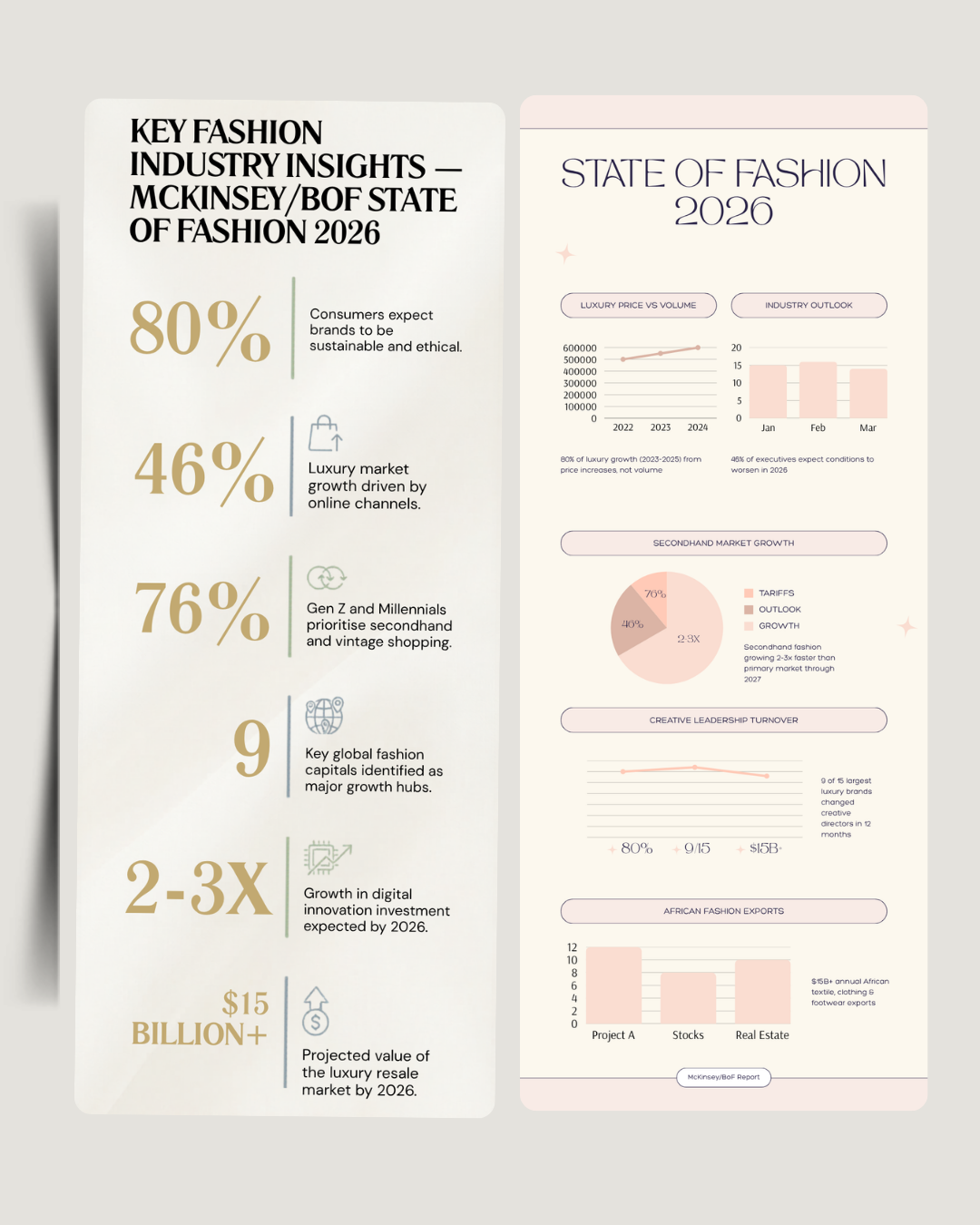
The State of Fashion 2026 report from McKinsey and Business of Fashion confirmed what the market had been signalling for two years: luxury's growth was built on price increases rather than value delivery. Between 2023 and 2025, approximately 80 percent of luxury market growth came from price hikes rather than volume gains. Consumers noticed. The reset is now structural, and it opens specific space for African and emerging design.
The Signal
The luxury fashion industry's structural recalibration in 2025 and 2026 is not a temporary correction. It is the consequence of a specific commercial strategy, raising prices faster than the quality or creativity of the products justified, meeting the specific cultural shift of a consumer base that has developed the knowledge and the alternatives to notice the gap. McKinsey's analysis for the State of Fashion 2026 report found that approximately 80 percent of luxury market growth between 2023 and 2025 came from price increases rather than volume gains. The consumer response in 2025 was to trade down, to buy secondhand, and to redirect discretionary spending toward experiences, wellness, and categories, most notably jewellery, where the value proposition felt more credible.
The industry's response has been the most significant creative leadership turnover in the history of modern luxury: nine of the largest fifteen luxury brands appointed new creative directors in the twelve months to September 2024, with four also appointing new CEOs. The spring/summer 2026 season, featuring debut collections from new creative directors at Chanel, Dior, Balenciaga, and Loewe, was described in industry reporting as an early test of whether the resets would restore the creative authority that price-led growth had eroded.
What This Means for African and Emerging Designers
The luxury reset creates a specific opportunity for African and emerging designers that the price-led luxury era did not. When luxury competed primarily on brand heritage and price signalling, African designers were excluded from the competitive tier by definition. Heritage is built over decades and African fashion houses are relatively young institutions. When luxury resets to compete on craftsmanship, authenticity, and creative distinctiveness, African designers are building from positions of genuine strength.
The demand for African textiles and prints has driven Western and Asian luxury brands to seek African partnerships, which represents both a commercial opportunity and the familiar risk of appropriation without attribution documented elsewhere in this series. The history of Western luxury's engagement with African craft traditions suggests that without deliberate commercial infrastructure on the African side, the shift in what luxury markets are seeking will benefit the seekers more than the sources.
The secondhand market growing two to three times faster than the primary market is also significant for African fashion's commercial development. Platforms that make shopping secondhand mainstream have created an alternative distribution channel that does not require the retail relationships, the trade show attendance, and the wholesale infrastructure that traditional fashion market entry demands. African designers who build direct-to-consumer digital channels, the Kenya and Ghana fintech-creator model identified in the Africa Creator Economy Report 2.0, are accessing global audiences through a distribution architecture that did not exist during the previous generation of African fashion's attempted global expansion.
The Implication
The luxury reset is the most favourable structural moment for authentic, craft-led, culturally specific design in a generation. African designers who have been building with genuine creative integrity rather than chasing global brand validation are now in a market that is actively seeking what they have always been making. The strategic question is not whether the opportunity is real. It is. The strategic question is whether African designers and their institutions are building the commercial infrastructure to capture the value that the market shift is creating, or whether that value will be captured by Western brands and platforms that appropriate African aesthetic intelligence without the African designers who originated it.
CLOSING NOTE: Every claim, figure, statistic, and institutional reference in this document is sourced from the public record and freely accessible information. T-INK Core Think Tank does not fabricate, exaggerate, or speculate beyond what the evidence supports. Full source attribution is available in the Reference Document for this series. This work is published in the public interest. Its purpose is intelligence. Its method is evidence.
EDITORIAL STATEMENT AND DISCLAIMER: This document is produced by T-INK Core Think Tank, the Creative and Cultural Intelligence engine of The Multiverse, for the purposes of education, analysis, and public understanding of the creative economy. Nothing contained in this document is intended to cause harm, create legal disputes, or target any individual or institution for personal attack. All figures, statistics, case references, industry data, legislative details, and institutional histories documented here are drawn entirely from public records, published reporting, official documents, regulatory filings, industry disclosures, academic research, and sources freely available and accessible in the public domain at the time of writing. No claim, figure, or statistic in this document has been fabricated or invented. Where disputes exist between accounts or where data is contested, those disputes and contestations are noted and the available evidence is presented without prejudice. Full source attribution is available in the Reference Document for this series. The purpose of this work is not to condemn but to document; not to inflame but to illuminate. The intelligence gathered here is public record. The analysis is ours. The conclusions are evidence-based.