AUTH-001: The NO FAKES Act and the Voice Cloning Question
What Artists Actually Need to Know
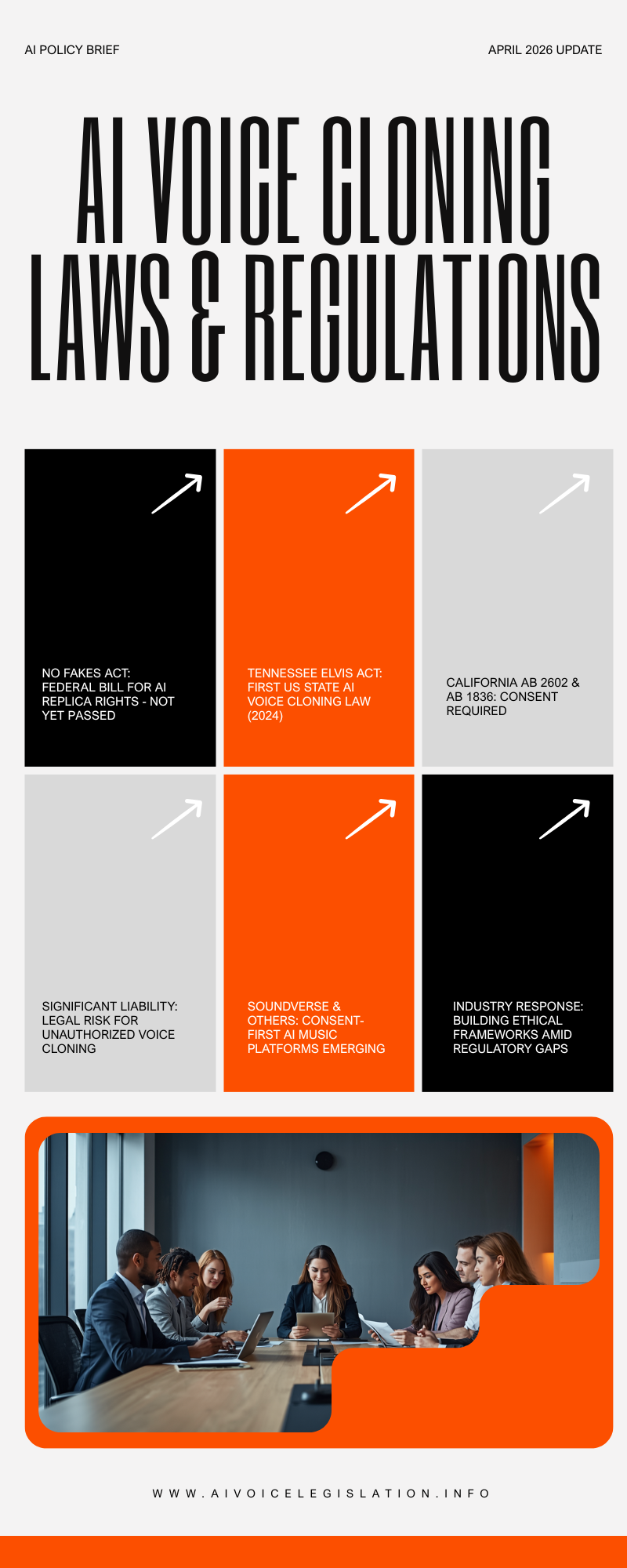
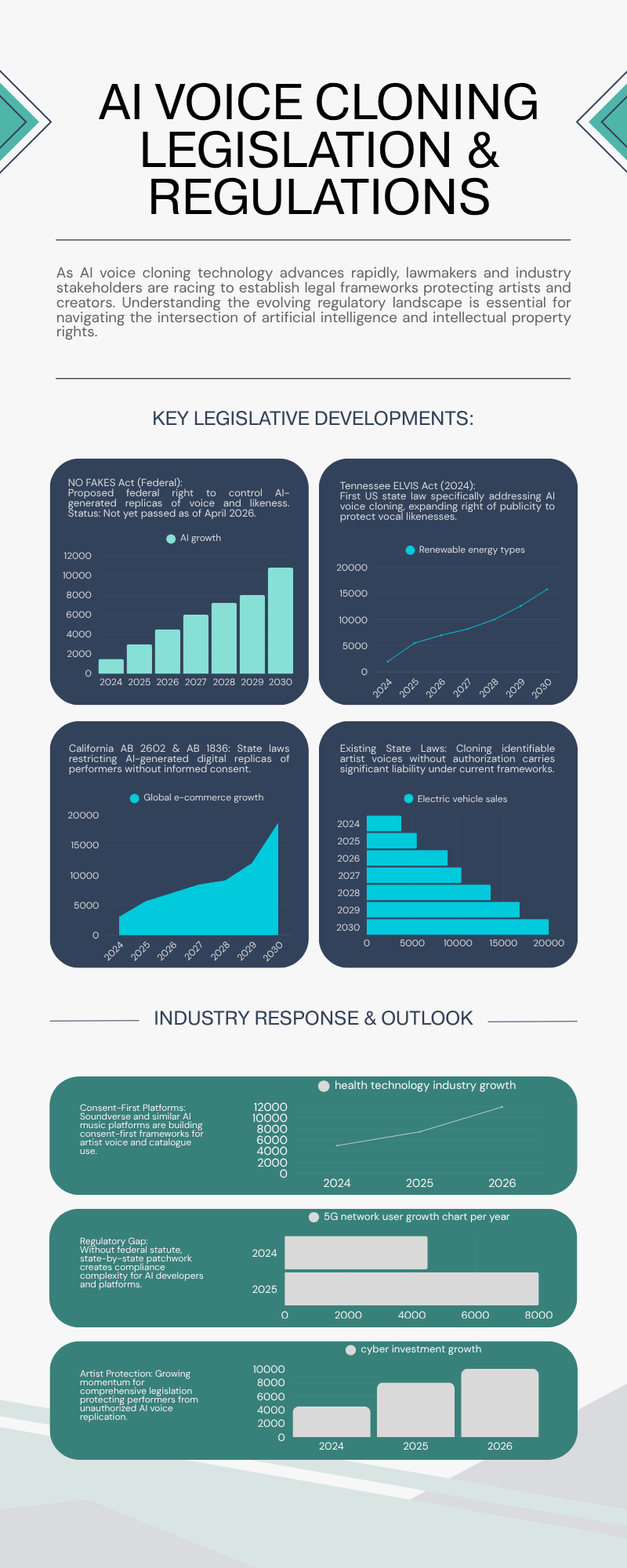
The NO FAKES Act, which would establish a federal right to control AI-generated replicas of a person's voice and likeness, was reintroduced in Congress but has not passed as of April 2026. Tennessee, California, and other states have passed state-level protections. The legal landscape is fragmented, enforcement is expensive, and the burden falls primarily on artists rather than platforms. Here is what the public record shows and what it means in practice.
The Signal
Voice cloning technology, the capacity to generate new audio performances in an identifiable artist's voice from a relatively small sample of existing recordings, became commercially and ethically urgent in 2025 after several high-profile cases of AI-generated songs using artist voices without consent went viral, generated streaming revenue, and produced returns that reached neither the platform holding the original recordings nor the artist whose voice had been replicated. The technology is not new. The commercial infrastructure for monetising it at scale is, and the regulatory framework designed to govern that infrastructure has not kept pace.
The regulatory response has been fragmented in ways that matter practically. Tennessee acted first with the ELVIS Act in 2024, establishing state-level protections specifically addressing AI-generated vocal replicas, named for the most famous example of a voice whose commercial value has survived its owner by decades. California added two state laws addressing digital replicas of voice and likeness. Federal legislation in the form of the NO FAKES Act, which would establish a uniform federal right to control AI-generated replicas, was reintroduced in Congress but has not passed as of April 2026. The gap between state action and federal inaction is not a temporary administrative delay. It is the current legal architecture within which voice cloning disputes are being resolved, and that architecture has specific structural consequences for artists at every level of the commercial music ecosystem.
The practical legal situation as of April 2026 is this: cloning an identifiable artist's voice without authorisation carries real legal risk under existing state right of publicity laws and the specific state statutes that have been enacted, even without a federal statute to provide uniform national coverage. That risk is not uniform across jurisdictions, which means the protection available to an artist depends significantly on where they reside, where they perform, and where the infringing activity originates and is distributed. The absence of a federal law means that enforcement is state-by-state, that detection and enforcement fall primarily on the affected artist and their legal representatives rather than on the platform infrastructure through which the infringing content is distributed, and that the cost of pursuing a voice cloning claim through state courts may exceed the direct commercial value of what was cloned for any artist who is not an established commercial brand with institutional legal infrastructure behind them.
That cost asymmetry is not incidental. It is the structural condition that makes voice cloning commercially attractive for the people doing it: the probability of a successful enforcement action is inversely proportional to the artist's ability to afford one, and the artists most likely to be targeted are those whose voices carry recognisable commercial value without the institutional legal infrastructure of major label representation.
The Implication for African and Diasporic Artists
Voice cloning presents specific and elevated risks for African and diasporic artists, and that specificity deserves direct examination rather than being absorbed into a general account of AI voice risk that treats all artists as equivalently positioned.
African and diasporic artists whose vocal signatures have been commercially significant, which is to say artists whose sound has influenced production, been widely sampled, referenced, and imitated across genres and geographies, have historical experience of commercial appropriation of their vocal and sonic identity that predates AI by decades. The same vocal distinctiveness that made an artist commercially significant enough to be imitated and sampled is the distinctiveness that makes them commercially viable as a target for AI voice cloning. And the legal infrastructure required to pursue a voice cloning claim under existing state law, the copyright and right of publicity attorneys, the forensic audio analysis, the discovery process in a state court proceeding, is expensive and jurisdiction-specific in ways that disadvantage artists without the institutional legal support that major Western label-signed artists access as a standard feature of their recording agreements.
The practical gap is this: an artist signed to a major label whose voice is cloned without consent has a legal department that will identify the infringement, assess the jurisdiction, determine the viable claim, and pursue enforcement with resources the label controls. An independent African artist whose voice is cloned without consent must identify the infringement themselves, retain counsel with relevant expertise in the applicable jurisdiction, fund the litigation, and manage the reputational and commercial dimensions of a public enforcement action simultaneously. These are not equivalent starting positions, and the regulatory framework as it currently stands does not address that inequality.
The emerging consent-first framework that platforms including Soundverse are developing, requiring explicit artist approval before using vocal characteristics for AI training, providing attribution when licensed vocal characteristics contribute to generated content, and establishing ongoing royalty mechanisms for contribution to AI training datasets, represents the commercial direction that the AI music ecosystem is being pressured toward by advocacy, litigation, and reputational risk. Whether that pressure produces durable industry-wide standards without federal legislation to mandate and enforce them is the question that 2026 will begin to answer. The pressure is real. The compliance is voluntary. Those are different things.
The Implication
African and diasporic artists whose vocal identities carry commercial value, which is to say any artist with a meaningful public profile and a distinctive enough sound to be recognisable as theirs, should be treating the voice cloning legal landscape as operational information rather than as a distant regulatory development.
Three specific actions are warranted now, before the federal legislative situation resolves. First, understand the specific state-level protections that apply to your jurisdiction of residence and the jurisdictions in which you primarily perform and distribute, because those protections are operative now regardless of what the federal legislature does or does not do in 2026. Second, document your specific vocal characteristics as part of your intellectual property registration practice, treating voice as a registerable creative asset in the same way that compositions and recordings are registered, because documentation of distinctiveness is the evidentiary foundation of any right of publicity or voice cloning claim. Third, treat any request to participate in AI training datasets, whether from a platform, a label, a technology partner, or any other entity, as a licensing negotiation requiring the same legal scrutiny as any other commercial use of your creative work, because contributing to a training dataset without defined terms is contributing to a commercial asset without compensation or control.
The federal legislative landscape will develop through 2026 and beyond. The state-level protections are operative now. The voice cloning market is operative now. The gap between those two facts is where the risk currently lives, and it is a gap that institutional legal infrastructure closes and individual creators without that infrastructure must navigate themselves.
CLOSING NOTE: Every claim, figure, statistic, and institutional reference in this document is sourced from the public record and freely accessible information. T-INK Core Think Tank does not fabricate, exaggerate, or speculate beyond what the evidence supports. Full source attribution is available in the Reference Document for this series. This work is published in the public interest. Its purpose is intelligence. Its method is evidence.
EDITORIAL STATEMENT AND DISCLAIMER: This document is produced by T-INK Core Think Tank, the Creative and Cultural Intelligence engine of The Multiverse, for the purposes of education, analysis, and public understanding of the creative economy. Nothing contained in this document is intended to cause harm, create legal disputes, or target any individual or institution for personal attack. All figures, statistics, case references, industry data, legislative details, and institutional histories documented here are drawn entirely from public records, published reporting, official documents, regulatory filings, industry disclosures, academic research, and sources freely available and accessible in the public domain at the time of writing. No claim, figure, or statistic in this document has been fabricated or invented. Where disputes exist between accounts or where data is contested, those disputes and contestations are noted and the available evidence is presented without prejudice. Full source attribution is available in the Reference Document for this series. The purpose of this work is not to condemn but to document; not to inflame but to illuminate. The intelligence gathered here is public record. The analysis is ours. The conclusions are evidence-based.