9: The Visibility Illusion
The Creative Collapse Series - Episode Nine
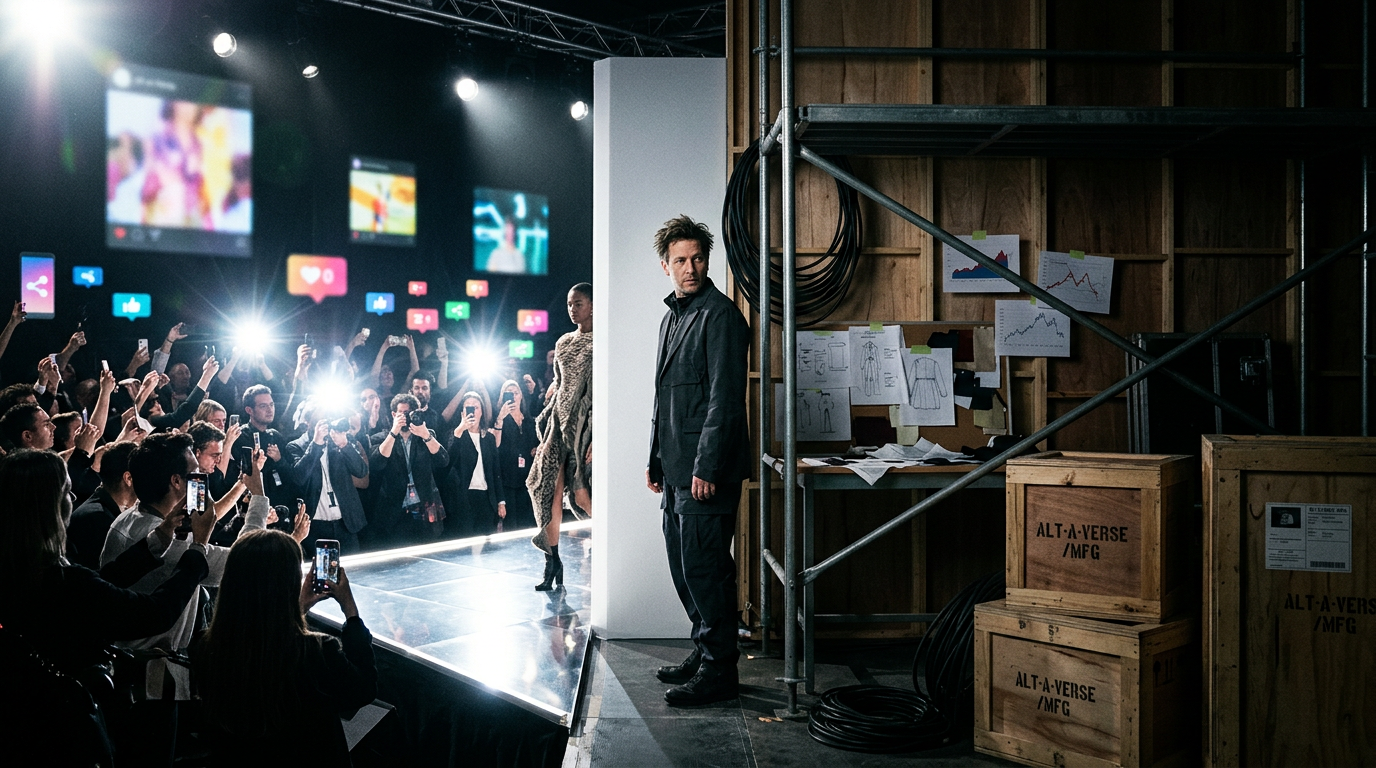
There is a specific kind of institutional crisis that social media was designed to make invisible. It does not appear in the content the brand posts. It does not surface in the engagement metrics that platform algorithms reward. It is not visible in the editorial coverage that celebrates the brand's cultural significance. It lives in the manufacturing relationship that is under strain, in the cash flow projection that does not work, in the founder's inbox at two in the morning, in the gap between what the brand looks like from outside and what it actually is from inside. That gap is what this episode is about: not the failures themselves, which this series has examined in detail across eight previous investigations, but the mechanism that makes those failures consistently surprising to the audiences who had the most information about the brands that experienced them.
The surprise is the structural phenomenon worth examining. Because if culturally influential brands are closing at the rate this series has documented, and if audiences are consistently expressing surprise when they do, the surprise is evidence not of insufficient information but of a perceptual architecture that is systematically producing the wrong conclusions from the available information. Understanding how that architecture works is the prerequisite for dismantling it, and dismantling it is the prerequisite for building the kind of honest public conversation about creative entrepreneurship that might eventually produce different structural conditions.
How Visibility Became the Measure of Stability
The conflation of visibility with stability did not begin with social media. It has always been easier to see the cultural output of creative businesses than to see the operational and financial conditions under which that output is produced. What social media changed is the speed and scale at which visibility operates, and the degree to which visibility has become both the primary currency of creative brand building and the primary evidence through which outside audiences evaluate what a brand actually is.
A brand that posts consistently, whose content generates engagement, whose products appear in the feeds of people whose taste the algorithm has determined you share, whose founder is articulate and compelling in interviews, whose aesthetic is coherent and distinctive: this brand appears successful. It appears to be growing. It appears to be doing what creative brands do when they are working. The appearance is not fabricated. The content is real. The engagement is real. The aesthetic is real. The operational crisis happening simultaneously behind it is also real, and it is invisible by design, not through deception but through the simple fact that operational crises are not the content that platforms are built to distribute.
The platform algorithm does not have a category for founder exhaustion. It does not reward posts about manufacturing delays. It does not amplify content about cash flow constraints. It amplifies content that generates the emotional responses that sustain engagement, and the emotional responses that social media platforms are optimised for are not the ones that honest accounts of creative entrepreneurship typically produce.
The result is that audiences build their understanding of a brand's condition from a data set that is systematically incomplete in a specific direction: it contains the highlights and excludes the structural realities, not because the brand is being dishonest but because the platform is not built to accommodate the full picture and the culture of creative entrepreneurship does not encourage sharing it.
What the Hanifa Moment Actually Showed
Hanifa's 2020 digital runway presentation was genuinely innovative. The decision to present the Pink Label Congo collection through digital 3D models moving in real space, without physical models, without a physical venue, in the early months of a pandemic that had closed every conventional avenue for fashion presentation, required creative vision, technical capability, and the willingness to attempt something that had no precedent and no guaranteed audience. The presentation worked. It reached millions of viewers. It generated the kind of global press coverage that takes years to build through conventional means. It repositioned Hanifa in the global fashion conversation in a single evening.
What the presentation also did, invisibly, was create a new set of expectations that the brand's operational infrastructure would need to meet in the period following the attention. The visibility created demand. The demand required manufacturing capacity. The manufacturing capacity required capital. The capital was not a feature of the presentation. The presentation showed the world what Hanifa's creative vision was capable of. It showed nothing about whether the operational and financial conditions existed to sustain the momentum the presentation created, because those conditions are not the kind of thing that a viral fashion moment is designed to communicate.
When difficulties emerged subsequently, the gap between the brand's cultural presence and its operational reality became visible in the worst possible way: through public discourse about order delays, rather than through an honest industry conversation about what it actually takes to sustain an independent fashion label through the scaling pressure that a viral breakthrough creates. The audience that had celebrated the 2020 presentation encountered the subsequent difficulties through the same platform logic that had made the presentation feel like unambiguous success: dramatic, emotionally activating, and stripped of the context required to understand what was actually happening structurally.
The Ami Colé Surprise and What It Reveals
When Ami Colé announced its closure in 2024, the response across the beauty industry and the broader creative community was dominated by expressions of surprise, grief, and confusion about how a brand that had seemed so well-positioned could end so abruptly. The confusion is itself the most revealing thing about the episode, because the structural pressures that produced the closure were not hidden. They were not even particularly difficult to identify for anyone who was looking at the brand's situation through the framework this series has been building: a capital structure designed for technology companies rather than consumer product businesses, a retail scaling requirement that created inventory financing needs exceeding what the venture investment covered, a marketing cost structure that operated as a continuous drain in a competitive market whose intensity had increased significantly since the brand launched, and a regulatory and operational complexity that the cultural celebration of the brand's founding premise had never addressed.
None of these pressures were secret. They are the standard structural conditions of beauty brand entrepreneurship, and they have been producing the same pattern of closure for independent beauty brands for years. What the Ami Colé surprise demonstrates is not that the closure was unforeseeable. It demonstrates that the visibility the brand had accumulated had made it functionally unimaginable to its audience that the brand could be in structural difficulty, because brands that look the way Ami Colé looked are not supposed to close. The appearance of success had been so thoroughly established through the brand's cultural presence that the structural reality of its situation was invisible not through concealment but through the perceptual architecture that the creative economy's relationship with social media has produced.
The Specific Cost of the Visibility Illusion for Founders
The visibility illusion does not only mislead audiences. It creates specific structural pressures for founders that compound the difficulties this series has examined throughout. A brand that appears successful from outside faces expectations of continued expansion and continued investment from partners, press, and platform algorithms that do not have access to the operational reality inside the brand. Managing those expectations while simultaneously managing the operational crisis that the outside world cannot see is a form of labour that has no name in the creative entrepreneurship discourse and no institutional support in the creative economy's ecosystem.
Aurora James has spoken about the specific burden of maintaining the public presence that Brother Vellies required while navigating the operational and financial pressures of building an independent fashion brand and simultaneously leading the Fifteen Percent Pledge. The public presence was not separate from the operational work. It was part of it, because maintaining visibility is a commercial necessity for brands whose continued existence depends on consumer attention. But maintaining visibility in conditions of operational difficulty requires the founder to perform stability she does not feel, competence she does not always have time to exercise, and confidence in a trajectory that the structural conditions of her business do not necessarily support. This performance is exhausting in itself. It is also commercially rational, because the alternative, honest public communication about structural difficulty, triggers the kind of platform discourse that this series examined in Episode Four, the digital courtroom that treats operational complexity as personal failure and compounds the structural crisis with a reputational one.
The Structural Design of the Illusion
The visibility illusion is not primarily the product of individual founder choices about what to share and what to conceal. It is a structural feature of the relationship between creative brand building, social media platform economics, and the cultural narratives that the creative economy uses to organise its understanding of what success looks like and what failure means.
Platforms are designed to surface and amplify content that generates engagement. Engagement is generated by the content that makes audiences feel something, and the feelings that creative brand content most reliably produces are aspiration, identification, and the particular pleasure of being admitted to a vision of the world that feels both elevated and authentic. These are not the feelings that honest accounts of operational difficulty produce. The platform logic therefore systematically rewards the content that sustains the illusion and provides no mechanism for the content that would disrupt it.
The cultural narratives of creative entrepreneurship compound this platform logic by positioning honesty about structural difficulty as a form of failure rather than as a form of accurate communication. Founders who publicly acknowledge operational challenges risk being perceived as unable to manage their businesses, which has commercial consequences in terms of the partnerships, investment interest, and consumer confidence that brand visibility is designed to generate. The rational response to this incentive structure is to maintain the visibility performance as long as possible, which is what most founders do, and which is why the closures consistently surprise audiences who had the most information about the brands that closed.
The surprise is not the audience's fault. It is the predictable output of a perceptual architecture that was designed, through platform incentives and cultural narratives, to make the operational reality of creative entrepreneurship invisible to everyone outside it.
What Honest Visibility Would Require
Correcting the visibility illusion does not require founders to make their structural difficulties public in ways that would compound those difficulties commercially. It requires the creative economy to develop the institutional culture and the structural supports that would make honest communication about operational challenges possible without the commercial consequences that currently make it irrational. This means investor relationships in which acknowledging difficulty triggers support rather than withdrawal of confidence. It means press and platform relationships in which operational complexity is covered with the same sophistication as cultural achievement. It means peer communities in which founders can share the reality of their situations without the information becoming a source of public discourse they cannot control.
None of these conditions currently exist at the scale required to change the perceptual architecture that produces the visibility illusion. Building them is part of the structural redesign that the creative economy requires, and it is the kind of structural redesign that no individual founder can build alone.
This series has documented the fractures. The fractures are real, they are structural, and they are producing outcomes that the creative economy's cultural celebration of creative entrepreneurship consistently fails to acknowledge. The more difficult work, which the Vault section of this series now begins, is imagining how the fractured systems might be rebuilt. Not optimised. Not reformed at the margin. Rebuilt, from the logic of what the people who actually generate the creative economy's cultural value actually need, rather than from the logic of the institutions that have organised the economy around their own interests while celebrating the founders who supply it with meaning.
The Creative Collapse Series public investigation concludes here.
The re-engineering work continues inside the Vault.