DOCUMENT 01 // The Original Sin of IP Law
LEX COLONIAE · FREE TIER · DOCUMENT 01
Berne, Paris and the Founding Architecture of a System Built for Some and Not for Others
The rooms where the rules were written, and the world that was not in them.
EDITORIAL NOTE
Published by The Multiverse, this work provides analysis, commentary, and education on public-interest matters. All factual statements are based on public records. The views expressed represent our good-faith opinion and fair comment, and should not be taken as professional, legal, or financial advice. For our full legal declaration, please see the footer below.
The Room Where the Rules Were Written
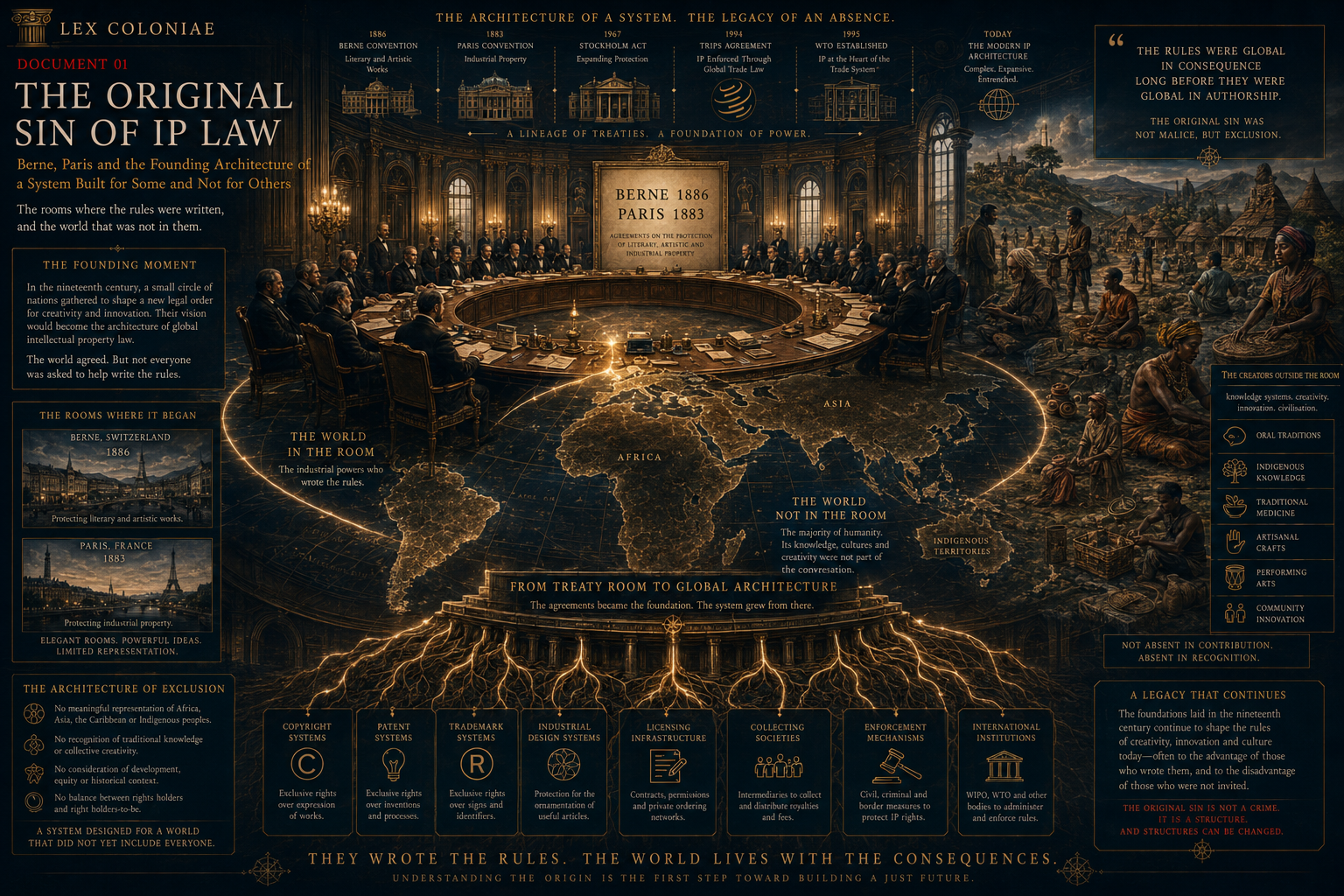
On 9 September 1886, representatives of ten nations met in the Swiss city of Berne and adopted the Convention for the Protection of Literary and Artistic Works. The countries in the room were Belgium, France, Germany, Great Britain, Haiti, Italy, Liberia, Spain, Switzerland and Tunisia, and the convention they signed established the foundational architecture of international copyright law that still governs the global creative economy today, in updated but structurally continuous form, nearly a hundred and forty years later. Three years earlier, in 1883, the Paris Convention had done the same work for industrial property, for patents, trademarks and designs. Together these two instruments are the foundation on which everything since has been built.
The significant fact about those rooms is who was not in them. The societies of sub-Saharan Africa were not present, because they were the colonial possessions of the European powers that were, their interests folded into those of the empires that ruled them. The Indigenous communities of the Americas, of Australia, of the Pacific and of Africa were represented in no form at all, and the vast traditional knowledge systems of Asia were largely absent. The foundational legal documents of the global creative and innovative economy were drafted by a small group of mostly European states to protect the specific commercial interests of their own publishing and industrial sectors. This is not a retroactive ethical complaint about a nineteenth-century diplomatic meeting. It is a precise observation about an architecture that was designed for specific purposes by specific parties, and that has continued to serve those purposes across every revision since.
Part One: The Architecture Built for the Individual Author
The Berne Convention rests on three principles, and all three were designed for the published works of individual European authors and translate badly, or not at all, to communal creative traditions. The first is automatic protection, under which copyright exists from the moment a work is created, with no registration required. This was built to protect identifiable authors against unauthorised reproduction, and it is useless to a communal tradition that has no single author and no single moment of creation. The second is the term, originally the life of the author plus fifty years and now plus seventy in most major markets, which is measured from the death of an individual and therefore cannot apply to a tradition maintained across many generations by a whole community. By default such a tradition is treated as having no protectable author at all, and falls into the public domain, free for anyone to exploit. The third is national treatment, under which each member country must protect foreign works as well as it protects its own. Between countries with comparable copyright systems this is fair reciprocity. Applied to the relationship between those countries and the traditional knowledge of societies with entirely different ways of producing culture, it yields an absurd result, in which a European company that draws on an African musical tradition receives full protection for the work it builds, while the tradition it drew on has no protection at all.
Part Two: The Patent System and the Theft It Permits
The Paris Convention built the patent and trademark system on a principle of priority, under which the first party to file an application receives the protection. For the industrial economies that wrote it, this rewarded the inventor who reached the patent office first. Applied globally, with no requirement that an applicant disclose whether an invention draws on traditional knowledge, it produced the phenomenon that the activist Pat Mooney named biopiracy in 1993, the patenting of traditional knowledge by parties who did not originate it and do not compensate those who did.
The cases are specific and well documented. The San people of southern Africa had used the Hoodia plant for generations to suppress hunger on long hunts. South Africa’s Council for Scientific and Industrial Research patented the active compound and licensed it to pharmaceutical companies without consulting the San, who secured a benefit-sharing agreement only after the fact, in 2002, once the patent and the protest were both already public. In 1995 the United States patent office granted a patent on the use of turmeric to heal wounds, a use documented in India for centuries and recorded in ancient texts, and the patent was revoked in 1997 only after India’s Council of Scientific and Industrial Research assembled the textual evidence to overturn it, the first time a traditional-knowledge patent was successfully challenged. A European patent on a neem-oil fungicide, granted to an American corporation and the United States Department of Agriculture for a property of the neem tree known in India for centuries, was revoked by the European Patent Office in 2005 after years of opposition. The pattern in every case is identical. Knowledge held communally and openly for generations is registered as a novel private invention by someone outside the community, and the burden of undoing the theft falls on the dispossessed, who must spend years and fortunes proving that what was taken was theirs all along.
Part Three: An Architecture, Not an Accident
The point of naming all this precisely is to refuse the comforting idea that these are isolated failures of an otherwise neutral system. They are the predictable output of an architecture that was designed, coherently and deliberately, around the interests of the parties in the room and against the interests of those outside it. The system did exactly what it was built to do. It protected the creative and industrial output of its authors with great sophistication, and it left the communal traditions of everyone else exposed as a free resource for those authors to draw upon.
That founding architecture was not softened over the following century. It was hardened. In 1994 the TRIPS Agreement took these standards and locked them into the rules of global trade, making them mandatory for almost every country on earth on pain of trade sanction, and that is the subject of the next document in this series. The first genuine correction did not arrive until 2024, when the treaty on genetic resources and associated traditional knowledge finally required patent applicants to disclose the origin of the knowledge they use, a breakthrough examined two documents from now, and one that remains, as of this writing, not yet in force and limited to the patent context. The original sin was committed in the 1880s, in rooms from which most of the world was absent. The system has been administering the consequences ever since, and has only just begun, partially and reluctantly, to make amends.
The foundational documents of the global creative economy were written in the 1880s by a small group of mostly European states, in rooms from which the colonised world was wholly absent. The system then did exactly what it was built to do. That is the original sin, and the world has been living inside it ever since.
The Multiverse
A CLOSING DECLARATION
This document is a work of public-interest analysis, commentary and education. Its factual content is drawn from the publicly available sources listed in the accompanying bibliography, and its arguments are the considered opinion of The Multiverse, offered in good faith as fair comment. References to named parties are made for the purposes of criticism, review, reporting and analysis, and not to defame or to pursue any personal grievance. Nothing in this document is legal advice; any reader facing a specific decision should consult a suitably qualified professional. Any material error of fact will be corrected on notification. © The Multiverse. All rights reserved.
EDITORIAL AND LEGAL DECLARATION
This document is published by The Multiverse as a work of analysis, commentary, education and public-interest journalism. It examines laws, treaties, institutions, industries and historical events, and the systems through which creative and economic value is created, transferred and protected. It is intended to inform and to advance public understanding and debate on matters of legitimate public interest.
The factual statements in this document are drawn from publicly available sources, which are identified in the accompanying reference bibliography. Where individuals, companies, institutions or specific cases are named, they are referred to as a matter of public record and for the purposes of criticism, review, reporting, education and analysis. Nothing in this document is intended to defame any person or organisation, to disparage any party maliciously, or to pursue any personal grievance. The arguments, interpretations and conclusions are the considered opinion of The Multiverse, offered in good faith as fair comment on matters of public interest, and should be read as such.
This document does not constitute legal, financial or professional advice. It is educational in nature and general in application, and it cannot account for the particular circumstances of any reader. Anyone facing a specific legal or commercial decision should obtain independent advice from a suitably qualified professional in the relevant jurisdiction before acting.
Names, trademarks and titles referred to in this document remain the property of their respective owners and are used for identification, commentary and analysis only, implying no affiliation or endorsement. The Multiverse has made reasonable efforts to ensure accuracy at the time of publication and will correct any material error of fact brought to its attention.
© The Multiverse. All rights reserved.