DOCUMENT 01 // THE CHARTER
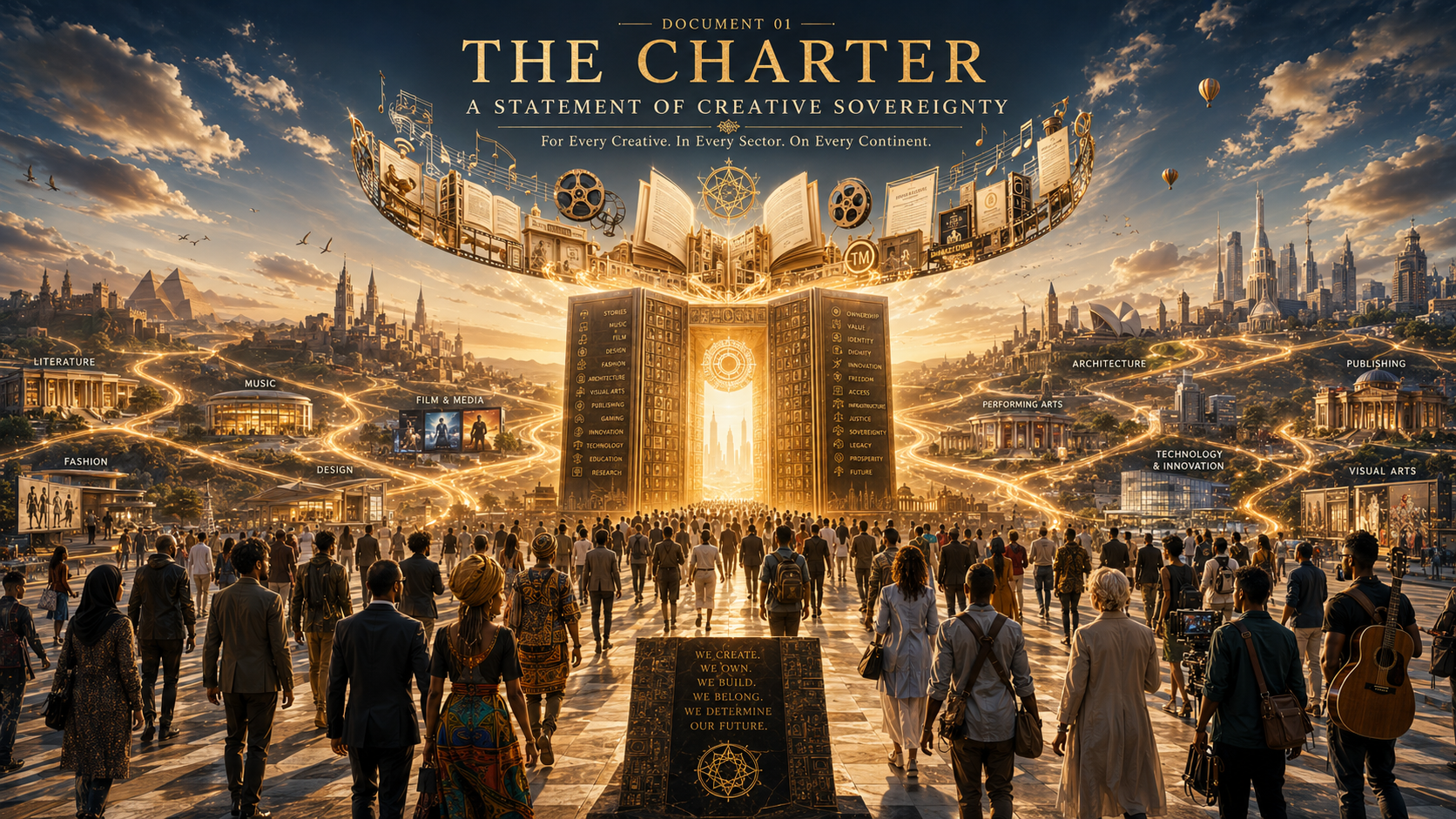
THE CHARTER · FREE TIER · DOCUMENT 01
A Statement of Creative Sovereignty
For Every Creative. In Every Sector. On Every Continent.
EDITORIAL NOTE
Published by The Multiverse, this work provides analysis, commentary, and education on public-interest matters. All factual statements are based on public records. The views expressed represent our good-faith opinion and fair comment, and should not be taken as professional, legal, or financial advice. For our full legal declaration, please see the footer below.
Preamble
Every human being who makes something, whether a film, a song, a novel, a building, a garment, a piece of music, a visual work, a textile pattern or any other expression of creative intelligence, holds an inherent relationship to what they have made. That relationship is not merely sentimental. It is economic, it is legal, and it is civilisational. The creative act generates value, and the person who performs it has a fundamental interest in the value it generates. Everything that follows in this document proceeds from that single proposition.
The systems that govern how creative value is captured, distributed and protected were not built around that interest. They were built around other interests entirely: the institutions that control distribution, the corporations that own publishing and recording infrastructure, the conglomerates that hold rights catalogues, the platforms that aggregate audiences, and the legal frameworks that protect the position of each of these against the claims of the very people whose creativity made those positions valuable in the first place.
This is not an accusation. It is a description. The legal architecture of the global creative economy was built by specific people, in specific rooms, at specific historical moments, to serve specific commercial interests. Understanding that architecture precisely and without sentiment is the prerequisite for changing it, and changing it is both possible and necessary, because the architecture as it stands fails the majority of the world’s creative people while enriching a small number of institutions at their expense.
THE CHARTER is the statement of what creative sovereignty means, what it requires, and what must be built to make it real. It is not a complaint. It is a specification. It says what should exist, and everything the Multiverse builds is built toward making that specification real.
THE CHARTER does not explain itself. It states what is true, names what has been done, and specifies what must be built. That is the only document worth writing.
Part One: What Creative Sovereignty Is
ARTICLE I: The Right to Own What You Make
Creative sovereignty begins with a single proposition: the person who makes a thing should own it. Not forever, and not without commercial relationships with publishers, distributors, labels and platforms, but as the default starting position from which any commercial relationship must be a negotiated departure rather than an automatic surrender. The creator owns the work. Any transfer of that ownership, and any licensing of rights within it, requires the creator’s informed, voluntary and fairly compensated agreement.
This proposition is not radical. It is the stated principle of intellectual property law in virtually every jurisdiction on earth. What the existing system fails to deliver is not the principle but the architecture that makes the principle real: the legal literacy that lets a creator understand what they are agreeing to, the negotiating leverage that lets them decline unfair terms, the institutional infrastructure that enforces their rights when those rights are violated, and the economic alternatives that make it possible to refuse an exploitative deal without surrendering all access to an audience. The principle without that architecture is aspiration. The architecture without the principle is machinery. The Charter specifies both, and the rest of this strand builds both.
ARTICLE II: The Right to the Value Your Work Generates
Ownership of a creative work is not a question of credit. It is a question of economics. A song streamed a billion times generates commercial value. A novel adapted into a film generates commercial value. A building that becomes an internationally celebrated landmark generates commercial value. A textile pattern absorbed into the seasonal collections of luxury houses generates commercial value. The question of who receives that value is not incidental to the creator’s interest. It is the creator’s interest, stated in its most precise form.
The existing system is structured so that most of the value generated by creative work flows to the entities that control distribution rather than to the people who made the work worth distributing. The recording company retains the masters and the larger share of streaming income. The publisher keeps the bulk of subsidiary rights. The platform owns the content it commissioned and captures the subscriber value that content draws. The fashion house keeps the archive its creative director built. In each case the entity that controls the infrastructure connecting the work to its audience captures the value the audience generates. The sharpest single illustration sits in music, where Africa remains the lowest royalty-collecting region in the world while producing some of the most commercially successful popular music on the planet. The value is generated in one place and collected in another, and the distance between the two is not an accident of the market. It is a product of the architecture.
ARTICLE III : The Right to Tell Your Own Story
Creative sovereignty reaches past the economic into the cultural. The right to tell your own story, in your own language, through your own aesthetic traditions, for your own community, without requiring the validation of institutions designed for other communities, is as fundamental as the right to own the economic value of what you make. One without the other is half a right.
That cultural right has been violated with particular consistency for African, Indigenous, Asian and other non-Western creative communities. Colonial education systems taught creators to regard their own traditions as inferior and their own languages as inadequate vehicles for serious expression, and distribution systems demanded cultural translation, the reshaping of a story until it became legible to a Western audience, as the price of reaching a global one. The history of African literature carries the clearest example. When Heinemann launched its African Writers Series in 1962, opening with Chinua Achebe’s Things Fall Apart and installing Achebe himself as its founding editorial adviser, it did something genuinely significant, carrying African writing to the world and building the careers of an entire generation. It also routed that writing through a London publishing house and made British editorial judgment the gateway to global literary recognition. The series saved and constrained African literature in the same gesture. Cultural sovereignty does not mean refusing the world. It means reaching it without surrendering the right to decide, at home, what is worth saying and how it should be said.
ARTICLE IV: The Right to the Infrastructure That Makes Rights Real
Rights without infrastructure are aspirations. A creator who technically owns their intellectual property but cannot afford a lawyer to enforce it does not effectively own it. A community whose traditional knowledge is technically protectable but has no access to the legal process required to assert that protection does not effectively have it. A designer who holds design rights but cannot monitor global markets for infringement does not effectively hold them. In each case the right exists on paper and dissolves in practice, which is the same, for the person relying on it, as not existing at all.
Creative sovereignty therefore requires not only the legal recognition of rights but the institutional machinery that makes them function: legal literacy programmes so that creators understand what they own, collective rights management organisations that enforce on behalf of those who cannot individually afford to, genuine developing-country representation in the treaty processes that set the terms of global IP law, and the financial mechanisms that let the holding of rights generate income rather than merely generate legal theory. Building that machinery is not optional. It is the minimum required for the principle of creative sovereignty to mean anything in practice, and every series in this strand is building a component of it.
Part Two: What Has Been Done
ARTICLE V: The Legal Architecture of Extraction
The international intellectual property system, as it stands, was built through a sequence of negotiations conducted primarily by the world’s most commercially powerful nations for the benefit of their most commercially significant industries. The Paris Convention of 1883 on industrial property, the Berne Convention of 1886 on copyright, the TRIPS Agreement of 1994 and the WIPO treaties that have extended the framework since were all negotiated in rooms where the primary interests represented belonged to the publishing houses, recording companies, pharmaceutical firms and, in time, the technology corporations of Europe and North America.
The communities whose traditional knowledge represents millennia of accumulated creative and intellectual achievement were not at those tables in any meaningful sense. Where they were present at all, they were present without the technical expertise, the legal capacity and the institutional weight required to advocate effectively against the coordinated position of developed-country commercial interests. The treaties that resulted protect corporate innovation with extraordinary sophistication, and they protect the communal creative traditions of the rest of the world barely at all. This is the legal architecture of extraction, and it is not hidden. It is written into the treaty texts, recorded in the negotiating histories, and visible in the commercial outcomes the framework has produced across every creative sector. The Charter names it plainly, because naming it precisely is the condition of changing it.
ARTICLE VI: The Sectors and Their Specific Violations
The same architecture produced the same extraction in every creative sector across the same historical period, which is the surest sign that what can look like a series of separate misfortunes is in fact a single system operating consistently. Five sectors show the pattern with particular clarity.
Film. The colonial distribution monopolies that controlled African cinema exhibition from the 1920s through independence established, early, that the screen would be owned elsewhere. The pattern persists in the rights-acquisition structures of the international streaming platforms, which fund African content in exchange for global rights packages whose long-term value dramatically exceeds the acquisition payment, in the absence of the residual payment frameworks that guild systems secured for creators in Western film industries, and in the continued control of the most significant archives of mid-twentieth-century African cinema by international distribution companies rather than by the countries whose stories those archives document.
Music. The recording-company expeditions of the 1940s and 1950s documented African musical traditions for the commercial benefit of British and American companies while paying African musicians flat session fees and retaining the master rights. The structure outlived the expeditions. It survives in the failure of African collecting societies to gather performance royalties from international broadcast and streaming, in the publishing assignments that have transferred ongoing income from African songwriters to international publishers, and in the streaming rate differentials that pay less per stream from African listeners than from Western ones. The cumulative result is the figure named in Article II: Africa remains the lowest royalty-collecting region in the world despite producing some of its most commercially successful popular music.
Literature. The colonial education systems that declared African languages inadequate for literary expression and imposed European languages as the only valid medium for serious intellectual work set the terms, and the publishing infrastructure enforced them. The Heinemann African Writers Series, launched in 1962, both saved and constrained African literature by making British editorial judgment the gateway to global recognition, and the publishing contracts of the era routinely transferred subsidiary, adaptation and translation rights from African authors to international houses. The absence of African-owned adaptation infrastructure means the most important works of African literature are still acquired and adapted by international production companies without meaningful African creative control.
Architecture. The systematic denial of African architectural achievement reached its most infamous expression at Great Zimbabwe, where colonial-era authorities and antiquarians damaged and removed archaeological evidence and promoted elaborate theories of foreign origin, all to avoid the conclusion the stonework plainly supported, which was that Africans had built it. The denial outlived the excavations. It survives in the colonial urban-planning frameworks that organised African cities as extraction infrastructure rather than as communities for human flourishing, in the architectural curricula that train African architects in European modernist traditions rather than in African vernacular ones, and in the commissioning patterns that award the most prestigious African building projects to international firms.
Fashion shows the structure in its purest form, because here the extraction has a single, continuous, identifiable corporate author. The Dutch firm now known as Vlisco was founded in Helmond in 1846 to mechanise the Indonesian batik process, and when its imitation prints failed in the Indonesian market it redirected them to West Africa, beginning regular export in 1876 and dominating the regional market by the 1930s. Those fabrics, designed in the Netherlands then and still designed in the Netherlands now, became so thoroughly woven into West and Central African identity that they read as unmistakably African, which means a European company has been selling West African communities an Africanness it owns the intellectual property in for the better part of a century and a half. The same logic governs the luxury houses whose collections draw consistently on African aesthetic traditions without attribution or compensation, an intellectual property framework that protects corporate innovation with full legal force while leaving communal textile traditions essentially unprotected, and the employment structures that transfer the creative output of African and Black designers into conglomerate archives in exchange for a salary rather than a stake.
The same legal architecture enabled the same extraction across every creative sector across the same historical period for the same structural reasons. This is not coincidence. It is a system. Systems can be redesigned.
ARTICLE VII: The Reform That Is and Is Not Happening
In May 2024, after more than two decades of negotiation initiated by a Colombian proposal in 1999, the member states of the World Intellectual Property Organization adopted by consensus the Treaty on Intellectual Property, Genetic Resources and Associated Traditional Knowledge. It was the first WIPO treaty to address traditional knowledge and the first to write in provisions specifically for Indigenous Peoples and local communities. Forty-four states have signed it, Malawi was the first to ratify, and Albania and Uganda have followed. It is the culmination of a generation of advocacy, and it is a genuine milestone.
It is also, by itself, insufficient, and as of now it is not yet law. The treaty enters into force only three months after the fifteenth ratification, and the count remains in single figures. Its disclosure obligations, significant as a precedent, do not create the enforceable rights, the royalty-collection mechanisms or the community governance frameworks that would make traditional knowledge protection commercially functional at the scale the global exploitation of African and Indigenous traditions demands. And it does not touch traditional cultural expressions at all, which means the textile patterns, musical traditions, architectural knowledge and craft techniques named throughout this Charter remain outside its protection. Those negotiations continue separately at the WIPO Intergovernmental Committee, whose fifty-second session in March 2026 ended, after more than twenty years of argument, by carrying the same draft texts forward to the next round. The treaty is evidence that change is possible inside the international system. It is not evidence that the system will reform itself adequately without sustained and sophisticated pressure.
At the national level the most advanced response on the continent is Nigeria’s National Intellectual Property Policy and Strategy, approved by the Federal Executive Council in November 2025 and launched the following month as the country’s first unified national IP framework. It proposes a national traditional knowledge registry, reinforces the Copyright Act of 2022, and begins building the domestic infrastructure that effective protection requires. It is the most comprehensive national IP policy yet produced in Africa, and it is the beginning of what every African country needs rather than the completion of it. The reform that is happening is real. The reform that is not yet happening is the comprehensive redesign of the international framework around the principle of creative sovereignty rather than the principle of corporate innovation, and that redesign is the work this strand exists to support.
Part Three: What Must Be Built
ARTICLE VIII The Principles of the New Legal Architecture
The legal architecture of creative sovereignty is built on principles that invert the priorities of the existing one. Where the current framework protects corporate innovation as its primary function, the new framework protects the creative rights of individuals and communities as its primary function. Where the current framework treats traditional knowledge as a public domain open to exploitation without restriction, the new framework treats it as community-owned intellectual property requiring consent and compensation for commercial use. Where the current framework concentrates the most valuable rights in the entities with the most power to claim them, the new framework starts from the creator and requires that any transfer of rights away from the creator be genuinely voluntary, genuinely informed and genuinely fair.
These are not aspirational abstractions. They are design specifications. Every treaty provision, contract structure and institutional mechanism proposed across this strand is measured against them, and the question asked of every legal instrument is not whether it is consistent with existing practice but whether it advances creative sovereignty as defined here. Existing practice has been the problem. Consistency with it is not a virtue.
ARTICLE IX: The Seven Pillars of Creative Legal Infrastructure
The infrastructure of creative legal sovereignty rests on seven pillars, and the strand is organised so that each of them is eventually built. The first is legal literacy infrastructure, the translation of legal knowledge that currently lives in textbooks and law-school curricula into practical, sector-specific knowledge that a working creative can actually access and apply. The second is collective rights management, the registries and collecting societies that monitor exploitation, gather income and distribute it at a scale no individual creator could achieve alone. The third is traditional knowledge protection, the registries, geographical indications, disclosure requirements and benefit-sharing frameworks that defend communal traditions from commercial use without attribution or compensation. The fourth is contract reform, comprising both the legislative minimum standards and the model agreements that establish creator-friendly terms as a visible and accessible alternative to the standard forms drafted by the powerful for their own benefit.
The fifth pillar is international treaty reform, the sustained and technically sophisticated advocacy required to move the global framework toward creative sovereignty within the constraints of the existing legal order. The sixth is enforcement infrastructure, the legal aid, the collective enforcement capacity and the cross-border cooperation that make a violation commercially consequential rather than merely regrettable. The seventh is alternative infrastructure, the creator-owned and African-owned publishing, distribution and rights-management institutions whose very existence reduces the leverage the extractive system holds over the creators it currently depends upon. Legal reform inside the existing system is necessary. Building the alternative to that system is what eventually makes the reform irreversible.
ARTICLE X: Who This Charter Is For
THE CHARTER is for every creative professional who has ever signed a contract without fully understanding what it transferred. For every musician who never received the royalties their music earned because the infrastructure to collect them did not exist. For every filmmaker whose film sits in a platform library generating subscriber value while the filmmaker holds nothing beyond the original fee. For every architect trained in someone else’s aesthetic tradition to design buildings in their own country. For every designer whose cultural heritage became the inspiration for a collection that earned millions without a single payment returning to the community that originated it.
It is for every creative in Africa, in Latin America, in South and Southeast Asia, in the Indigenous communities of Australia and the Americas, in the Caribbean, and in every other place where the legal architecture of the global creative economy has been used to extract value from creative genius rather than to protect and reward it. And it is also for every creative in the West who has signed away rights they did not know they held, been paid a flat fee for work that earned someone else a fortune, or been employed by an institution whose standard terms quietly transferred their output into its portfolio. The specific forms of vulnerability differ between contexts. The underlying principle is identical everywhere: systems that should protect creators were designed to serve other interests instead.
THE CHARTER does not belong to one sector, one continent or one political tradition. It belongs to every person who makes something and deserves to own what they make. That is the only qualification required, and it is the only audience this document needs.
THE CHARTER is not the end of the argument. It is the beginning of the building.
The Multiverse
A CLOSING DECLARATION
This document is a work of public-interest analysis, commentary and education. Its factual content is drawn from the publicly available sources listed in the accompanying bibliography, and its arguments are the considered opinion of The Multiverse, offered in good faith as fair comment. References to named parties are made for the purposes of criticism, review, reporting and analysis, and not to defame or to pursue any personal grievance. Nothing in this document is legal advice; any reader facing a specific decision should consult a suitably qualified professional. Any material error of fact will be corrected on notification. © The Multiverse. All rights reserved.
EDITORIAL AND LEGAL DECLARATION
This document is published by The Multiverse as a work of analysis, commentary, education and public-interest journalism. It examines laws, treaties, institutions, industries and historical events, and the systems through which creative and economic value is created, transferred and protected. It is intended to inform and to advance public understanding and debate on matters of legitimate public interest.
The factual statements in this document are drawn from publicly available sources, which are identified in the accompanying reference bibliography. Where individuals, companies, institutions or specific cases are named, they are referred to as a matter of public record and for the purposes of criticism, review, reporting, education and analysis. Nothing in this document is intended to defame any person or organisation, to disparage any party maliciously, or to pursue any personal grievance. The arguments, interpretations and conclusions are the considered opinion of The Multiverse, offered in good faith as fair comment on matters of public interest, and should be read as such.
This document does not constitute legal, financial or professional advice. It is educational in nature and general in application, and it cannot account for the particular circumstances of any reader. Anyone facing a specific legal or commercial decision should obtain independent advice from a suitably qualified professional in the relevant jurisdiction before acting.
Names, trademarks and titles referred to in this document remain the property of their respective owners and are used for identification, commentary and analysis only, implying no affiliation or endorsement. The Multiverse has made reasonable efforts to ensure accuracy at the time of publication and will correct any material error of fact brought to its attention.