DOCUMENT 00 // LEX COLONIAE
LEX COLONIAE · SERIES OVERVIEW · DOCUMENT 00
The Colonial Legal Architecture Still Governing Creative Industries
Series Two of The Sovereign Clause. The indictment.
EDITORIAL NOTE
Published by The Multiverse, this work provides analysis, commentary, and education on public-interest matters. All factual statements are based on public records. The views expressed represent our good-faith opinion and fair comment, and should not be taken as professional, legal, or financial advice. For our full legal declaration, please see the footer below.
The Second Movement
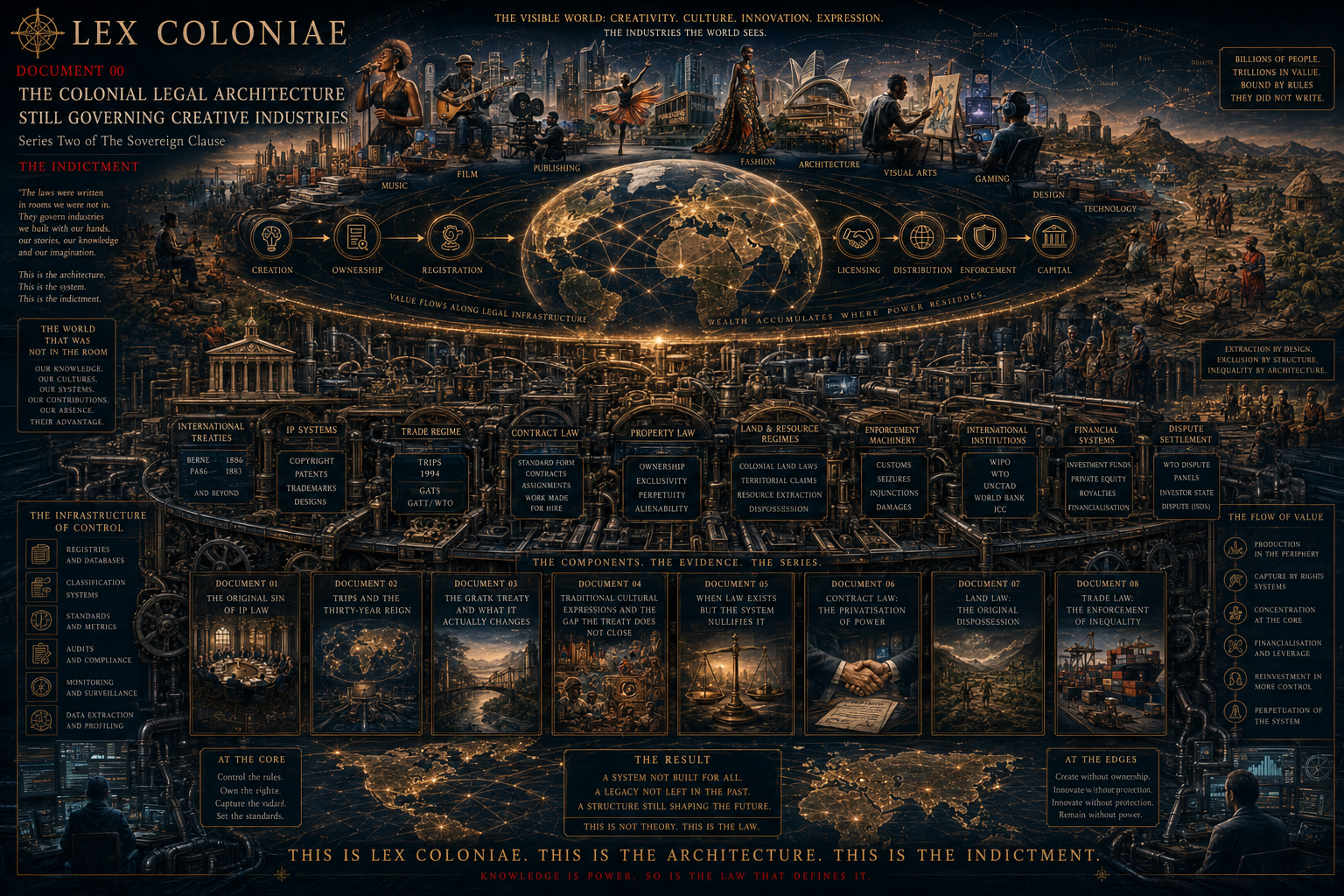
Lex Coloniae is the second of the three series that make up The Sovereign Clause, and it is the indictment. Where the Charter declared the standard, stating without apology what creative sovereignty is and what it requires, Lex Coloniae names the obstacle. It is the colonial legal history of the global creative economy, set down as a precise legal and historical record rather than as a grievance, because the most powerful version of this argument is the one that simply shows, with dates and names and treaty texts, how the law governing creative work came to be built the way it is, by whom, and at whose expense.
The name states the subject. Lex Coloniae is the law of the colony, the body of legal architecture assembled during the colonial era and across the century that followed, which still governs how creative and intellectual value moves around the world. The series traces that architecture from its foundations to its present operation, and it does so in a particular spirit. It carries no solutions of its own. Every blueprint for repair that this series once contained has moved into the third series, the Vault, so that Lex Coloniae can do one thing completely, which is to establish, beyond reasonable dispute, that the system was built for some people and not for others, and that the consequences were not an accident.
What the Series Covers
The free tier sets out the founding architecture and its first real challenge. It opens with the original sin of the system, the Berne and Paris Conventions of the 1880s and the rooms in which they were written, and follows with the way the 1994 TRIPS Agreement locked that architecture into global trade law, the genuine breakthrough of the 2024 treaty on genetic resources and associated traditional knowledge, and the gap that treaty still leaves open. The builder tier then brings the law down to the ground, examining how copyright, contract, land and trade law actually operate on the working creative and the knowledge-holding community, where the abstractions of treaty law become the concrete facts of who is paid and who is not.
Why It Matters Now
This is not legal history for its own sake. The architecture Lex Coloniae describes is under active negotiation at this moment. The 2024 treaty on genetic resources is signed by forty-four states and is not yet in force, the separate negotiations on traditional cultural expressions remain unresolved after more than two decades and were carried forward again at the World Intellectual Property Organization in March 2026, and national frameworks such as Nigeria’s, launched at the end of 2025, are being written right now. The case this series builds is the evidence base for those negotiations. Naming the obstacle precisely is the precondition for removing it.
The Charter declared the standard. Lex Coloniae names the obstacle. It carries no solutions of its own, by design, so that it can do one thing completely: prove that the system was built for some and not for others, and that this was not an accident.
How to Read It
Lex Coloniae is built to be read until the obstacle is unmistakable, and then to hand the reader onward. It ends at the point of maximum clarity about what is wrong, and the way out, the contracts, the model legislation, the reform programme and the institutional blueprints, waits in the Vault, the third series of the strand. Read the Charter to know the standard. Read Lex Coloniae to know what stands in its way. Then enter the Vault to build the alternative.
The Multiverse
A CLOSING DECLARATION
This document is a work of public-interest analysis, commentary and education. Its factual content is drawn from the publicly available sources listed in the accompanying bibliography, and its arguments are the considered opinion of The Multiverse, offered in good faith as fair comment. References to named parties are made for the purposes of criticism, review, reporting and analysis, and not to defame or to pursue any personal grievance. Nothing in this document is legal advice; any reader facing a specific decision should consult a suitably qualified professional. Any material error of fact will be corrected on notification. © The Multiverse. All rights reserved.
EDITORIAL AND LEGAL DECLARATION
This document is published by The Multiverse as a work of analysis, commentary, education and public-interest journalism. It examines laws, treaties, institutions, industries and historical events, and the systems through which creative and economic value is created, transferred and protected. It is intended to inform and to advance public understanding and debate on matters of legitimate public interest.
The factual statements in this document are drawn from publicly available sources, which are identified in the accompanying reference bibliography. Where individuals, companies, institutions or specific cases are named, they are referred to as a matter of public record and for the purposes of criticism, review, reporting, education and analysis. Nothing in this document is intended to defame any person or organisation, to disparage any party maliciously, or to pursue any personal grievance. The arguments, interpretations and conclusions are the considered opinion of The Multiverse, offered in good faith as fair comment on matters of public interest, and should be read as such.
This document does not constitute legal, financial or professional advice. It is educational in nature and general in application, and it cannot account for the particular circumstances of any reader. Anyone facing a specific legal or commercial decision should obtain independent advice from a suitably qualified professional in the relevant jurisdiction before acting.
Names, trademarks and titles referred to in this document remain the property of their respective owners and are used for identification, commentary and analysis only, implying no affiliation or endorsement. The Multiverse has made reasonable efforts to ensure accuracy at the time of publication and will correct any material error of fact brought to its attention.
© The Multiverse. All rights reserved.