Core 8: The Invisible Systems Behind Creative Industries
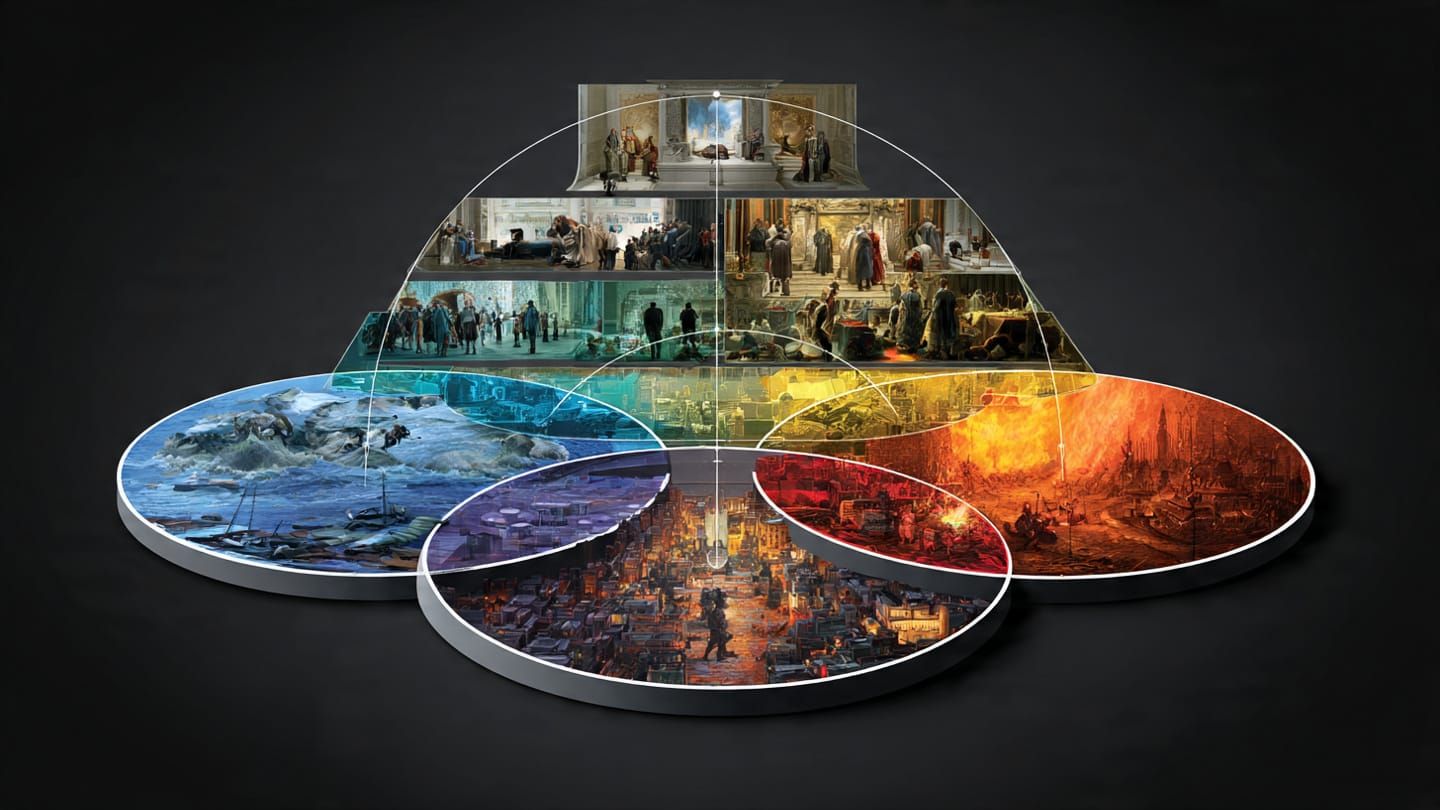
Narrative Engineering: The Core Basics - Part Eight
Most people who work in or around creative industries develop, over time, a surface-level understanding of how those industries function. They understand talent. They understand trends. They understand audiences, platforms, and the dynamics of visibility. What they rarely develop, what almost no formal education in creative fields adequately addresses, is an understanding of the architecture that sits beneath all of that. The invisible systems that determine not simply who succeeds, but on whose terms, and who captures the value that success generates.
These systems are invisible not because they are concealed in any conspiratorial sense, but because they are so thoroughly embedded in the normal operation of creative industries that most people experience them as simply the way things are. The way fashion works. The way publishing works. The way the music industry works. That naturalness is itself the consequence of how completely these systems have been normalised, and normalisation, as Narrative Engineering consistently reveals, is one of the most powerful mechanisms through which structural power protects and perpetuates itself. A system that feels like the natural order of things does not need to be defended. It simply operates.
This piece maps those systems across six domains: fashion, publishing, media, technology, intellectual property, and cultural gatekeeping. Not to produce a comprehensive survey, but to make visible the structural logic that runs through all of them, the logic that explains why the creative economy consistently produces the outcomes it produces, and why talent, alone, has never been sufficient to navigate it.
Fashion: The System Behind the Spectacle
The global fashion industry generates approximately two and a half trillion dollars in annual revenue. It is one of the most culturally influential systems on the planet, shaping not only how people dress but how they understand beauty, status, identity, and the relationship between aesthetic and economic value. It is also governed by a set of invisible systems that most people working within it, including many who have built commercially successful careers within it, do not fully understand as systems rather than as simply the conditions of the industry.
The first and most consequential of these systems is the gatekeeping architecture of fashion weeks. Paris, Milan, New York, and London fashion weeks are not simply showcases of creative work. They are legitimacy machines, and legitimacy in fashion is the precondition for the commercial relationships that determine whether a designer can sustain a business rather than a project. Fashion weeks determine which designers are taken seriously by the buyers, press, and institutional investors whose attention translates into the kind of commercial traction that makes a brand viable. Access to this system is not merit-based in any straightforward sense. It requires resources that most independent designers do not have, relationships with the gatekeepers that control scheduling and coverage that most designers outside the established centres of fashion power have not been able to build, and the kind of institutional backing, from existing fashion houses, from investors, from the educational networks concentrated in Paris, Milan, New York, and London, that most designers globally have no access to. The result is a system that consistently produces the same centres of cultural authority across generations, regardless of where the most innovative creative work is actually originating.
The second system is the retail and wholesale architecture. The terms on which independent designers access major retail channels are structurally disadvantageous in ways that function as a sorting mechanism rather than simply as commercial pressure. Payment timelines of sixty to ninety days after delivery, markdown requirements that transfer the commercial risk of unsold inventory to the brand, and return and chargeback policies designed for brands with the capital reserves to absorb them combine to systematically filter out the designers who cannot absorb these conditions. Which is to say, the designers who are not already capitalised through the networks of investment and institutional support that established designers take for granted. The conditions of retail access are not designed to be onerous. They are the natural product of a system designed around the interests of its most powerful participants, which means that their burden falls disproportionately on the least powerful participants who are most dependent on access.
The third system is the intellectual property architecture. Fashion design protection is structurally weak in most jurisdictions, and this is not an accident of legal history. It reflects the interests of the dominant players in the industry, for whom the ability to move rapidly from observation to production without the friction of IP enforcement is a significant commercial advantage. The fast fashion model that has generated billions for Zara, Shein, H&M, and their competitors is built almost entirely on this architectural feature. Each season, the aesthetic innovations of independent designers and smaller labels are observed, copied, and mass-produced at price points the originators cannot match, generating revenue for the copiers and undermining the commercial viability of the originals. This is legal. It is the system operating as designed.
Publishing: Who Controls the Story
The publishing industry is built on a specific paradox: it exists to distribute ideas, and it is governed by systems that concentrate the power to decide which ideas get distributed in the hands of a remarkably small number of institutions whose selection processes are significantly less meritocratic than the industry's self-presentation would suggest.
The traditional publishing model appears, on the surface, to be a system in which the best ideas rise to the top through a structured process of assessment and selection. In practice, access to the first stage of that process, the literary agent, is heavily mediated by social and institutional networks that are not evenly distributed across the population of people who write. The agents who represent the most commercially significant authors are concentrated in New York and London, are disproportionately white, and are most accessible to writers who are already embedded in the professional and social networks that these agents inhabit and trust. The query letter system, through which most aspiring authors first access the publishing process, is theoretically open to anyone who can write a letter. The response rates for authors without existing industry relationships, without educational backgrounds from the universities whose graduates populate publishing, and without the cultural capital that comes from proximity to the industry's centres tell a different story.
What the traditional publishing process produces is not a selection of the best writing. It is a selection of the best-connected writing, and then a deployment of the industry's distribution infrastructure and marketing resources to make that writing the most visible, which is subsequently interpreted as evidence that the selection process identified the best work. The circularity of this logic is its most powerful protective feature: the system validates its own selections by amplifying them, and the amplification is read as evidence that the selection was sound. The books that receive marketing investment become the books that sell, and the books that sell become the books that are cited as evidence that the market is choosing the best work.
The consolidation of publishing into five major conglomerates, Penguin Random House, HarperCollins, Simon and Schuster, Hachette, and Macmillan, which together control the majority of commercially significant English-language publishing globally, has intensified this dynamic by reducing the number of distinct institutional perspectives shaping acquisition decisions. Their choices about what to acquire, how heavily to market it, and what to translate and distribute internationally shape what gets read, what gets taught in schools and universities, and what becomes part of the cultural record that future generations inherit. The architecture of literary culture is partly a product of literary merit. It is also, significantly, a product of these institutional decisions made under commercial pressures that have no straightforward relationship to literary or cultural value.
Media: The Architecture of Attention
Media is perhaps the most consequential invisible system in the creative economy because it is the system through which all other systems are described, explained, legitimised, or ignored. The framing of creative industries in public discourse, which stories get told about them, whose achievements are covered and whose are not, which failures are attributed to structural causes and which to individual insufficiency, all of this is determined by a media system whose own structural logic is rarely examined with the same rigour it applies to other subjects.
The media system operates through two overlapping architectures. The ownership architecture, which is relatively well understood, describes a landscape in which a small number of corporations, News Corp, Disney, Comcast, Warner Bros. Discovery, and a handful of comparable conglomerates, control media assets whose combined reach touches the daily information environment of billions of people. What is less examined is how ownership concentration shapes not only which stories get told but which stories receive the resources required to be told well. A story that contradicts the commercial interests of a media owner is not necessarily suppressed. It is more likely simply not prioritised, not resourced, not followed up, not given the prominence that would make it impossible to ignore. The effect is the same as suppression. The mechanism is less visible.
The attention architecture is newer and in some respects more consequential for creative practitioners. The algorithmic systems through which digital media is distributed, the recommendation engines of YouTube, the news feeds of Facebook and Instagram, the discovery systems of TikTok, are active shapers of what receives attention, built around engagement metrics that systematically reward content producing the strongest emotional responses. For creative practitioners from communities and cultures whose work does not fit neatly into the emotional grammar that engagement-maximising algorithms reward, this architecture represents a structural barrier that is experienced as an absence of audience when it is actually the consequence of system design. The audience does not find the work not because the work is insufficient but because the distribution system was built around a different kind of work and has not been redesigned to accommodate it.
Technology: Platforms as Infrastructure
The technology industry's relationship to creative industries has been narrated, almost universally, as one of democratisation. Lower production costs, accessible distribution, direct artist-to-audience relationships: the story of what technology has done to creative industries is the story of gatekeepers removed and opportunities expanded for everyone willing to take advantage of them.
This narrative is not entirely wrong. The costs of producing music, film, and written content have fallen dramatically. Distribution is genuinely more accessible than it was thirty years ago, and the accessibility has created real opportunities for practitioners who would previously have had no viable path to the audiences their work deserved. But the democratisation narrative consistently obscures what has actually happened to the ownership and control of creative infrastructure. The gatekeepers of the pre-digital creative economy have not been eliminated. They have been supplemented by a new and in some respects more powerful set of gatekeepers: the platform companies whose algorithmic infrastructure now mediates the relationship between creative practitioners and their audiences more thoroughly than any previous generation of industry intermediaries.
Spotify does not own the music it distributes, but it controls the discovery infrastructure through which most listeners find music they have not actively searched for. The playlist, the algorithmic recommendation, the editorial feature are the mechanisms through which musical careers are now substantially made and unmade, and access to these mechanisms reflects the promotional investment of rights holders rather than the quality of the music they represent. YouTube does not own the videos it hosts, but the advertising revenue generated by those videos flows primarily to YouTube, not to the creators whose work generates the engagement that makes the platform valuable. Amazon does not own the books it sells, but its dominance of book retail gives it structural influence over the publishing economy that no traditional bookseller has ever approached. These platforms are infrastructure, and infrastructure, as this series has consistently argued, is where power actually lives in the creative economy. The form of the power has changed. Its location has not shifted as far from the centre as the democratisation narrative suggests.
Intellectual Property: The Legal Architecture of Ownership
Intellectual property law is the legal system through which creative economies determine who owns what. In theory, it is a system designed to protect creators by granting them exclusive rights over their work for a defined period, allowing them to control how it is used and to generate economic returns from that control. In practice, it is a system whose design and ongoing administration has been shaped significantly by the interests of the institutions that own large intellectual property portfolios, the major record labels, the film studios, the publishing conglomerates, the technology companies, rather than the individual creators who originally produced the work those portfolios contain.
The history of copyright extension in the United States illustrates this clearly and specifically. The original Copyright Act of 1790 granted protection for fourteen years, renewable once, reflecting the view that a temporary monopoly was sufficient incentive for creative production and that works should eventually enter the public domain where they could be freely built upon. The current term, following a series of extensions lobbied for primarily by the entertainment industry rather than by individual creators, is the life of the author plus seventy years. Each extension has been justified publicly in terms of protecting creators. Each extension has primarily benefited the corporations that own the catalogues of deceased creators whose work would otherwise have entered the public domain and therefore ceased to generate royalty income for those corporations. The most recent major extension, the Sonny Bono Copyright Term Extension Act of 1998, was passed shortly before Mickey Mouse's original 1928 appearance was due to enter the public domain. It is sometimes referred to informally as the Mickey Mouse Protection Act, and the name is more analytically precise than is generally acknowledged.
For individual creators, the intellectual property system offers protection that is theoretically robust and practically difficult to access without the legal expertise and financial resources that most independent creative practitioners do not have. Copyright litigation in the United States averages in the hundreds of thousands of dollars in legal costs, placing it effectively beyond the reach of most individual creators regardless of the strength of their claim. The protection that IP law nominally provides to creators is most practically available to those who need it least, the large institutions with legal departments and the financial capacity for sustained litigation, and least available to those who need it most, the independent creators whose work is most vulnerable to appropriation by parties with more resources.
Cultural Gatekeeping: Who Decides What Matters
The final invisible system this piece examines is perhaps the most consequential because it operates at the level of meaning and cultural legitimacy rather than at the level of commercial terms and legal frameworks. The system of cultural gatekeeping determines which creative work is considered significant, which communities are understood as sources of cultural innovation, and which are understood as consumers of culture produced elsewhere.
Cultural gatekeeping is exercised through a distributed network of institutions: the critics and publications that determine which art is reviewed and how, the curators and gallery directors that determine which visual work is exhibited and therefore enters the commercial and institutional art markets, the festival programmers who determine which films receive the screen time and critical attention that shapes international distribution, the academics and educational institutions that determine which creative traditions are studied and taught and therefore which become the reference points against which all subsequent creative work is measured. These institutions share several features: they are disproportionately located in a small number of cities, primarily in North America and Western Europe; they are staffed by people from a relatively narrow range of social and educational backgrounds; and they are shaped by aesthetic and critical traditions developed primarily in Europe and North America over the past two to three centuries.
Understanding cultural gatekeeping as a system, rather than as the natural operation of informed aesthetic judgement, is essential to understanding outcomes that are otherwise inexplicable. Why African fashion is described by mainstream industry media as too expensive while equivalent European garments of comparable or lesser craftsmanship are described as investment pieces. Why African cinema struggles for international distribution regardless of the quality of specific films. Why African music was systematically excluded from global commercial radio for decades before streaming platforms made the gatekeepers of radio irrelevant for certain audiences. These are not failures of African creative production. They are the predictable outputs of a gatekeeping system built to serve other interests and trained to value other traditions, and the people operating within those systems are, in most cases, not making malicious decisions. They are making decisions shaped by a system whose assumptions they have internalised so thoroughly that they experience those assumptions as simple good judgement.
The Common Architecture
What all six of these systems share is a structural logic that runs consistently across their apparently different mechanisms. They were built by specific people with specific interests at specific historical moments. They have been sustained and reinforced across time by the people and institutions that benefit from their continued operation. And they are experienced by those who navigate them as simply the conditions of the industry, the background against which creative work happens, rather than as constructed systems that reflect choices that could have been made differently and could still be made differently.
Systems that are understood as natural are assumed to be unchangeable, and the assumption of unchangeability is one of the most important mechanisms through which unjust systems sustain themselves. Systems that are understood as constructed, as the product of specific choices made by specific actors for specific reasons at specific historical moments, can be examined, challenged, and redesigned. They can be named precisely enough that the examination produces strategic insight rather than generalised frustration. They can be mapped in enough detail that the redesign addresses the actual mechanisms of power rather than their visible symptoms.
That is the work of Narrative Engineering at the systems level: not to produce critique that goes nowhere, but to make visible the architecture that most people are navigating without knowing it exists, so that the navigation can become intentional and the redesign can become possible.
This piece is part of the Narrative Engineering: The Core Basics series inside The Multiverse. It builds directly on Core 7: The Broken Economy of the Creative Industry. Core 9: The Visibility Illusion examines how the architecture mapped here produces the specific dynamic through which creative success is made to look like individual achievement rather than structural access.