Core 4: The Narrative Power Stack
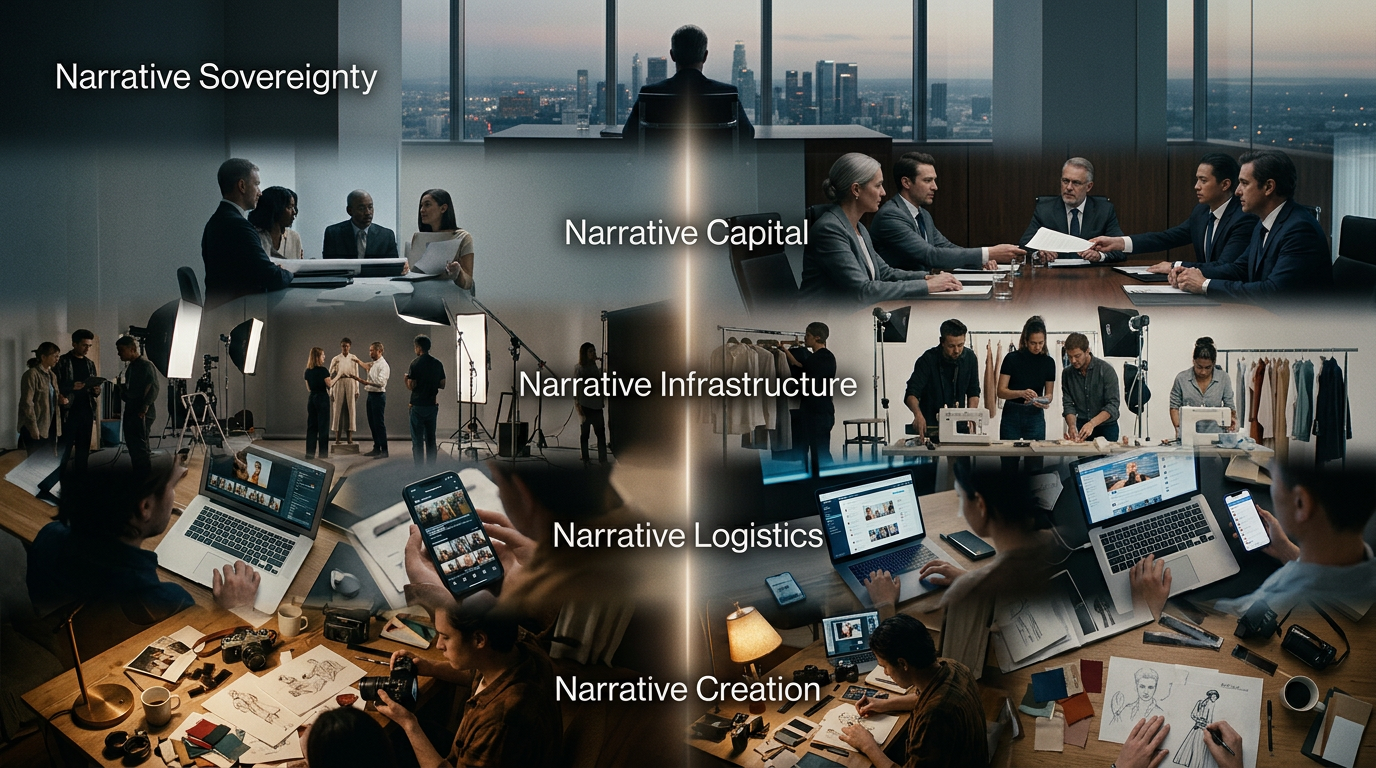
Narrative Engineering: The Core Basics - Part Four
If the Narrative Power Triangle explains what the three forces of creative economies are, narrative, infrastructure, and capital, then the Narrative Power Stack answers a harder question. It explains how those forces actually move. It maps the sequence through which an idea travels from the moment of its creation to the point at which it either becomes embedded in the fabric of global culture and economy, or stalls somewhere along the way, culturally influential but structurally powerless. That distinction, between cultural influence and structural power, is the central distinction this framework is built to make visible.
Most frameworks in the creative world focus on what is visible: content, trends, platforms, virality, and the cultural moments that appear to make or break careers and movements. There is a reason for that focus. Visibility is where the energy concentrates. It is where the excitement is, where the industry's attention is directed, and where most creative careers are experienced as happening. But visibility is not where power is formed. It is where power becomes visible. Beneath every dominant creative industry, every globally recognised cultural force, and every ecosystem that has successfully converted cultural influence into economic sovereignty, there is a layered structure that most conversations about creative economies never reach. The Narrative Power Stack is a framework for reaching it and for using what is found there to build differently.
Why Sequence Matters
The Triangle established three forces in relationship with each other. The Stack introduces something the Triangle does not explicitly address: dependency. Each layer of the Stack functions only because of what sits beneath it. Remove a lower layer and everything above it becomes unstable, not immediately, not always obviously, but structurally and inevitably, in ways that tend to become visible only after the instability has already done significant damage.
This dependency structure is what explains one of the most frustrating and recurring patterns in the global creative economy: two creative ecosystems that appear remarkably similar at the surface, similar talent, similar cultural energy, similar narratives gaining global traction, and yet produce completely different outcomes over a decade or two. The difference is almost never found in the quality of the creative work itself. It is found in the layers beneath the work, the layers that most people never think to examine because they are not visible in the way that a viral moment or a fashion week appearance is visible.
Understanding the Stack as a sequence rather than a collection of parallel factors changes the questions worth asking. It moves the conversation away from how do we get more visibility, which is a logistics question, and toward what is the system that our narrative is actually moving through and where precisely is that system breaking down. These are structural questions, and they are the only questions that ultimately matter if the goal is not simply cultural influence, which can be achieved at the second layer of the Stack, but lasting economic and institutional power, which requires all five layers functioning in alignment.
Layer One: Creation
At the foundation of the Stack is creation, the point at which ideas, stories, and cultural expressions originate. This is where writers, designers, filmmakers, musicians, and cultural thinkers introduce new ways of seeing, feeling, and interpreting the world. It is the most celebrated layer of the creative economy, the one around which the mythology of creative success is almost entirely constructed, and in many ways the most romanticised.
Creation genuinely matters. Without it, nothing else in the Stack exists. But the accessibility of creation in the current moment, the radical democratisation of the tools required to produce music, write, film, design, and publish, has revealed a structural truth that the mythology tends to obscure: creation alone does not generate power, and increasingly, creation alone does not even generate sustainable visibility. A creator can produce work that is genuinely extraordinary, work that captures something true and significant about the world, that resonates deeply with the people who encounter it, that moves people in ways that last, and still remain economically invisible and structurally vulnerable to the extraction of whatever value her work generates. This is not a failure of talent or quality. It is a consequence of treating creation as the whole game when it is only the first layer of a much longer sequence.
Power is not determined by what is created. It is determined by what happens to that creation as it moves through the layers above, and the creator who does not understand those layers consistently finds herself generating cultural energy that other people's systems convert into economic and institutional returns.
Layer Two: Logistics
For a narrative to have influence, it must travel, and the second layer of the Stack, narrative logistics, refers to the pathways through which ideas move from creators to audiences. Social media platforms. Publishing networks. Streaming services. Media ecosystems. Distribution infrastructure, both digital and physical. These are the systems that shape which stories are amplified to global reach and which are buried despite their quality.
This is the layer that receives the most attention in mainstream creative strategy, and that attention is not entirely misplaced. Build your platform. Grow your audience. Understand the algorithm. Distribute consistently. These are logistics-level interventions, and they are not wrong. Visibility is real, and the ability to distribute a narrative effectively to the audiences it is designed to reach is genuinely valuable as a foundation for everything that follows. But logistics is not neutral, and it is not sufficient, and treating it as the primary strategic focus is one of the most expensive misallocations of creative energy that the current mythology produces.
Consider two creators with equivalent skill, equivalent cultural insight, and equivalent quality of creative output. One has access to strong distribution infrastructure, institutional relationships that amplify her work, platform positioning that benefits from algorithmic favour, and the kind of structural visibility that compounds over time as each successful piece increases the reach of the next. The other does not have these things. The first creator's narrative travels widely and accumulates the audience and institutional attention that eventually produces Stage Three legitimacy. The second, despite producing work of equal or greater quality, reaches a fraction of the audience and remains perpetually at the level of creative promise without structural recognition.
This is not a talent differential. It is a logistics differential. And the solution is not to tell the second creator to post more consistently or optimise her content strategy more aggressively. The solution is to understand that logistics operates within a structural system that has biases built into it, biases that favour established ecosystems, familiar narrative categories, and existing concentrations of cultural authority, and that those biases cannot be overcome at the logistics layer alone.
Layer Three: Infrastructure
Infrastructure is the layer that determines whether a narrative can exist beyond a single moment of visibility. While logistics allows narratives to move, infrastructure allows them to endure. It encompasses the production systems, manufacturing networks, media institutions, educational pipelines, technology platforms, legal frameworks, and professional ecosystems that support consistent creative production, distribution, and development over time rather than requiring each moment of cultural significance to be achieved from scratch.
Infrastructure answers the question that logistics never asks: can this narrative be produced, repeated, and delivered at the quality and scale the market requires, not once, not occasionally, but sustainably across years and decades and the transitions between generations of creative practitioners?
Without infrastructure, even the most widely distributed and genuinely resonant creative work remains fragile. Individual projects can succeed. Moments can achieve genuine global visibility. Artists can receive recognition that transforms their individual careers. But industries cannot form from logistics alone, and it is industries rather than individual successes that convert cultural influence into lasting economic and institutional power. Industries require systems, the kind of durable, interconnected infrastructure that allows creative work to be scaled, refined, professionalised, economically protected, and passed forward to the next generation of practitioners who can build from the foundations that the preceding generation established rather than starting over from nothing.
Nollywood's trajectory illustrates this precisely. Nigerian filmmakers built one of the world's largest film industries by volume of output through a combination of creative determination and informal distribution infrastructure that bypassed the institutional gatekeeping structures of Western film. The creative output was real and the cultural reach was significant. But the absence of formal financing mechanisms, intellectual property protection, production quality infrastructure, and international distribution relationships meant that for decades the industry remained informal and fragmented, generating cultural reach that could not be fully converted into the institutional legitimacy and economic returns that a formal industrial infrastructure would have produced. The creativity was always there. The infrastructure that would have allowed it to compound was not, and the gap between those two things is the gap between cultural significance and industrial power.
Layer Four: Capital
If infrastructure provides the structural stability that allows narratives to endure, capital provides the acceleration that allows them to scale at the speed that competitive global markets require. Financial resources enable creative systems to expand production capacity, support distribution development, fund talent pipelines, and allow the infrastructure layer to grow with the pace of demand rather than perpetually lagging behind it. But capital is more than a resource in a mechanical sense. It is a directional force, and understanding its directionality is one of the most important reorientations that the Narrative Power Stack makes possible.
Capital does not flow toward the best narratives. It flows toward the most established ones, toward narratives that have already demonstrated institutional legitimacy at Layer Three, that have existing infrastructure at Layer Three, and that are associated with the kind of structural legibility that makes investment feel safe and return seem predictable. This is not irrational behaviour on the part of capital allocators. It is the logical consequence of a risk management framework that treats familiarity as a proxy for quality and institutional track record as a proxy for future performance.
The consequence for creative ecosystems that are outside the traditional centres of global cultural authority is a structural disadvantage in capital access that is entirely independent of the quality of the creative work they produce. Two creative ecosystems can possess identical levels of genuine talent, similar cultural narrative strength, and comparable infrastructure development. The one with greater access to capital will scale faster, reach further, build the institutional presence that makes future capital flows more likely, and establish the compounding advantages that come from being able to invest in the next generation of infrastructure while competitors are still trying to build the current one. Capital compounds in favour of existing power, and where it does not flow, creative ecosystems grow slowly, inconsistently, and at the mercy of external investors whose priorities and timelines may not align with the long-term interests of the ecosystem they are nominally supporting.
South Korea's experience with its cultural industries provides the most instructive contemporary illustration of what deliberate capital deployment at the infrastructure level produces. Following the 1997 Asian financial crisis, the South Korean government made a strategic decision to invest state capital in the development of cultural industry infrastructure: production facilities, training academies, distribution networks, export promotion mechanisms, and the legal frameworks required to protect intellectual property as it moved through international markets. The investment was sustained across multiple government administrations because it was understood as an economic development strategy rather than as cultural spending, and the returns it generated were measured across tourism, consumer products, language study, and diplomatic relationship quality rather than simply in the box office receipts or streaming numbers that would have been the narrow measure of cultural industry success.
The capital did not flow toward the best Korean stories. It flowed toward building the systems that would allow excellent Korean stories to reach global audiences at the quality and scale required to produce the institutional legitimacy that Stage Three requires. That is capital functioning at the Stack level rather than at the individual project level, and it is the difference between a successful film and a globally dominant creative industry.
Layer Five: Sovereignty
At the apex of the Stack is the layer that mainstream creative discourse almost never addresses seriously because it requires a level of structural ambition that the visibility-focused mythology of the creative economy is not designed to sustain: narrative sovereignty. Sovereignty refers to the capacity to control the creation, distribution, infrastructure, and capital surrounding a narrative, to operate not merely within a system that others have designed and that others ultimately govern, but to determine the conditions of the system itself.
When narrative sovereignty is achieved, the consequences extend far beyond the cultural domain. Narratives that have reached this layer stop being creative outputs and become something categorically more consequential: industries, economic systems, and institutions that shape how the world understands value, legitimacy, and possibility. They determine which stories the world considers serious. They influence which aesthetics global consumers aspire to. They shape which investments seem rational and which seem speculative. They define, across generations, what the world considers important enough to protect.
Hollywood did not become the dominant global storytelling force because American filmmakers were more talented than their contemporaries in other parts of the world. It became dominant because it achieved sovereignty: control over the narrative, the infrastructure, the capital flows, and ultimately the institutional systems that determined which stories the world would see, on whose terms those stories would be told, and who would capture the economic value generated by the global appetite for storytelling that Hollywood's dominance had itself helped to create. Each layer of the Stack compounded into the next, and the sovereignty achieved through that compounding is what has made Hollywood's institutional position so durable even as individual studios have risen and fallen and as the distribution landscape has been transformed by streaming.
The distance between ecosystems that have achieved genuine narrative sovereignty and those that remain perpetually promising, perpetually influential, and perpetually unable to fully capture the economic returns of their own creativity is not a talent gap and it is not a creative vision gap. It is a sovereignty gap, a gap in control over the layers of the Stack that determine where the value generated by cultural influence ultimately lands.
Where the Stack Breaks
The Stack's most practical value is not in explaining success but in diagnosing the specific structural patterns that prevent creative ecosystems from converting their cultural power into lasting economic authority. Each failure mode is distinct, has a specific structural cause, and requires a specific structural response rather than a generic exhortation to create better work or build a larger audience.
Creation without effective logistics produces extraordinary work that remains invisible, not because it is insufficient but because it has no reliable pathway to reach the audiences that would value it. The problem is at Layer Two, not Layer One, and the solution is distribution infrastructure rather than better creative work.
Strong creation and strong logistics without infrastructure produces moments of recognition that cannot be converted into anything durable. The viral hit that generates enormous excitement and then leads nowhere sustainable. The cultural trend that shifts global aesthetics without generating lasting economic value for the communities that originated it. The individual creative career that achieves genuine recognition without producing the institutional relationships and economic security that would allow the next generation of creators in the same ecosystem to build on a more developed foundation. The problem is at Layer Three, and the solution is infrastructure investment rather than better content strategy.
Infrastructure without sufficient capital produces ecosystems that are structurally organised and genuinely talented but perpetually unable to scale at the speed that global markets require, perpetually dependent on external investment that comes with external priorities, and perpetually watching the compounding advantages of capital accumulate in the ecosystems that already have it. The problem is at Layer Four, and the solution requires developing domestic capital mechanisms rather than optimising the creative output that the existing capital environment is failing to fund at the required scale.
Capital without sovereignty produces the most insidious failure mode: growth that serves interests other than those of the ecosystem itself. External investment that expands industries in apparent size while contracting their self-determination. Financing structures that extract value in proportion to what they appear to provide. Institutional relationships that provide access while requiring the creative ecosystem to operate on terms that were designed by and ultimately serve the interests of the institutions providing the access. The problem is at Layer Five, and it requires the most difficult and most important kind of strategic work: building the control infrastructure that allows capital to serve the ecosystem's own vision rather than requiring the ecosystem to serve the capital's priorities.
The African Creative Economy Examined Through the Stack
The Stack is most clarifying when applied to the specific structural situation of African creative industries, because the gap between Layer One and Layer Five is currently wider there than almost anywhere else in the global creative economy, and the consequences of that gap are the most extensively and most publicly documented.
At the creation layer, the output is not the problem and has not been the problem for a significant number of years. African creative work across music, fashion, film, and digital culture is among the most culturally significant and globally influential being produced anywhere in the world. Afrobeats has demonstrated demand that is now impossible for the global music industry to ignore. African designers are commanding serious attention at the world's most prestigious fashion platforms. African filmmakers are producing work that is receiving institutional recognition at major international festivals. African digital creators are building global audiences that cross every cultural boundary the platform algorithms create. The creative energy is real, abundant, and demonstrably capable of producing the kinds of cultural resonance that global audiences respond to.
At the logistics layer, the situation has improved substantially, primarily through the digital platforms that bypassed the traditional institutional gatekeeping structures that had previously controlled access to global distribution. An African musician in Lagos can now reach a listener in London, New York, or Tokyo without the mediation of a Western record label's international division, and this represents a genuine structural change in the accessibility of Layer Two.
But Layers Three, Four, and Five tell a fundamentally different story. Infrastructure at Layer Three is still developing, unevenly distributed across the continent, and often without the coordination across markets and sectors that would allow it to compound into the kind of continental industrial ecosystem that would match the scale of the creative output it is supposed to support. Capital at Layer Four remains fragmented, frequently externally controlled, and often structured in ways that extract value from the ecosystem in proportion to the visibility it creates rather than building the institutional foundations that would allow the ecosystem to retain that value. And narrative sovereignty at Layer Five, genuine, self-determined control over the direction, the infrastructure, the capital flows, and the institutional systems that determine what African creativity becomes and who benefits from it, remains substantially out of reach in most markets and most sectors.
The outcome is the pattern that anyone paying serious attention to the global creative economy already recognises: African creativity travels globally and shapes the world's cultural imagination in demonstrable and measurable ways, while the economic and institutional power generated by that creativity continues to accumulate disproportionately in the ecosystems that have the infrastructure and capital to receive and monetise it. This is a Stack problem, specific, diagnosable, and addressable through structural interventions targeted at the layers where the breakdown is occurring rather than through exhortations to the individual creators working at Layer One to produce better work or build larger audiences.
Narrative Engineering Across All Five Layers
This is precisely where Narrative Engineering operates, and the distinction from most creative strategy is worth making explicit. Most creative strategy addresses the top of the Stack, optimising for visibility and reach at the logistics layer, treating the layers beneath as fixed conditions to be navigated rather than as design problems to be solved. Narrative Engineering operates across all five layers simultaneously, asking where the narrative breaks down structurally, what infrastructure is missing or misaligned, where capital is flowing and who controls its direction, and what would be required to move a creative ecosystem from logistics-level influence toward genuine sovereignty.
Creation introduces the idea. Logistics moves it. Infrastructure sustains it. Capital scales it. Sovereignty controls it. When all five layers function in alignment, narratives extend beyond the cultural domain and become embedded in the economic and institutional fabric of the world in ways that compound across generations. When they do not, even the most genuinely significant creative work remains structurally powerless despite its cultural influence, generating value that other people's systems convert into economic and institutional returns.
Talent is everywhere. Culture is everywhere. Genuinely world-class, historically significant creativity is distributed across the globe in ways that no established creative industry has ever fully acknowledged. The question that the Stack forces is not whether the narratives exist, because they do, and in many cases they are extraordinary. The question is what layer of the Stack those narratives are currently operating at, and what it would take to build the layers beneath them that they do not yet have.
To operate only at the creation layer is to participate in culture. To understand the full Stack is to see how culture becomes system, and to work deliberately across all five layers, building the infrastructure, developing the capital access, and ultimately working toward the sovereignty that turns creative influence into self-determined power, is to move from participation to design. That is where the future of creative economies will be determined.
This piece is part of the Narrative Engineering: The Core Basics series. Core 5 builds directly on the Stack framework by examining the specific mechanisms through which narrative ecosystems can be deliberately constructed to reach Layer Five sovereignty.