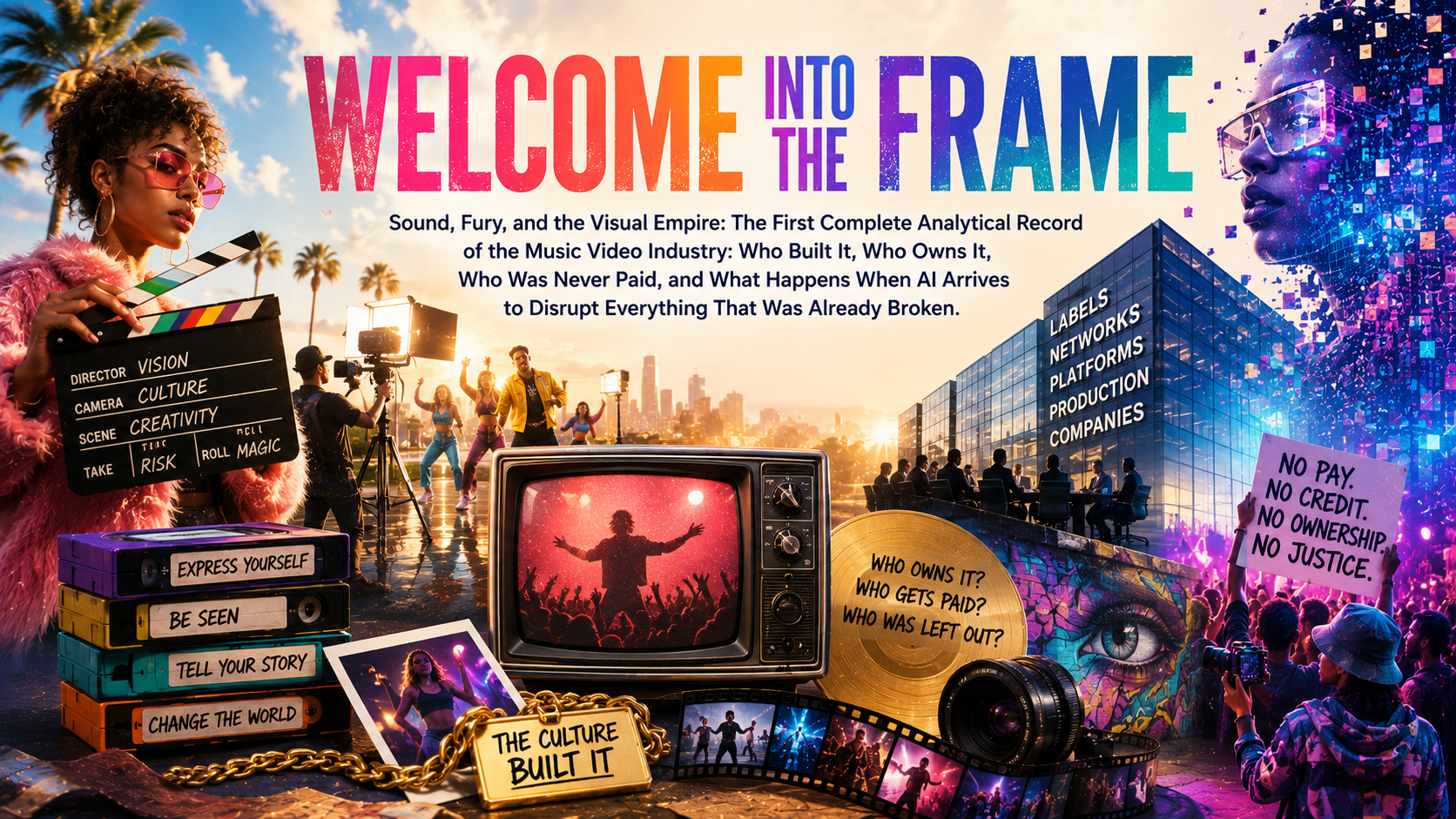
WELCOME INTO THE FRAME
Sound, Fury, and the Visual Empire: The First Complete Analytical Record of the Music Video Industry: Who Built It, Who Owns It, Who Was Never Paid, and What Happens When AI Arrives to Disrupt Everything That Was Already Broken.
[THE FRAME | AUDIT]
Investigative Standard & Intent This document is a product of The Multiverse and is grounded in Structural Imagination. The following analysis is a forensic examination of systems and architectures; it is not intended to target or attack any specific individual, institution, or company.
Every claim, figure, and contract term presented is drawn exclusively from verified public records and is fully attributed in the Reference Documents archive. This work is for the purposes of education, analysis, and civilisational record.
What This Project Is
The Frame: Sound, Fury, and the Visual Empire is the first comprehensive investigative and analytical project dedicated entirely to the music video industry. It is the direct companion to The Ledger: Sound and Fury, which documented the exploitation of artists in the recorded music industry across one hundred years. The Frame extends that documentation into the visual arm of the same industry: the music video ecosystem that grew from a promotional afterthought in 1981 into a multi-billion dollar commercial infrastructure that shaped how artists were seen, how cultures were exported, and how an entire generation of directors, cinematographers, editors, production designers, choreographers, stylists, and crew members built careers in a system that owned everything they created and paid them for the day they showed up rather than for the decades their work generated value.
The Frame examines this industry through the same methodology that defined The Ledger: deep research, documented evidence, honest assessment of both exploitation and counter-tradition, and the consistent application of three analytical variables; race, gender, and geography to the question of who built the visual empire, who profited from it, who was disposable within it, and who has found ways to build differently. The project covers the United States, the United Kingdom, and Africa, specifically the Nigerian Afrobeats visual ecosystem, with the same evidential rigour applied to each context.
This project has never been done in the form The Frame attempts. Music videos have been discussed as cultural artefacts, as promotional tools, as aesthetic statements, and occasionally as commercial milestones. They have never been systematically examined as an industry with its own exploitation architecture, its own labour economics, its own racial and gender differentials, and its own specific form of creative dispossession: the director who made the video that defined a decade and received a day rate for the shoot and nothing for the thirty years that followed.
Series Structure
Series 01: The Machine Behind the Image
The foundational history. How music videos went from promotional afterthoughts to a multi-billion dollar commercial ecosystem. The MTV launch of August 1, 1981. How the label's ownership of everything the director creates was built into the architecture from the beginning. The production company structures that mediated between labels and directors. The commercial logic that made video budgets escalate from $50,000 to $7 million across fifteen years. Who controlled what at every stage.
Series 02: The Engine Room
The full production crew ecosystem documented as it has never been documented before. Every role from Executive Producer to Set Dresser: what each person does, what each person earns, who owns what they produce, and how the pay structure has worked decade by decade from the MTV era through the streaming era to the AI disruption happening now. The exploitation that happens not at the superstar level but at the crew level, the people who made the images that shaped culture and whose names appear in a crawl at the end of a video nobody watches.
Series 03: The Directors
The people behind the camera who shaped how music looks. The US directors who built the visual language of pop and hip-hop and then crossed into Hollywood taking their aesthetic with them while leaving their music video catalogues behind without ownership or royalty participation. The UK directors who built a parallel tradition. The women directors who fought to access a male-dominated field. The Black directors whose aesthetic innovations defined eras that then promoted white directors to the positions their innovations had made commercially viable.
Series 04: The African Frame
The Afrobeats visual empire as its own complete subject. How music video production in Nigeria went from uncredited directors and borrowed cameras through Clarence Peters building an entire production infrastructure from his office in Omole Estate, to TG Omori charging $94,000 a video and publicly arguing that directors deserve a percentage of streaming revenue. What the money looks like, what the ownership looks like, what the exploitation looks like when it happens at the African level.
Series 05: The Exploitation Files
The specific cases where the system worked exactly as designed against the people inside it. Directors whose concepts were appropriated without credit or compensation. Crew members paid below market rates or not paid at all. Black directors whose visual innovations were absorbed by the industry and reproduced with bigger budgets for white artists without attribution. The gatekeeping structures that determined whose aesthetic got amplified and whose got absorbed.
Series 06: The Disruptors
The people and technologies that changed the rules. YouTube breaking MTV's distribution monopoly. TikTok redefining what a music video is. The independent directors who built their own production companies and retained creative control. The AI tools, Runway, Kling, Veo, that are now generating music video quality visuals for five hundred dollars that previously required a fifty-thousand dollar crew. What this means for every person who built their career on skills that are being automated.
Series 07: The Blueprint
The constructive case. What a fair music video industry would look like structurally. What directors should own. What crews should receive. How streaming royalties should flow to visual creators when a video directly drives a song's streaming performance. The comparison with film and advertising where director rights and ownership structures sometimes operate differently. The new independent models being built right now.
Series 08: The Vault
Vault-tier monetisable frameworks and professional resources. The complete rate card for music video crew roles. The director's contract template. The streaming royalty argument framework. The AI disruption survival guide for music video creatives. These are the documents The Multiverse can deploy as premium professional resources.
THE FRAME: SOUND, FURY, AND THE VISUAL EMPIRE
The Multiverse // Begun March 2026 // A companion to The Ledger: Sound and Fury
CLOSING NOTE: Every claim, figure, statistic, and institutional history in this document is sourced from the public record. The Multiverse does not fabricate, exaggerate, or speculate beyond what the evidence supports. Full source attribution is available in our Reference Documents folder archive vault. This work is published in the public interest. Its purpose is education. Its method is evidence. Its commitment is to the truth of what happened and what continues to happen.
EDITORIAL STATEMENT & LEGAL DISCLAIMER
Standard of Evidence
This document is produced by The Multiverse as an analytical and educational component of The Ledger: Sound and Fury. All arguments, models, and case studies are grounded in documented evidence, including public records, legal scholarship, sworn testimonies, and global financial disclosures. All data is cross-referenced with the Series Research Reference Document held in our archives.
Legal Notice & Intent
- Structural Imagination: The purpose of this work is education, analysis, and Structural Imagination. It is not designed to attack any specific name, institution, or company.
- No False Claim of Implementation: No claim is made that any specific individual or organisation will implement the solutions or frameworks proposed.
- Non-Advisory: This work does not constitute legal or financial advice.
- Methodology: Illustrative examples are clearly labeled, and every solution proposed is grounded in historical or legal precedent.
- Liability: The Multiverse assumes no liability for actions taken based on this analysis; the work of building a different creative economy begins with the knowledge that one is possible.