Episode 3: The Manufacturing Trap
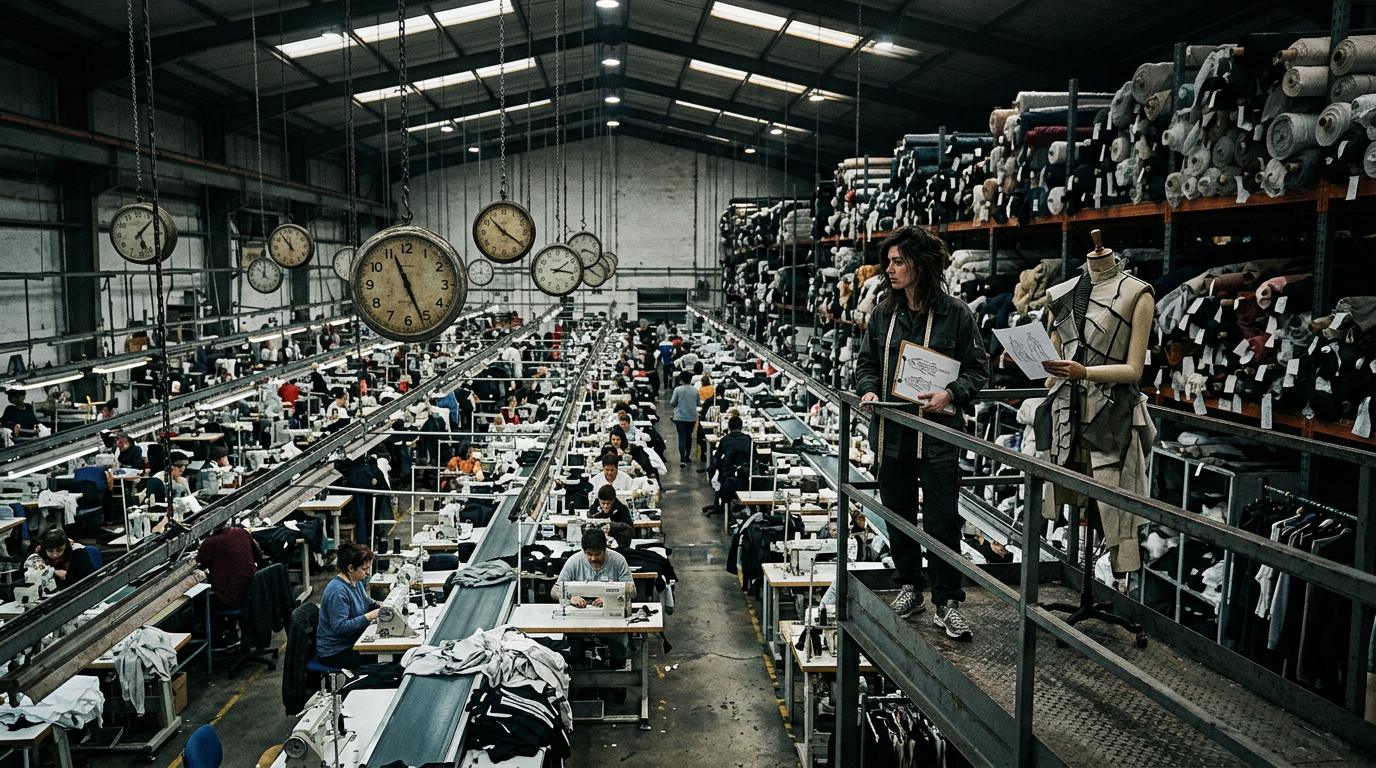
Why supply chain realities often determine the survival of independent fashion brands
For many consumers, fashion appears to move effortlessly from design concept to finished product. Collections are announced, garments appear on runways, and shortly afterwards those same pieces become available for purchase online or in stores. The process seems seamless, giving the impression that once a designer creates a product, the systems required to manufacture and deliver it naturally fall into place.
In reality, the production process behind independent fashion brands is far more complex. Transforming a design into a finished garment requires coordination across a network of manufacturers, fabric suppliers, pattern makers, quality controllers, and logistics providers. Each of these components must operate in precise alignment for a brand to deliver products on schedule.
For large fashion houses with established supply chains and internal production teams, this complexity is managed through long-standing partnerships and significant operational infrastructure. Independent designers, however, often navigate these systems without the same institutional support.
This creates a structural vulnerability within the production process. When any link in the supply chain experiences disruption, whether through factory delays, material shortages, or shipping complications, the consequences can cascade across the entire business.
For brands operating with limited financial buffers and high customer expectations, the production environment can quickly become one of the most challenging aspects of sustaining a creative enterprise.
Structural Pressure
Manufacturing within the fashion industry is shaped by a set of logistical constraints that many consumers rarely encounter directly.
One of the most significant of these constraints is the concept of minimum order quantities. Many factories require brands to produce a certain number of units per design before they will accept a production order. These minimum thresholds exist because factories must maintain efficiency across their production lines.
For emerging designers, however, committing to large manufacturing volumes carries considerable financial risk. Producing too many units can leave a brand with unsold inventory, tying up capital that might otherwise be used for future development. Producing too few units may make the order economically unviable for the manufacturer.
Beyond production volume, designers must also navigate timelines that are often outside their direct control. Fabric sourcing may depend on suppliers located in different countries. Factories may be managing orders for multiple brands simultaneously, meaning production schedules can shift unexpectedly. Quality control issues may require additional rounds of sampling and revision before garments are approved for full-scale manufacturing.
Even after production is complete, the logistics process introduces additional uncertainty. International shipping routes can be affected by customs inspections, regulatory documentation requirements, or broader disruptions within global supply chains.
Each stage of this process introduces potential delays. For large corporations with extensive operational teams and financial reserves, these disruptions can often be absorbed or mitigated through alternative suppliers and contingency planning. Independent brands rarely have access to such flexibility.
Instead, they must navigate production environments where delays in one stage can disrupt the entire commercial cycle of the business.
Case Insight
For many founders, manufacturing challenges represent a turning point in the life of a brand. While the early stages of entrepreneurship often revolve around design and brand building, the transition to larger-scale production introduces operational pressures that require a different set of skills.
Designers must learn to manage relationships with manufacturers, negotiate production timelines, oversee quality standards, and anticipate logistical risks that may affect product delivery. In effect, they are required to become supply chain managers in addition to creative directors.
When production delays occur, the consequences extend far beyond the factory floor. Late deliveries can lead to dissatisfied customers, refund requests, and reputational damage particularly in an environment where customer experiences are frequently shared online.
For founders operating without large operational teams, responding to these situations can be overwhelming. While attempting to resolve production issues with manufacturers and logistics providers, they must simultaneously communicate with customers, manage financial obligations, and protect the reputation of the brand.
In such circumstances, the manufacturing system effectively becomes the central stress point of the entire business.
Systemic Implication
The production challenges faced by independent designers reveal a broader structural issue within the fashion ecosystem. While the industry celebrates creativity and innovation, the infrastructure required to support emerging brands remains unevenly distributed.
Large fashion conglomerates benefit from vertically integrated production networks, long-term supplier relationships, and sophisticated logistics operations. These systems allow established brands to maintain control over manufacturing processes and respond quickly to disruptions.
Independent designers, by contrast, often operate within fragmented supply chains where each stage of production involves negotiating with external partners who may prioritise larger clients with more predictable order volumes.
This imbalance creates an environment in which smaller brands must navigate the same complex production landscape as global fashion houses but without comparable resources or leverage.
The result is a production ecosystem that rewards scale while placing emerging designers at a structural disadvantage.
When delays or disruptions occur, the consequences fall disproportionately on the independent founders who rely on these systems to transform creative ideas into tangible products.
If manufacturing systems play such a central role in determining the success or failure of independent brands, an important question emerges: how should creative founders approach growth in an industry where production infrastructure remains uneven?
Is it possible for emerging brands to scale sustainably without overextending their manufacturing commitments? What alternative production models might allow designers to maintain creative independence while reducing operational risk?
And perhaps most importantly, how does the increasing pressure of public visibility interact with these fragile production systems? Because in today’s digital environment, operational challenges rarely remain private for long.
The next investigation examines how social media has transformed the relationship between brands and their audiences and why founders increasingly find themselves navigating not only manufacturing systems, but also the court of public opinion.
Part of The Creative Collapse Series, an ongoing investigation into the structural pressures shaping the modern creative economy.